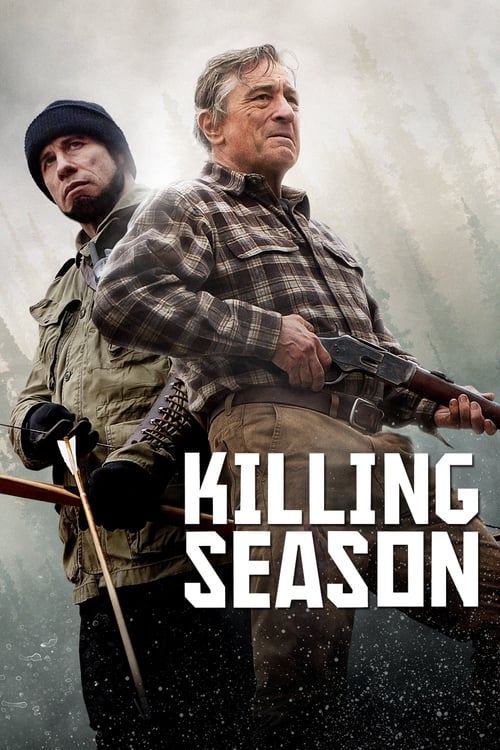
Killing Season (2013)
Directed by Mark Steven Johnson
No — Killing Season is not woke, scoring 4 out of 100 on our wokeness meter.
Killing Season arrived in 2013 promising the first on-screen pairing of Robert De Niro and John Travolta, and it delivers precisely that, along with little else.
Consciousness Markers
The film gestures toward an anti-war message, with the two enemies reaching mutual understanding and the Serb declaring 'I am healing,' but the moralizing is mild and buried under gore.
The cast is almost entirely white, with Bulgarian actors filling Serbian roles. There is no deliberate representation casting agenda at work here.
The Bosnian War's ethnic dimensions are present as backdrop, but the film treats the conflict as a personal vendetta rather than engaging any modern racial-justice consciousness.
No LGBTQ+ characters, themes, or subtext appear anywhere in this two-hander about war veterans.
The film is a male-dominated revenge thriller with no feminist themes or notable female characters driving the narrative.
No environmental or climate themes whatsoever.
No critique of capitalism, wealth, or class structures.
No body-positivity themes or messaging.
No neurodivergent characters or themes.
The film is described by critics as 'historically suspect,' but it does not attempt any deliberate revisionist reframing of history in the modern ideological sense.
Why it received this score
Killing Season arrived in 2013 promising the first on-screen pairing of Robert De Niro and John Travolta, and it delivers precisely that, along with little else. The premise is a Bosnian War reckoning relocated to the Smoky Mountain wilderness, where two veterans hunt each other through the undergrowth. It is a male-dominated revenge picture in the most literal sense: two men, one cabin, a great deal of blood. The cast is almost entirely white, with Bulgarian performers standing in for Serbs, a production convenience that carries no representational intent whatsoever.
On the matters of social consciousness that occupy our current discourse, the film is a void. There are no LGBTQ characters or subtext, no environmental anxieties, no critique of wealth or class, no engagement with body image, and no neurodivergent figures. The ethnic dimensions of the Bosnian conflict serve as scenery for a personal vendetta, not as a platform for any modern racial reckoning. Critics found the history suspect, though the film never bothers to reframe it with ideological purpose. It simply gets things wrong in the ordinary, careless way that genre films often do.
A faint moral pulse remains. The two enemies eventually reach an understanding, the Serb declares that he is healing, and a baptism closes the proceedings. This is anti-war sentiment of a mild and familiar vintage, and it sits buried beneath so much gore that any sermonizing barely registers. The result is a grimy little thriller with no agenda beyond filling ninety minutes. It is not offensive. It is merely tired, and so, by the end, are we.
Analysis generated by our Consciousness Algorithm


Synopsis
Two veterans of the Bosnian War, one American, one Serbian, clash in the remote Smoky Mountain wilderness.
Questions about Killing Season
Is Killing Season woke?
No — Killing Season is not woke, scoring 4 out of 100 on our wokeness meter. That earns it a verdict of Ultra Based.
Does Killing Season have any woke elements?
Very few. None of the 10 markers reaches 30, the level where a marker counts as present; the highest is Lecture Energy at 15.
How does Killing Season compare to other 2013 movies?
It ranks #210 of the 274 films from 2013 we've scored; their average is 14. The wokest is Belle (76).
How is the Woke Score calculated?
An AI-assisted process researches the film and its reception, scores it 0–100 on ten markers, then combines those into one 0–100 Woke Score. It measures a specific set of 2020s cultural themes, not film quality.