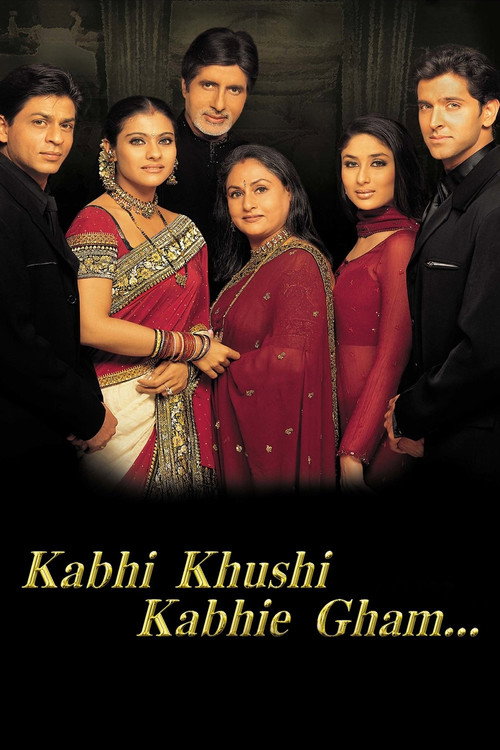
Kabhi Khushi Kabhie Gham (2001)
Directed by Karan Johar
No — Kabhi Khushi Kabhie Gham is not woke, scoring 17 out of 100 on our wokeness meter.
Kabhi Khushi Kabhie Gham arrives with the confidence of an empire, three and a half hours of Delhi drawing rooms, London shopping centres, and reunions staged at funerals.
Consciousness Markers
The film is highly melodramatic and didactic, with lengthy speeches about family duty, forgiveness, and the mother's critique of patriarchal infallibility, though its preaching is aimed at traditional family values rather than modern social justice.
Nandini delivers a notable critique of her husband's patriarchal authority, and female characters show agency, but the film ultimately upholds traditional family and patriarchal values.
The film features an all-Indian cast in a Bollywood production, with no deliberate inclusive casting of marginalized groups in the modern woke sense.
There are no LGBTQ+ themes, characters, or subtext in the film.
The film addresses class differences, not racial consciousness or systemic racism.
There is no environmental or climate-related theme in the film.
The film critiques Western consumer culture mildly but does not advocate anti-capitalist or eat-the-rich sentiments; the wealthy family is portrayed sympathetically.
There is no body positivity theme or messaging in the film.
There is no representation or discussion of neurodivergence in the film.
The film is a fictional family drama and does not engage in revisionist history.
Why it received this score
Kabhi Khushi Kabhie Gham arrives with the confidence of an empire, three and a half hours of Delhi drawing rooms, London shopping centres, and reunions staged at funerals. Its tagline promises that the entire affair concerns loving one's parents, and it means this without irony. As a document of social consciousness in the modern sense, it is nearly barren ground, though not entirely flat.
The film's one genuine provocation comes from Nandini, the matriarch, who late in the proceedings informs her husband that he is not infallible, that a husband is not a god, and she borrows his own dismissive phrase to silence him. It is a sharp piece of domestic rebellion. The film then resolves in favor of the family, reconciles father to son, and files the rebellion under sentimental closure. Female characters show will and appetite, but the structure they inhabit remains patriarchal and is never seriously questioned. The class conflict is real and foregrounded, the Chandni Chowk girl against the industrialist dynasty, yet the wealth itself is treated with reverence. The rich are not devoured.
Other categories remain untouched. No queer presence, no climate anxiety, no meditation on bodies or brains, no reworking of history. The film's sermonizing runs long and loud, arriving in swelling music and tearful monologues, but its congregation is the traditional household and its scripture is filial duty. A short sequence sneers at Starbucks and Burger King, which is as close as the film comes to a critique of commerce, and it is a critique of foreign taste, not of capital. There remains a lavish, exhausting, sincerely felt melodrama about a father learning to say he loves his son. It is many things. Dangerous to the established order is not among them.
Analysis generated by our Consciousness Algorithm


Synopsis
Years after his father disowns his adopted brother for marrying a woman of lower social standing, a young man goes on a mission to reunite his family.
Questions about Kabhi Khushi Kabhie Gham
Is Kabhi Khushi Kabhie Gham woke?
No — Kabhi Khushi Kabhie Gham is not woke, scoring 17 out of 100 on our wokeness meter. That earns it a verdict of Ultra Based.
Does Kabhi Khushi Kabhie Gham have any woke elements?
Very few. None of the 10 markers reaches 30, the level where a marker counts as present; the highest is Lecture Energy at 25.
How does Kabhi Khushi Kabhie Gham compare to other 2001 movies?
It ranks #31 of the 148 films from 2001 we've scored; their average is 12. The wokest is Monster's Ball (60).
How is the Woke Score calculated?
An AI-assisted process researches the film and its reception, scores it 0–100 on ten markers, then combines those into one 0–100 Woke Score. It measures a specific set of 2020s cultural themes, not film quality.