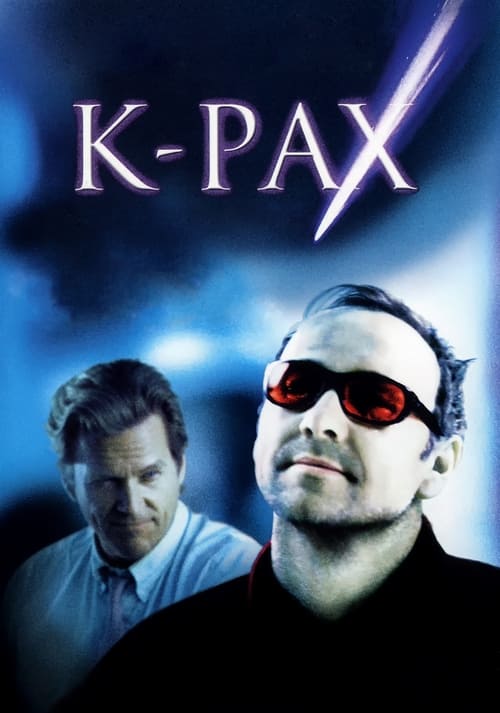
K-PAX (2001)
Directed by Iain Softley
No — K-PAX is not woke, scoring 14 out of 100 on our wokeness meter.
A man in a psychiatric institute claims to be from a planet one thousand light years away, and a weary doctor spends two hours deciding whether to believe him.
Consciousness Markers
The cast includes Alfre Woodard as a psychiatrist and Ajay Naidu and Tracy Vilar in supporting roles, but these are natural, unremarked presences in a 2001 studio film rather than a deliberate diversity statement.
The film sympathetically portrays psychiatric inpatients and treats mental illness with dignity, but frames it as trauma and delusion to be diagnosed and 'cured' rather than as an identity to be celebrated.
The closing voiceover about the universe repeating and making 'this time count' carries a soft pseudo-spiritual homily, though it is personal uplift rather than social-justice preaching.
Mary McCormack and Alfre Woodard play competent professional women, but the film offers no feminist critique or gendered commentary.
No LGBTQ+ characters, themes, or subtext appear anywhere in the film.
Race is never addressed or thematized; the film is entirely concerned with psychiatry, memory, and extraterrestrial possibility.
No environmental or climate themes are present.
The film contains no economic critique or class-based messaging.
No body-positivity themes or messaging appear.
No historical events are reinterpreted or revised.
Why it received this score
A man in a psychiatric institute claims to be from a planet one thousand light years away, and a weary doctor spends two hours deciding whether to believe him. This is K-PAX, a 2001 studio product adapted from Gene Brewer's novel, and it arrives with the soft earnestness of a film convinced it is saying something profound about the human condition. It is not. It is a mystery that resolves by declining to resolve, and a drama that mistakes ambiguity for depth.
On the matter of social consciousness, the film is nearly barren. Alfre Woodard appears as a psychiatrist and Ajay Naidu and Tracy Vilar drift through supporting roles, all of them present without comment, which in 2001 was simply how a well-cast studio film looked. Mary McCormack and Woodard play capable professionals, yet the screenplay offers no gendered critique whatsoever. The ward's patients are treated with a certain dignity, and the film is gentler toward mental illness than its contemporaries, but it frames their conditions as trauma and delusion awaiting diagnosis and cure. There is no identity to celebrate here, only a puzzle to solve. Race, class, climate, and the body go entirely unmentioned. The film is too busy staring at the stars.
The closing voiceover, in which prot explains that the universe repeats itself and we should make this time count, is a soft homily, personal uplift dressed in cosmic robes. It preaches, but only about reconciliation with one's estranged son. The picture opened at number one and then sank, earning less than its budget, and a plagiarism suit from an Argentine director hung over it for years. What remains is a handsome, foggy exercise in pseudo-spiritual comfort, a film that generates light and very little heat.
Analysis generated by our Consciousness Algorithm
Part of


Synopsis
Prot is a patient at a mental hospital who claims to be from a far away planet. His psychiatrist tries to help him, only to begin to doubt his own explanations.
Questions about K-PAX
Is K-PAX woke?
No — K-PAX is not woke, scoring 14 out of 100 on our wokeness meter. That earns it a verdict of Ultra Based.
Does K-PAX have any woke elements?
Very few. None of the 10 markers reaches 30, the level where a marker counts as present; the highest is Representation Casting at 22.
How does K-PAX compare to other 2001 movies?
It ranks #44 of the 148 films from 2001 we've scored; their average is 12. The wokest is Monster's Ball (60).
How is the Woke Score calculated?
An AI-assisted process researches the film and its reception, scores it 0–100 on ten markers, then combines those into one 0–100 Woke Score. It measures a specific set of 2020s cultural themes, not film quality.