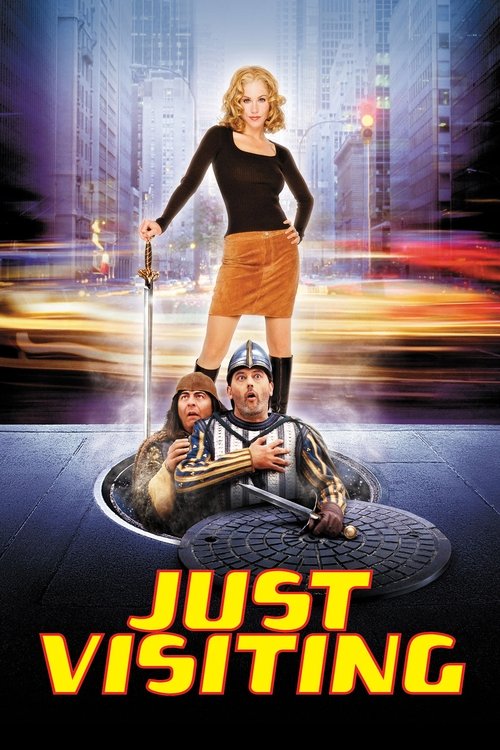
Just Visiting (2001)
Directed by Jean-Marie Poiré
No — Just Visiting is not woke, scoring 9 out of 100 on our wokeness meter.
Just Visiting arrives in 2001 as a remake of a French comedy barely eight years old, the sort of arithmetic that suggests a studio chasing a formula instead of a muse.
Consciousness Markers
Julia is a working museum employee who sees through and dumps her money-grubbing fiance and later reclaims her ancestral castle, giving her a modicum of agency. However, she largely functions as the reincarnated love interest and damsel for the knight's arc.
The villain Hunter Cassidy is a transparently money-hungry fiance scheming after Julia's fortune, offering a mild anti-materialist jab. It is a stock comedic antagonist rather than a systemic critique of wealth.
André's exposure to modern 'equal rights' ideals provides a faint didactic beat, but the film remains a broad slapstick comedy that never pauses to preach at length.
The principal cast is overwhelmingly white, with Jean Reno, Christina Applegate, Christian Clavier, Malcolm McDowell and Tara Reid heading a thoroughly homogenous ensemble. No meaningful diverse casting effort is evident.
The serf André's romance with the gardener Angelique introduces a vague 'equal rights for all people' notion, but it is framed around class and serfdom rather than race, and is played for light comedy.
There are no LGBTQ+ characters, themes, or subtext anywhere in the film's medieval-to-modern fish-out-of-water premise.
The film contains no environmental themes, climate commentary, or ecological messaging of any kind.
There is no body-positivity theme; the film does not engage with body image, size, or physical self-acceptance.
No neurodivergent characters or themes are present in the film.
The time-travel premise contrasts medieval and modern manners for comedy, but it does not reinterpret or reframe history through a modern progressive lens.
Why it received this score
Just Visiting arrives in 2001 as a remake of a French comedy barely eight years old, the sort of arithmetic that suggests a studio chasing a formula instead of a muse. Jean Reno and Christian Clavier reprise their roles as a medieval knight and his valet, flung from the twelfth century into a Chicago museum, where they cause panic, get arrested, and are rescued by a museum employee who resembles the princess the knight accidentally killed. Sturdy farce machinery. The execution cost $35 million and returned roughly $16 million worldwide, which is its own kind of verdict.
The film's engagement with contemporary social questions is faint and largely incidental. Julia, the descendant, works at a museum, sees through her fortune-hunting fiance, and eventually reclaims her ancestral castle, granting her a modest measure of self-determination before she settles back into the reincarnated-love-interest slot. The serf Andre is introduced to the notion of equal rights by a gardener named Angelique, though the film frames this around class and servitude and plays it for chuckles. The villain wants money. That is the extent of the economic critique.
The cast is uniformly white, the themes are uniformly absent, and the film never pauses to instruct anyone about anything. No environmental conscience, no engagement with body image, no neurodivergent interiority, no reconsideration of the historical record. There is something respectable about a comedy that simply wants to be silly, and this one wants nothing else. It achieves that unevenly, and it leaves behind no cultural residue whatsoever. A blank page in the ledger, filed under 2001, collecting dust alongside the rest of the medieval fish-out-of-water pictures.
Analysis generated by our Consciousness Algorithm


Synopsis
A knight and his valet are plagued by a witch, and to repair the damage they make use of the services of a wizard. However, something goes wrong and they are transported from the 12th century to the year 2000. There the knight meets some of his family and slowly learns what this new century is like. However, he still needs to get back to the 12th century to deal with the witch, so he starts looking for a wizard. Remake of 1993 French film Les Visiteurs (The Visitors).
Questions about Just Visiting
Is Just Visiting woke?
No — Just Visiting is not woke, scoring 9 out of 100 on our wokeness meter. That earns it a verdict of Ultra Based.
Does Just Visiting have any woke elements?
Very few. None of the 10 markers reaches 30, the level where a marker counts as present; the highest is Eat the Rich at 15.
How does Just Visiting compare to other 2001 movies?
It ranks #58 of the 148 films from 2001 we've scored; their average is 12. The wokest is Monster's Ball (60).
How is the Woke Score calculated?
An AI-assisted process researches the film and its reception, scores it 0–100 on ten markers, then combines those into one 0–100 Woke Score. It measures a specific set of 2020s cultural themes, not film quality.