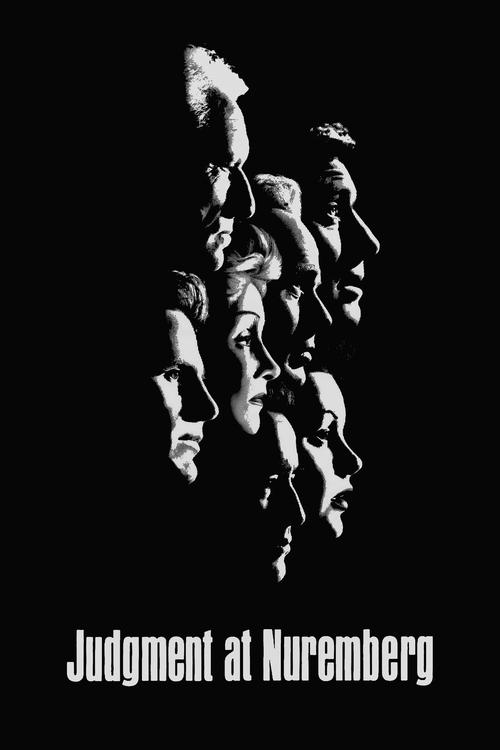
Judgment at Nuremberg (1961)
Directed by Stanley Kramer
No — Judgment at Nuremberg is not woke, scoring 0 out of 100 on our wokeness meter.
Stanley Kramer's Judgment at Nuremberg arrives from 1961, an era that had not yet assembled the current cultural vocabulary, and it conducts itself accordingly.
Consciousness Markers
The film is unapologetically a message picture, with Tracy's climactic monologue and Rolfe's speeches explicitly instructing the audience on collective guilt and moral responsibility.
The cast is a uniformly white ensemble of Hollywood and European stars; there is no deliberate diverse or inclusive casting agenda at play.
No LGBTQ+ characters, themes, or subtext appear anywhere in the courtroom proceedings or personal subplots.
Marlene Dietrich and Judy Garland play substantial roles, but the film advances no feminist critique of patriarchy or gender power structures.
The film confronts Nazi racial persecution of Jews as historical atrocity, but this is Holocaust reckoning, not the modern 2020s idiom of racial consciousness.
No environmental or climate themes whatsoever; the concerns are juridical and moral.
The film critiques totalitarianism and complicit bureaucracy, not capitalism or economic inequality.
No body-positivity themes; the concentration camp footage is deployed as evidence of atrocity, not as body-image commentary.
Montgomery Clift's jittery witness is a study in trauma and guilt, not a modern neurodivergence narrative.
The film is a fictionalized but essentially faithful reconstruction of the Judges' Trial, not a modern ideological rewriting of the historical record.
Why it received this score
Stanley Kramer's Judgment at Nuremberg arrives from 1961, an era that had not yet assembled the current cultural vocabulary, and it conducts itself accordingly. The film is a courtroom drama of unusual gravity, depicting a fictionalized version of the 1947 Judges' Trial, in which four German jurists answer for crimes against humanity. Spencer Tracy presides with the weariness of a man who has seen the worst and intends to say so at length. The cast is a wall of mid-century Hollywood and European stars, uniformly white, deployed with no visible interest in demographic accounting. No subplot interrogates gender, no character arrives bearing an identity to be explained, and no economic critique is smuggled into the verdict.
The picture's moral architecture rests on collective guilt and individual conscience. Maximilian Schell's defense attorney argues that the Americans, the Vatican, and Stalin all share the blame, and the film lets him make that case without resolving it neatly. Marlene Dietrich's widow and Judy Garland's frightened witness exist as people, not as positions in an argument. Montgomery Clift's trembling testimony reads as trauma and nothing else. The historical record is treated as something to reconstruct faithfully, not to revise. The concentration camp footage is deployed as evidence of atrocity, which it is.
Where the film pushes, it pushes openly. Tracy's closing monologue and Schell's summations instruct the audience directly on responsibility, and the camera does not blink. This is a message picture and it knows it. The sermonizing is earned, but it is sermonizing. A somber, well-made artifact from a less self-conscious age. The markers of contemporary social consciousness are absent from it, and the film does not appear to miss them.
Analysis generated by our Consciousness Algorithm


Synopsis
In 1947, four German judges who served on the bench during the Nazi regime face a military tribunal to answer charges of crimes against humanity. Chief Justice Haywood hears evidence and testimony not only from lead defendant Ernst Janning and his defense attorney Hans Rolfe, but also from the widow of a Nazi general, an idealistic U.S. Army captain and reluctant witness Irene Wallner.
Questions about Judgment at Nuremberg
Is Judgment at Nuremberg woke?
No — Judgment at Nuremberg is not woke, scoring 0 out of 100 on our wokeness meter. That earns it a verdict of Ultra Based.
Does Judgment at Nuremberg have any woke elements?
1 of the 10 markers register at 30 or above, led by Lecture Energy (35). On Lecture Energy: The film is unapologetically a message picture, with Tracy's climactic monologue and Rolfe's speeches explicitly instructing the audience on collective guilt and moral responsibility.
How does Judgment at Nuremberg compare to other 1961 movies?
It ranks #11 of the 13 films from 1961 we've scored; their average is 6. The wokest is The Hustler (29).
How is the Woke Score calculated?
An AI-assisted process researches the film and its reception, scores it 0–100 on ten markers, then combines those into one 0–100 Woke Score. It measures a specific set of 2020s cultural themes, not film quality.