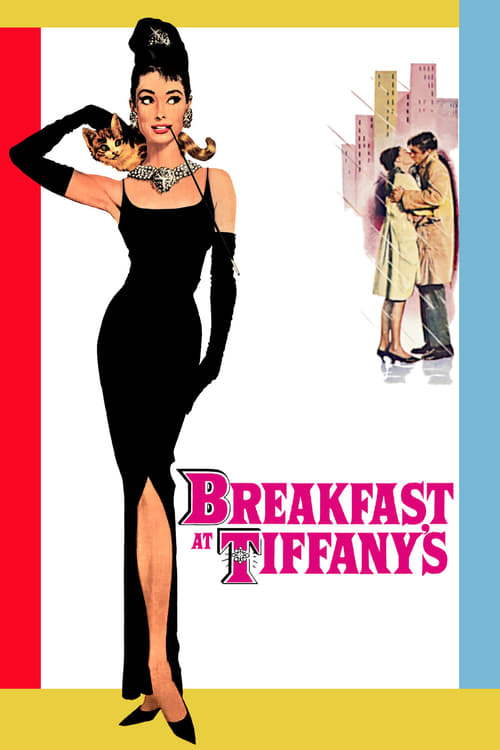
Breakfast at Tiffany's (1961)
Directed by Blake Edwards
No — Breakfast at Tiffany's is not woke, scoring 6 out of 100 on our wokeness meter.
Breakfast at Tiffany's is a polished 1961 confection, and its cultural ledger is a study in misplaced priorities.
Consciousness Markers
Holly's declaration that she belongs to nobody gestures at independence, but the character is fundamentally defined by her pursuit of a wealthy husband, hardly a feminist program.
The cast is almost entirely white, and the sole prominent Asian character, I.Y. Yunioshi, is played by Mickey Rooney in notorious yellowface — the antithesis of authentic representation.
The source novella's gay narrator and subtext were deliberately stripped out during adaptation, replacing them with a heterosexual love interest; the film actively removes rather than advances LGBTQ content.
The film engages no racial themes whatsoever; its only racialized element is the caricatured yellowface performance, which is a liability rather than consciousness.
No environmental or climate themes appear anywhere in the film.
The film is a love letter to aspirational consumerism, built around the Tiffany & Co. storefront and a protagonist chasing a millionaire; it is the opposite of eat-the-rich.
No body-positivity themes are present.
Holly is eccentric and flighty, but the film frames this as whimsical personality rather than any neurodivergent identity or theme.
The film is a contemporary-set romantic comedy with no historical revisionism.
The film is a light romantic comedy that never lectures its audience on social or political matters.
Why it received this score
Breakfast at Tiffany's is a polished 1961 confection, and its cultural ledger is a study in misplaced priorities. The film's most conspicuous gesture toward diversity is Mickey Rooney's I.Y. Yunioshi, a performance in yellowface so aggressive it has aged into a liability. The surrounding cast is white, the source novella's gay narrator has been replaced by a heterosexual love interest, and the gay subtext has been sanded away. This is not representation. It is an erasure with a hit song attached. Holly Golightly's famous claim that she belongs to nobody can be read as independence, and the film briefly enjoys that reading. But her energies are directed toward marrying a millionaire, and the story treats this as a charming quirk. The result is a heroine whose freedom is mostly a matter of timing and wardrobe. The film does not mount a feminist argument, and it does not try.
The movie's relationship to money is devotional. Tiffany's is treated as a secular cathedral, and Holly's pursuit of wealth is folded into romance. There is no critique of the rich, no class anger, no eat-the-rich impulse. The movie wants the diamond and the man. It has no environmental program, no body-positive message, no neurodivergent framework, no historical revisionism, and no sermonizing. Holly's eccentricity is whimsy, not diagnosis. The film's racial imagination is absent except for the yellowface caricature, which is not consciousness but a stain.
As a romantic comedy, it never lectures. It enchants, it sells a lifestyle, and it occasionally embarrasses. The social consciousness on display is thin and mostly accidental. We are left with Audrey Hepburn, a cat, and a store window. The ledger is not flattering, but the film remains a useful specimen: a beloved classic whose progressive credentials are largely a rumor.
Analysis generated by our Consciousness Algorithm
Part of


Synopsis
Holly Golightly is an eccentric New York City playgirl determined to marry a Brazilian millionaire. But when young writer Paul Varjak moves into her apartment building, her past threatens to get in their way.
Questions about Breakfast at Tiffany's
Is Breakfast at Tiffany's woke?
No — Breakfast at Tiffany's is not woke, scoring 6 out of 100 on our wokeness meter. That earns it a verdict of Ultra Based.
Does Breakfast at Tiffany's have any woke elements?
Very few. None of the 10 markers reaches 30, the level where a marker counts as present; the highest is Feminist Agenda at 15.
How does Breakfast at Tiffany's compare to other 1961 movies?
It ranks #4 of the 13 films from 1961 we've scored; their average is 6. The wokest is The Hustler (29).
How is the Woke Score calculated?
An AI-assisted process researches the film and its reception, scores it 0–100 on ten markers, then combines those into one 0–100 Woke Score. It measures a specific set of 2020s cultural themes, not film quality.