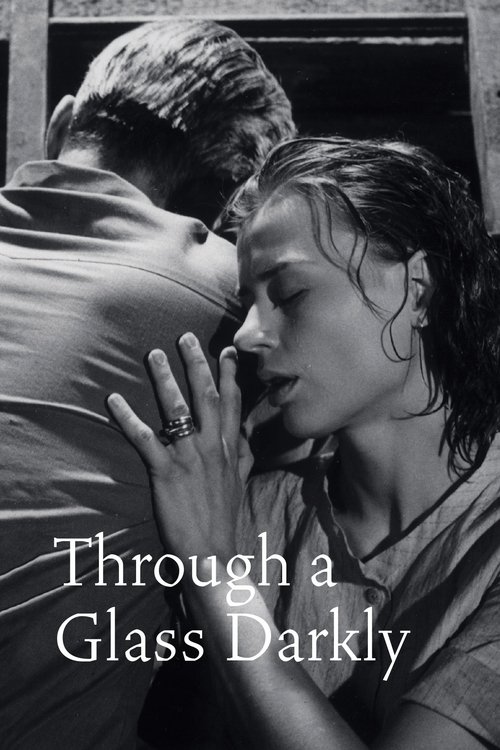
Through a Glass Darkly (1961)
Directed by Ingmar Bergman
No — Through a Glass Darkly is not woke, scoring 5 out of 100 on our wokeness meter.
Through a Glass Darkly arrives from 1961 with no interest in the questions that currently occupy the culture.
Consciousness Markers
Schizophrenia is the film's central subject, with Karin's voices and visions rendered sympathetically, though as tragic dissolution rather than as neurodivergent identity.
The closing 'God is love' exchange carries a didactic theological thesis, but it is existential philosophy rather than modern social sermonizing.
A 1961 Swedish chamber drama with an entirely Scandinavian cast; no modern representation-casting sensibility is present or intended.
No LGBTQ+ themes or characters appear; the film's sexual content concerns heterosexual marital withdrawal and an incestuous encounter.
Karin is a richly drawn female protagonist, but her suffering is framed theologically and psychologically, not as a feminist critique of patriarchy.
Race is entirely absent from the film's concerns; it is a white Scandinavian family drama about faith, art, and psychosis.
The island setting and storm are atmospheric and symbolic, not ecological advocacy.
The film critiques the artist as a callous exploiter of his daughter's illness, but this is an aesthetic-moral indictment, not an economic or class-based one.
No body-positivity themes; Karin's physical withdrawal and sexuality are treated as symptoms of illness.
No historical revisionism; the film is a contemporary (to 1961) fictional chamber drama.
Why it received this score
Through a Glass Darkly arrives from 1961 with no interest in the questions that currently occupy the culture. Four people spend a day on a remote island: a novelist who has learned to convert his daughter's illness into material, her doctor husband, her adolescent brother, and Karin herself, newly released from an asylum and already slipping. Bergman called his cast a string quartet, and the film behaves like one. The ensemble is Scandinavian because the story is Scandinavian. Nobody in the frame is there to represent anyone.
The one place the film brushes against contemporary sensibilities is its treatment of psychosis. Karin hears voices behind the peeling wallpaper. She waits for a god to emerge from a crack in the attic wall and receives, instead, a spider with a cold and calm face. Bergman grants her visions a terrible internal logic and never mocks her for having them. This is sympathy, not identity. She is not a neurodivergent protagonist negotiating a hostile world. She is a woman coming apart, and the film watches her go. The father's exploitation of her suffering earns a moral indictment, the artist as charlatan and heartless scavenger, but the charge is aesthetic and spiritual, not economic. The storm over the island is weather, not prophecy.
What remains is the ending, where David tells his son that God is love and love is God. The exchange functions as a thesis statement delivered with the calm of a sermon, and Bergman spent the rest of his career regretting it, calling it a diffuse veneer smeared over a divine concept he had actually touched. That is the full extent of the film's lecturing, and its subject is the silence of God. Anyone auditing this picture for signs of current cultural alignment will find the shelves bare and will find, in their place, a masterpiece. Which complicates the audit considerably.
Analysis generated by our Consciousness Algorithm


Synopsis
Karin hopes to recover from her recent stay at a mental hospital by spending the summer at her family's cottage on a tiny island. Her husband, Martin, cares for her but is frustrated by her physical withdrawal. Her younger brother, Minus, is confused by Karin's vulnerability and his own budding sexuality. Their father, David, cannot overcome his haughty remoteness. Beset by visions, Karin descends further into madness.
Questions about Through a Glass Darkly
Is Through a Glass Darkly woke?
No — Through a Glass Darkly is not woke, scoring 5 out of 100 on our wokeness meter. That earns it a verdict of Ultra Based.
Does Through a Glass Darkly have any woke elements?
Very few. None of the 10 markers reaches 30, the level where a marker counts as present; the highest is Neurodivergence at 20.
How does Through a Glass Darkly compare to other 1961 movies?
It ranks #6 of the 13 films from 1961 we've scored; their average is 6. The wokest is The Hustler (29).
How is the Woke Score calculated?
An AI-assisted process researches the film and its reception, scores it 0–100 on ten markers, then combines those into one 0–100 Woke Score. It measures a specific set of 2020s cultural themes, not film quality.