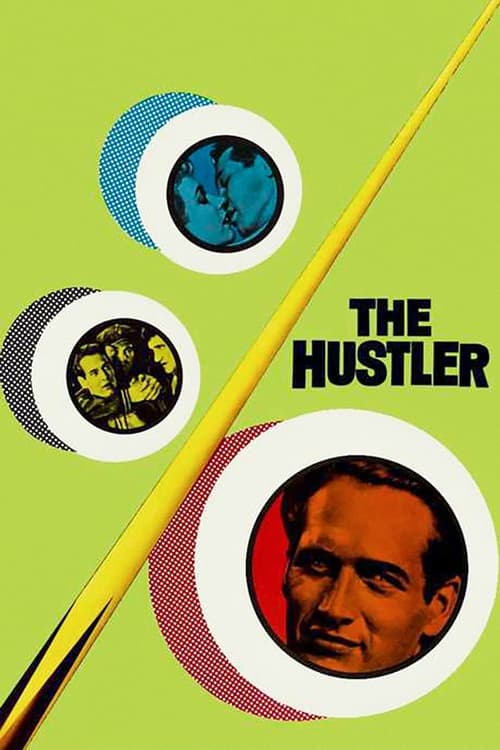
The Hustler (1961)
Directed by Robert Rossen
No — The Hustler is not especially woke, scoring 29 out of 100 on our wokeness meter.
The Hustler arrives from 1961, which is to say from a moment when a film could be about a man's soul and still get made.
Consciousness Markers
Rossen explicitly frames money as a corrupting, malign force, showing Eddie, Bert, and Findley all perverted by the pursuit of it and exposing class divisions through details like the whiskey orders. This is a genuine thematic critique, though rooted in mid-century humanism rather than modern eat-the-rich rhetoric.
The film is a restrained character study that shows rather than tells; its moral themes about winning and losing emerge through action and tragedy rather than preachy exposition.
The cast is entirely white, with no meaningful racial or ethnic diversity and no commentary on representation whatsoever.
There are no LGBTQ+ characters, themes, or subtext anywhere in the film.
Piper Laurie's Sarah is a memorably written, tragic figure, but the film is a male-centered study of ego and self-destruction with no feminist framework or critique of patriarchy.
Race is entirely absent as a subject; the film's social observations concern class and character, not racial dynamics.
No environmental or climate themes appear in the film.
No body-positivity themes or messaging are present.
No neurodivergent characters or themes are depicted or discussed.
The film is a fictional adaptation of a novel and makes no attempt to revise or reinterpret historical events.
Why it received this score
The Hustler arrives from 1961, which is to say from a moment when a film could be about a man's soul and still get made. Robert Rossen's study of Fast Eddie Felson, a pool hustler with talent and no character, moves through Ames Billiards and bus terminals and a Kentucky Derby weekend with the patience of a director who trusts his audience to keep up. Paul Newman plays the ambition. George C. Scott plays the price. Piper Laurie's Sarah exists to be destroyed, and the film does not pretend otherwise.
Where the picture carries any social charge, it is economic. Rossen, who named names before the House Un-American Activities Committee and plainly never forgave himself, treats money as a contaminant. Eddie, Bert, and Findley are all twisted by the pursuit of it. Only Minnesota Fats, who never touches the cash, escapes intact, a thesis stated through staging instead of speeches. The whiskey orders, Bert's blended against Eddie's bottled in bond with no ice and no glass, carry the class argument in a single exchange. This is mid-century humanism with a grudge, not a modern sermon.
That is the film's saving grace: it shows. The moral sits in camera placement, in who stands above whom, in a man kneeling over a body and then rising to his feet. Nothing gets explained twice. For a story about winning and losing, it refuses to lecture about either. The result is a cold, exact, unforgiving piece of work, and it has aged better than most of what followed it.
Analysis generated by our Consciousness Algorithm


Synopsis
Fast Eddie Felson is a small-time pool hustler with a lot of talent but a self-destructive attitude. His bravado causes him to challenge the legendary Minnesota Fats to a high-stakes match.
Questions about The Hustler
Is The Hustler woke?
No — The Hustler is not especially woke, scoring 29 out of 100 on our wokeness meter. That earns it a verdict of Based.
Does The Hustler have any woke elements?
1 of the 10 markers register at 30 or above, led by Eat the Rich (40). On Eat the Rich: Rossen explicitly frames money as a corrupting, malign force, showing Eddie, Bert, and Findley all perverted by the pursuit of it and exposing class divisions through details like the whiskey orders.
How does The Hustler compare to other 1961 movies?
It is the wokest of the 13 films from 1961 we've scored; their average is 6.
How is the Woke Score calculated?
An AI-assisted process researches the film and its reception, scores it 0–100 on ten markers, then combines those into one 0–100 Woke Score. It measures a specific set of 2020s cultural themes, not film quality.