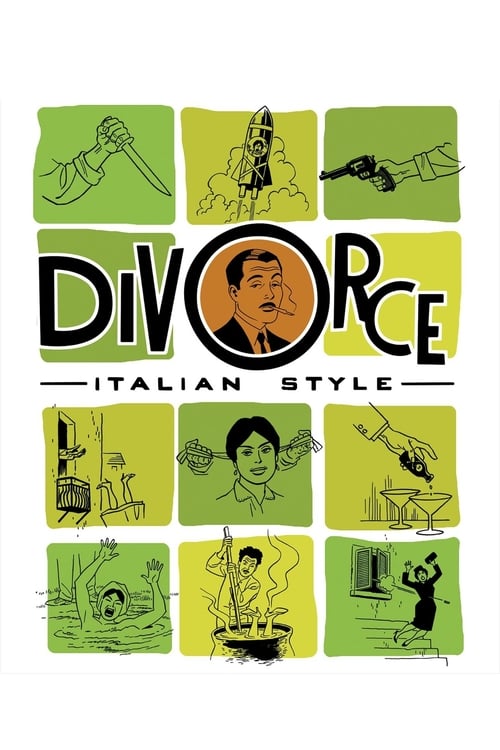
Divorce Italian Style (1961)
Directed by Pietro Germi
No — Divorce Italian Style is not woke, scoring 3 out of 100 on our wokeness meter.
Pietro Germi's 1961 black comedy arrives from an era when a man could not simply file paperwork to escape an unhappy marriage, so he instead engineered an elaborate cuckolding scheme culminating in a legally sanctioned murder.
Consciousness Markers
The film satirizes Sicilian honor culture and the mistreatment of women under archaic divorce laws, but it is a male-centric black comedy without a modern feminist agenda.
The film offers social satire but does not lecture or preach in a modern activist sense.
All-Italian cast of white actors; no diversity or representation casting elements.
No LGBTQ+ themes or characters.
No racial themes or consciousness; the film is set in a homogeneous Sicilian society.
No environmental or climate themes.
No anti-capitalist or eat-the-rich messaging; the focus is on honor and divorce law.
No body positivity themes.
No neurodivergence themes.
Not a historical revisionist work; it is a fictional satire based on a novel.
Why it received this score
Pietro Germi's 1961 black comedy arrives from an era when a man could not simply file paperwork to escape an unhappy marriage, so he instead engineered an elaborate cuckolding scheme culminating in a legally sanctioned murder. Ferdinando Cefalù, an impoverished Sicilian baron played by Marcello Mastroianni with the weary elegance of a man who has run out of options, spends the runtime auditioning methods of disposing of his wife. The film treats this as farce, and it is very funny in the manner of a country laughing at its own criminal code.
Make no mistake, the target here is a genuine social sickness: the honor culture of southern Italy, where a betrayed husband received a slap on the wrist and a woman's fidelity was a matter of family property. That is a worthy subject, and the screenplay won an Academy Award for its trouble. Yet the perspective remains stubbornly Ferdinando's. Rosalia exists to be faithful, then to be dispatched. Angela, the teenage cousin, exists to be won. The women of Agramonte are items in a ledger of masculine reputation, and the film observes their predicament without ever handing them the microphone.
Measured against the cultural sensibilities of a later century, this is a lean specimen indeed. There is no diversity casting in a homogeneous Sicilian town. No racial reckoning. No environmental sermon. The satire skewers provincial hypocrisy, not capitalism, and it does so with a smirk instead of a lecture. What remains is a sharp, cynical, beautifully constructed comedy about a legal system that rewarded murder, adapted from Giovanni Arpino's novel, and remembered as one of the films that shaped a nation's memory. The ledger of modern virtue stays almost entirely blank, which is its own kind of period detail.
Analysis generated by our Consciousness Algorithm


Synopsis
Ferdinando Cefalù is desperate to marry his cousin, Angela, but he is married to Rosalia and divorce is illegal in Italy. To get around the law, he tries to trick his wife into having an affair so he can catch her and murder her, as he knows he would be given a light sentence for killing an adulterous woman. He persuades a painter to lure his wife into an affair, but Rosalia proves to be more faithful than he expected.
Questions about Divorce Italian Style
Is Divorce Italian Style woke?
No — Divorce Italian Style is not woke, scoring 3 out of 100 on our wokeness meter. That earns it a verdict of Ultra Based.
Does Divorce Italian Style have any woke elements?
Very few. None of the 10 markers reaches 30, the level where a marker counts as present; the highest is Feminist Agenda at 5.
How does Divorce Italian Style compare to other 1961 movies?
It ranks #7 of the 13 films from 1961 we've scored; their average is 6. The wokest is The Hustler (29).
How is the Woke Score calculated?
An AI-assisted process researches the film and its reception, scores it 0–100 on ten markers, then combines those into one 0–100 Woke Score. It measures a specific set of 2020s cultural themes, not film quality.