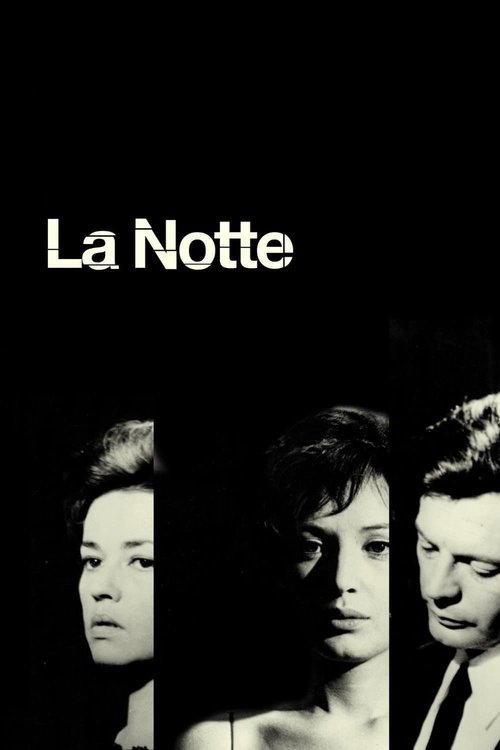
La Notte (1961)
Directed by Michelangelo Antonioni
No — La Notte is not woke, scoring 8 out of 100 on our wokeness meter.
Michelangelo Antonioni's La Notte spends a single day and night in Milan with a novelist and his wife, and it would be generous to call the results a plot.
Consciousness Markers
The millionaire industrialist Gherardini and his vapid socialite party carry a faint critique of bourgeois wealth, but the film's target is spiritual emptiness rather than capitalism itself.
Lidia and Valentina are given genuine interiority and the male protagonist's callousness is quietly indicted, but this is existential character study rather than a feminist thesis.
The cast is entirely white European, drawn from Italian and French cinema of the era, with no deliberate diversity casting of any kind.
No LGBTQ+ characters, themes, or subtext are present in this study of heterosexual marital dissolution.
Race is entirely absent from the film's concerns; the milieu is uniformly white Milanese bourgeoisie.
No environmental or climate themes appear; the rainstorm is a mood device, not an ecological statement.
No body-positivity themes; the censorship notes concern nudity as erotic content, not body acceptance.
No neurodivergence is depicted or discussed; the characters' malaise is existential, not clinical.
The film engages no historical narrative to revise; it is a contemporary 1961 Milanese drama.
Antonioni deliberately abandons traditional storytelling for atmosphere and mood, offering no sermons or didactic messaging.
Why it received this score
Michelangelo Antonioni's La Notte spends a single day and night in Milan with a novelist and his wife, and it would be generous to call the results a plot. Giovanni signs books, drifts through a hospital corridor, and accepts a flirtation from a feverish young woman; Lidia walks the old neighborhood and watches rockets rise over an empty field. The film is a mood with a runtime. Its concerns are spiritual bankruptcy, marital exhaustion, and the specific ache of two people sharing a room while occupying different planets. Every face on screen is white, European, and drawn from the Italian and French cinema of the era, which is to say the film makes no gesture toward diversity casting. Race never enters the frame. Neither does climate, nor neurodivergence, nor any question of the body as a site of affirmation. These absences are not failures. They are simply the boundaries of the film's interests.
Where a faint pulse of social consciousness can be detected, it arrives quietly. Jeanne Moreau's Lidia and Monica Vitti's Valentina are granted real interiority, and the camera lingers on their boredom, their intelligence, their separate private griefs. Giovanni's casual cruelty toward his wife is observed without being announced, and the film's sympathy sits with the women. That is character writing, not a thesis. The millionaire industrialist Gherardini and his chattering guests carry a thin vein of contempt for idle wealth, though the target is spiritual vacancy, not the economic system that produces it. Antonioni indicts the party, not the profit.
The film's real achievement is formal. Antonioni abandons conventional storytelling for composition and atmosphere, and he offers no sermons, no lessons, no invitation to be improved. There is nothing here that strains to instruct an audience. La Notte is a cold, beautiful, unreachable object, admired for sixty years by people who like their cinema difficult. Kubrick placed it among his favorites. Mad Men name-dropped it. The picture earns its reputation honestly, and it earns its place in the catalog as existential observation with almost no interest in the cultural battles of a later century.
Analysis generated by our Consciousness Algorithm


Synopsis
A day in the life of an unfaithful married couple and their steadily deteriorating relationship in Milan.
Questions about La Notte
Is La Notte woke?
No — La Notte is not woke, scoring 8 out of 100 on our wokeness meter. That earns it a verdict of Ultra Based.
Does La Notte have any woke elements?
Very few. None of the 10 markers reaches 30, the level where a marker counts as present; the highest is Eat the Rich at 15.
How does La Notte compare to other 1961 movies?
It ranks #3 of the 13 films from 1961 we've scored; their average is 6. The wokest is The Hustler (29).
How is the Woke Score calculated?
An AI-assisted process researches the film and its reception, scores it 0–100 on ten markers, then combines those into one 0–100 Woke Score. It measures a specific set of 2020s cultural themes, not film quality.