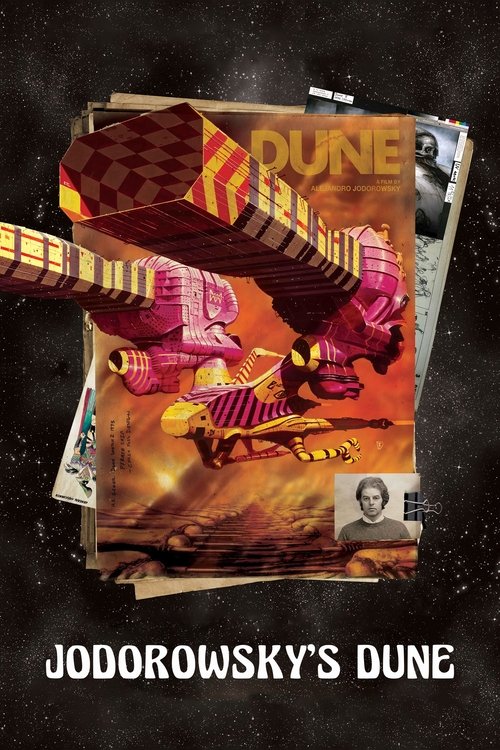
Jodorowsky's Dune (2013)
Directed by Frank Pavich
No — Jodorowsky's Dune is not woke, scoring 0 out of 100 on our wokeness meter.
Frank Pavich's Jodorowsky's Dune is a documentary about a film that does not exist, which turns out to be the ideal subject for a documentary, since there is nothing to watch and therefore nothing to argue about.
Consciousness Markers
The film advances an enthusiastic thesis about the project's influence on later sci-fi, but it is aesthetic advocacy rather than social or political lecturing.
The interviewees are the surviving European and American collaborators of a 1970s project; their presence reflects historical fact rather than any deliberate diversity casting.
Amanda Lear appears as a participant, but her identity is never discussed and the film contains no LGBTQ+ themes or commentary.
The documentary is a tribute to a male auteur's grandiose vision and contains no feminist framing or critique.
Race is entirely absent as a subject; the film concerns the economics and aesthetics of a failed science-fiction production.
No environmental or climate themes appear anywhere in the documentary.
The film laments Hollywood's refusal to fund an uncompromising vision, but frames this as a business reality rather than an anti-capitalist indictment.
No body-image or body-positivity content is present.
No discussion of neurodivergence or mental health appears in the film.
The documentary recounts the actual production history of the abandoned Dune adaptation without reinterpreting it through a modern ideological lens.
Why it received this score
Frank Pavich's Jodorowsky's Dune is a documentary about a film that does not exist, which turns out to be the ideal subject for a documentary, since there is nothing to watch and therefore nothing to argue about. For two and a half years in the mid-1970s, the Chilean-French director assembled a team of designers, illustrators, and a Dalí who demanded to be paid by the hour, all in service of an adaptation of Frank Herbert's novel that would run ten to fourteen hours and cost more than anyone wished to spend. The money ran out. The book of storyboards survives. That is the whole story, and the film tells it with affection and a stack of talking heads.
What the film does not do is audit the past for contemporary approval. The participants are the surviving European and American collaborators of the project, present because they were there, not because a casting director was counting. Amanda Lear appears and is permitted to be a person rather than a category. Race, climate, capital, bodies, and the interior weather of the mind are simply not on the agenda. Hollywood declines to fund a visionary, and the film treats this as an accounting problem, which it was, instead of a moral indictment of the profit motive. Refreshing, in its way.
There is an argument here, advanced with genuine enthusiasm, that Jodorowsky's unmade Dune seeded the visual language of Star Wars, Alien, and much else. It is a claim about aesthetics and influence, delivered as advocacy, not as a sermon on how we ought to live. The documentary wants us to mourn a lost masterpiece. We can do that. We have been asked for nothing more.
Analysis generated by our Consciousness Algorithm


Synopsis
In 1974, Chilean-French director Alejandro Jodorowsky embarked on the quixotic project of adapting Frank Herbert's influential novel Dune (1969) for the big screen. After investing two years, and millions of dollars, the gigantic project ended in failure; but the artists Jodorowsky brought together to carry it out continued to work together, and ended up laying the foundations for modern science fiction cinema.
Questions about Jodorowsky's Dune
Is Jodorowsky's Dune woke?
No — Jodorowsky's Dune is not woke, scoring 0 out of 100 on our wokeness meter. That earns it a verdict of Ultra Based.
Does Jodorowsky's Dune have any woke elements?
Very few. None of the 10 markers reaches 30, the level where a marker counts as present; the highest is Lecture Energy at 10.
How does Jodorowsky's Dune compare to other 2013 movies?
It ranks #249 of the 274 films from 2013 we've scored; their average is 14. The wokest is Belle (76).
How is the Woke Score calculated?
An AI-assisted process researches the film and its reception, scores it 0–100 on ten markers, then combines those into one 0–100 Woke Score. It measures a specific set of 2020s cultural themes, not film quality.