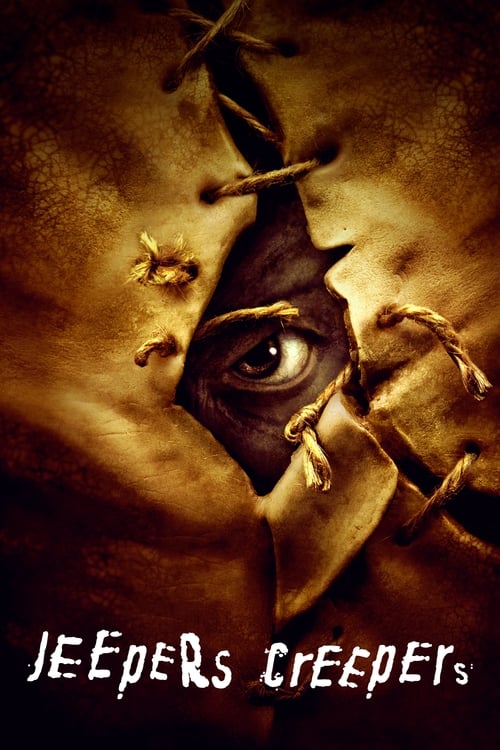
Jeepers Creepers (2001)
Directed by Victor Salva
No — Jeepers Creepers is not woke, scoring 7 out of 100 on our wokeness meter.
Victor Salva's Jeepers Creepers arrives from 2001 with the tidy confidence of a creature feature that knows precisely how long it can hold a highway at night before the audience begins checking the exits.
Consciousness Markers
Writer-director Victor Salva stated he deliberately killed mostly male characters because he was tired of seeing women slaughtered on screen, and used red herrings so the female lead Trish survives while her brother dies — a mild, unstated subversion of the final-girl trope.
Gina Philips and Justin Long lead as white siblings, with a handful of diverse supporting players such as Patricia Belcher as the psychic Jezelle; the casting reflects ordinary commercial horror convention rather than any deliberate inclusivity agenda.
No LGBTQ+ characters, themes, or subtext whatsoever.
A Black supporting character appears as the psychic, but her race is never acknowledged or thematized; no racial commentary of any kind.
No environmental or climate themes present.
No economic critique or anti-rich messaging; the antagonist is a supernatural predator, not capital.
No body-image or body-positivity themes; the monster's body horror is used for fright, not self-acceptance messaging.
No neurodivergent characters or themes.
No historical revisionism; the film is a straightforward fictional creature feature.
Exposition about the Creeper's 23-year cycle is delivered as plot mechanics, not moral instruction or social commentary.
Why it received this score
Victor Salva's Jeepers Creepers arrives from 2001 with the tidy confidence of a creature feature that knows precisely how long it can hold a highway at night before the audience begins checking the exits. Two siblings, one truck, a pipe in a field, and a thing with wings. It grossed fifty-nine million dollars against a ten million dollar budget, which in the moral ledger of American Zoetrope passes for restraint. The first half is genuinely unnerving. The second half is a police station, and the film never quite recovers from the trade.
The picture's progressive credentials, such as they are, live almost entirely in casting arithmetic. Gina Philips and Justin Long lead as white siblings, and the supporting ranks include Patricia Belcher as the psychic Jezelle, a Black woman whose race the screenplay never notices, comments upon, or troubles itself to address. This is commercial horror convention in its natural habitat, not a statement of intent. There is no queer presence of any kind. There is no environmental lament, no critique of accumulated wealth, no interest in bodies except as inventory. The antagonist is an ancient predator that feeds every twenty-third spring, and it holds no economic philosophy whatsoever.
Where the film gestures, faintly, toward a social conscience is in Salva's decision to have the Creeper prey mostly on men. He said he was tired of watching women slaughtered on screen, and he seeded red herrings so that Trish would survive while her brother Darry does not. That is a genuine inversion of the expected pattern, and it arrives without a single line of dialogue explaining itself. No character turns to the camera to instruct us on the matter. The sermon is absent. What we have instead is a modest structural choice buried inside a monster movie, and the film seems content to leave it there, unexamined, which is its own quiet dignity. The creature eats, the credits roll, and nobody learns anything about society. Refreshing, in its way. Almost restful. The genre could use more of this restraint, though it rarely asks for my opinion on the subject, and it will not start now. I have catalogued worse. I have catalogued a great deal worse, and I suspect I will again before the season ends. The score sits low, and it earns that low score honestly, which is more than most films manage. I respect the honesty. I do not respect much else about the final act, but the honesty stands.
We are left, then, with a lean and competent fright machine that asks nothing of its audience beyond a willingness to be startled, and rewards that willingness often enough to justify the ticket. It does not lecture. It does not moralize. It simply eats people on a schedule, and for that small mercy I am, in the end, grateful. The Creeper will return in twenty-three years. So will the sequels, sooner. I will be here, clipboard in hand, waiting to classify them. It is, after all, the work.
Analysis generated by our Consciousness Algorithm


Synopsis
On a desolate country highway, two homeward-bound teens are nearly run off the road by a maniac in a beat-up truck, and later spot him shoving what appears to be a body down a sewer pipe.
Questions about Jeepers Creepers
Is Jeepers Creepers woke?
No — Jeepers Creepers is not woke, scoring 7 out of 100 on our wokeness meter. That earns it a verdict of Ultra Based.
Does Jeepers Creepers have any woke elements?
Very few. None of the 10 markers reaches 30, the level where a marker counts as present; the highest is Feminist Agenda at 15.
How does Jeepers Creepers compare to other 2001 movies?
It ranks #85 of the 148 films from 2001 we've scored; their average is 12. The wokest is Monster's Ball (60).
Is Jeepers Creepers the most woke Jeepers Creepers movie?
Yes. It scores highest of the 3 Jeepers Creepers films we've scored.