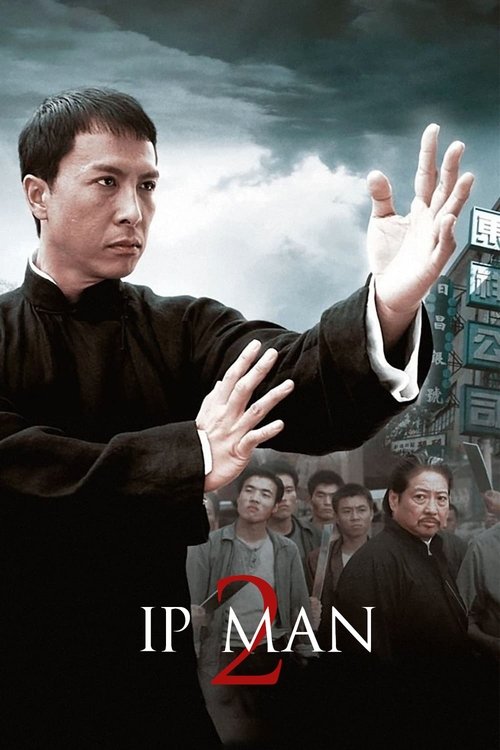
Ip Man 2 (2010)
Directed by Wilson Yip
No — Ip Man 2 is not especially woke, scoring 31 out of 100 on our wokeness meter.
Wilson Yip's Ip Man 2 arrives as a sequel with a clear assignment: continue Donnie Yen's stoic Wing Chun master into British Hong Kong, where the martial arts circuit doubles as a colonial pressure valve.
Consciousness Markers
The central conflict pits Chinese martial artists against a racist British boxer and corrupt colonial officials, and Ip Man's closing speech explicitly calls for respect across race, culture, and status.
Ip Man's closing address to the arena, urging mutual respect regardless of race, culture, or status, is a direct on-screen moral lecture delivered to the audience.
The plot indicts colonial corruption and a protection-money racket run by British officials and martial-arts masters, giving it a mild anti-exploitation, anti-establishment streak.
The film is a loose biopic that invents the Twister storyline and other dramatic beats, but this is standard biopic embellishment rather than ideologically motivated historical revision.
Ip Man's wife Wing-sing has a modest arc from naive young woman to supportive adult and is pregnant, but the film is overwhelmingly a male martial-arts narrative with no feminist thesis.
The cast is a natural Hong Kong/Chinese ensemble appropriate to a Hong Kong production; there is no deliberate diversity-casting agenda at work.
No LGBTQ+ characters, themes, or subtext appear anywhere in the film.
No environmental or climate themes are present.
No body-positivity themes or messaging are present.
Chow Ching-chuen's brain damage is a tragic plot device rather than a depiction of neurodivergence framed through a modern advocacy lens.
Why it received this score
Wilson Yip's Ip Man 2 arrives as a sequel with a clear assignment: continue Donnie Yen's stoic Wing Chun master into British Hong Kong, where the martial arts circuit doubles as a colonial pressure valve. The film is a Hong Kong production with a Hong Kong and mainland Chinese ensemble, cast along lines of cultural and industrial logic. There is no diversity-casting agenda to decode here. Nor is there any LGBTQ thread, climate lament, or body-positivity subplot. The movie wants to show a man punching, and then to show him making a speech after the punching.
Its social consciousness is real but narrow. The villains are a racist British boxer, Taylor "The Twister" Miller, and a corrupt superintendent named Wallace, both of whom treat Chinese martial artists as colonial curiosities and revenue streams. The protection racket run through the martial arts schools gives the film a mild anti-exploitation impulse, though it aims at crooked officials and gangsters, not an economic system. Ip Man's closing address to the arena, asking for mutual respect across race, culture, and status, is an on-screen sermon delivered without irony. The lecture lands because the film has spent an hour earning the grievance. It is still a lecture.
Elsewhere the film is content to be a sturdy genre exercise. Ip's wife, Wing-sing, moves from naive young woman to supportive adult and spends much of the runtime pregnant, which is a modest arc inside a male-dominated narrative. Chow Ching-chuen's brain damage is a tragic plot device, not a study of neurodivergence. The story invents the Twister match and other dramatic beats, but this is standard biopic embellishment, not ideological rewriting. The result is a well-choreographed sequel that occasionally pauses to instruct the audience on colonial injustice. The instruction is effective, if not subtle. The film throws a respectable punch, then turns to the camera and explains why the punch was necessary.
Analysis generated by our Consciousness Algorithm
Part of


Synopsis
Having defeated the best fighters of the Imperial Japanese army in occupied Shanghai, Ip Man and his family settle in post-war Hong Kong. Struggling to make a living, Master Ip opens a kung fu school to bring his celebrated art of Wing Chun to the troubled youth of Hong Kong. His growing reputation soon brings challenges from powerful enemies, including pre-eminent Hung Gar master, Hung Quan.
Questions about Ip Man 2
Is Ip Man 2 woke?
No — Ip Man 2 is not especially woke, scoring 31 out of 100 on our wokeness meter. That earns it a verdict of Based.
Does Ip Man 2 have any woke elements?
2 of the 10 markers register at 30 or above, led by Racial Consciousness (55) and Lecture Energy (45). On Racial Consciousness: The central conflict pits Chinese martial artists against a racist British boxer and corrupt colonial officials, and Ip Man's closing speech explicitly calls for respect across race, culture, and status.
How does Ip Man 2 compare to other 2010 movies?
It ranks #16 of the 238 films from 2010 we've scored; their average is 11. The wokest is My Name Is Khan (84).
Is Ip Man 2 the most woke Ip Man movie?
Yes. It scores highest of the 4 Ip Man films we've scored.