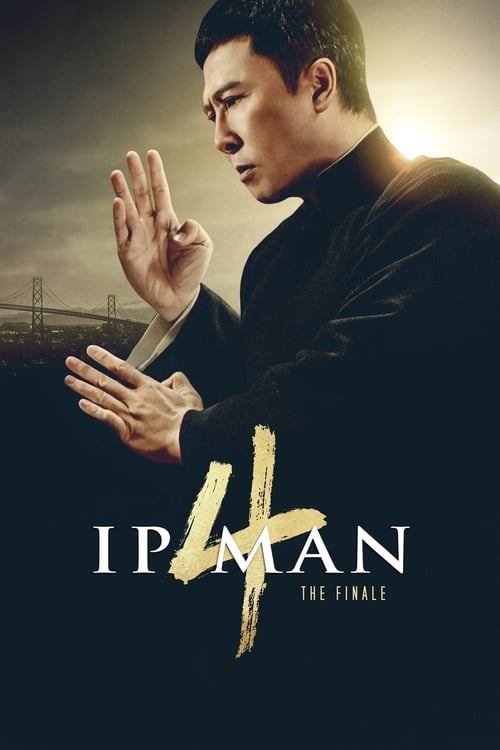
Ip Man 4: The Finale (2019)
Directed by Wilson Yip
No — Ip Man 4: The Finale is not especially woke, scoring 28 out of 100 on our wokeness meter.
Ip Man 4: The Finale arrives as the fourth and purportedly last installment of a franchise that has spent a decade teaching audiences that Wing Chun solves most problems and creates several new ones.
Consciousness Markers
Anti-Chinese racism in 1960s America is the film's central dramatic engine: racist cheerleaders, a xenophobic INS officer, and openly bigoted Marines drive the plot, with characters explicitly debating the white-Chinese tension in San Francisco.
Characters deliver periodic speeches about Chinese dignity, the immigrant experience, and the wrongness of racism, though the moralizing is largely subsumed into the fight choreography rather than delivered as direct sermon.
The cast is overwhelmingly Chinese and Hong Kong performers, which is organic to a Chinese-produced Ip Man biopic rather than a box-ticking exercise; a Black INS officer and Black Marine appear in supporting roles without commentary.
Yonah Wan defends herself against a racist bully and Ip Man affirms she was right to fight back, but the film remains a male-dominated martial-arts narrative with women largely as catalysts for male conflict.
The film is a loose, dramatized biopic that invents a Marine-corps kung fu showdown and an epilogue claiming the Marines adopted Chinese kung fu in 2001, but this is genre embellishment rather than ideological rewriting of history.
No LGBTQ+ characters, themes, or subtext of any kind appear in the film.
No environmental or climate-related themes are present.
No critique of capitalism, wealth, or class exploitation appears; the conflict is cultural and racial, not economic.
No body-positivity themes or messaging are present.
No neurodivergent characters or themes are depicted.
Why it received this score
Ip Man 4: The Finale arrives as the fourth and purportedly last installment of a franchise that has spent a decade teaching audiences that Wing Chun solves most problems and creates several new ones. This time the grandmaster, played with weary dignity by Donnie Yen, travels from Hong Kong to San Francisco in 1964 to secure a school placement for his son. What he finds is a Chinatown power structure, a Marine base full of karate enthusiasts, and a great deal of anti-Chinese hostility. The film's dramatic engine is racial grievance, plainly stated and repeatedly discussed. Racist cheerleaders, a xenophobic immigration officer, and a gunnery sergeant who insults everyone within earshot all push the plot forward. The bigotry is the plot. This is a Chinese production telling a Chinese story about Chinese dignity, so the casting reads as organic, with a Black INS officer and a Black Marine in supporting roles and no commentary attached.
The women get a brief moment of dignity. Wan's daughter Yonah fights back against a bully, and Ip Man endorses her decision, a small progressive gesture inside a narrative that still treats women as the spark for male confrontation. Beyond that, the film has no interest in other contemporary preoccupations. There is no environmental lament, no critique of wealth, no body-positive messaging, no neurodivergent characters. The politics on offer are cultural and national, delivered with a moderate amount of speechifying. Characters pause to explain the immigrant experience and the wrongness of bigotry, though most of the moral argument gets absorbed into the punching, which is the more honest delivery mechanism.
As history, the film is loose in the way martial arts biopics are always loose. It invents a Marine Corps kung fu showdown and closes with onscreen text claiming the Marines formally adopted Chinese kung fu in 2001, a tidy flourish that genre convention permits and historians would dispute. It is a sturdy conclusion to a series more interested in choreography than the archive. It lectures a little, fights a lot, and never pretends to be about anything other than what it is.
Analysis generated by our Consciousness Algorithm
Part of


Synopsis
Following the death of his wife, Ip Man travels to San Francisco to ease tensions between the local kung fu masters and his star student, Bruce Lee, while searching for a better future for his son.
Questions about Ip Man 4: The Finale
Is Ip Man 4: The Finale woke?
No — Ip Man 4: The Finale is not especially woke, scoring 28 out of 100 on our wokeness meter. That earns it a verdict of Based.
Does Ip Man 4: The Finale have any woke elements?
2 of the 10 markers register at 30 or above, led by Racial Consciousness (70) and Lecture Energy (35). On Racial Consciousness: Anti-Chinese racism in 1960s America is the film's central dramatic engine: racist cheerleaders, a xenophobic INS officer, and openly bigoted Marines drive the plot, with characters explicitly debating the white-Chinese tension in San Francisco.
How does Ip Man 4: The Finale compare to other 2019 movies?
It ranks #80 of the 284 films from 2019 we've scored; their average is 22. The wokest is Black Christmas (79).
Is Ip Man 4: The Finale the most woke Ip Man movie?
No. It ranks #2 of the 4 Ip Man films we've scored; the wokest is Ip Man 2 (31).