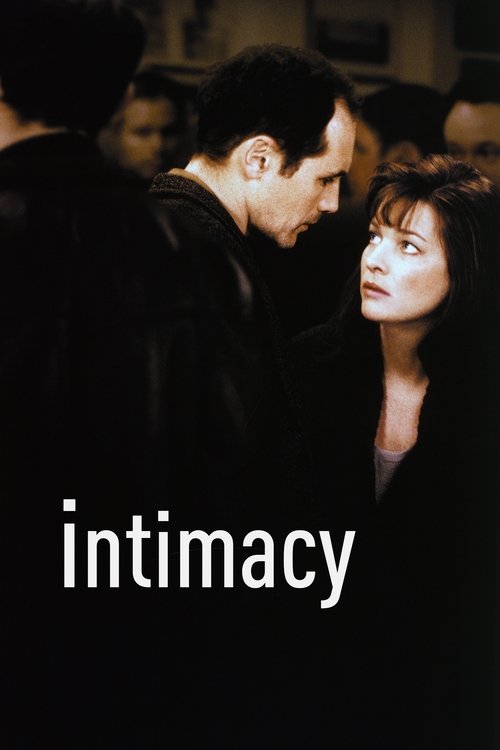
Intimacy (2001)
Directed by Patrice Chéreau
No — Intimacy is not woke, scoring 3 out of 100 on our wokeness meter.
Patrice Chéreau's Intimacy arrived in 2001 with a Golden Bear, a Silver Bear for Kerry Fox, and a reputation built almost entirely on the fact that its performers did things on camera that most performers decline to do.
Consciousness Markers
Claire is granted a degree of sexual agency and a refusal to leave her family on her own terms, but the film is framed largely through Jay's possessive male gaze rather than any feminist thesis.
The cast is overwhelmingly white European (Rylance, Fox, Spall, Harker), with no deliberate diversity casting and no minority characters positioned for representational weight.
No LGBTQ+ characters, themes, or subtext appear anywhere in the film's narrative of heterosexual adultery and alienation.
Race is entirely absent as a concern; the 'black cab' refers to a London taxi, not a character's identity, and no racial themes are engaged.
No environmental or climate content of any kind.
The film's milieu of pubs, squats, and suburban malaise carries no economic critique or eat-the-rich messaging.
The unsimulated sex and nudity are deployed for raw realism and alienation, not as a body-positive statement; the film offers no body-acceptance framing.
No neurodivergent characters or themes are present.
The film is a contemporary relationship drama with no historical subject matter to revise.
Chéreau's film is a mood-driven, near-wordless study of isolation; it preaches nothing and delivers no moralizing monologue.
Why it received this score
Patrice Chéreau's Intimacy arrived in 2001 with a Golden Bear, a Silver Bear for Kerry Fox, and a reputation built almost entirely on the fact that its performers did things on camera that most performers decline to do. The plot is spare to the point of skeletal: a failed musician named Jay, a woman who arrives every Wednesday, sex without names, and the slow corrosion that follows when he decides to learn who she is. It is a mood piece, near-wordless in its central passages, and it belongs to the New French Extremity only in its commitment to physical candor.
An audit of the film's cultural commitments yields very little, and this is not a criticism so much as an observation about the era. The cast is uniformly white and European, with no representational architecture to speak of. Race never enters the frame as a subject, and the black cab driven by Claire's husband is a London taxi, nothing more. No LGBTQ presence. No environmental concern. The pubs, squats and grey suburbs carry no economic argument. The explicit nudity exists to convey isolation, not to celebrate any body, and the film has no interest in neurodivergence, historical revision, or moral instruction of any kind.
The lone flicker of contemporary sensibility is Claire herself, who is granted a measure of sexual agency and who declines, on her own terms, to abandon her family. Even that is filtered through Jay's possessive gaze. The film preaches nothing and resolves nothing. It simply ends, and Claire walks away without looking back.
Analysis generated by our Consciousness Algorithm


Synopsis
Failed musician Jay abandoned his family and now earns a living as head bartender in a trendy London pub. Every Wednesday afternoon, a woman comes to his house for graphic, almost wordless, sex. One day, Jay follows her and learns about her. This eventually disrupts their relationship.
Questions about Intimacy
Is Intimacy woke?
No — Intimacy is not woke, scoring 3 out of 100 on our wokeness meter. That earns it a verdict of Ultra Based.
Does Intimacy have any woke elements?
Very few. None of the 10 markers reaches 30, the level where a marker counts as present; the highest is Feminist Agenda at 8.
How does Intimacy compare to other 2001 movies?
It ranks #119 of the 148 films from 2001 we've scored; their average is 12. The wokest is Monster's Ball (60).
How is the Woke Score calculated?
An AI-assisted process researches the film and its reception, scores it 0–100 on ten markers, then combines those into one 0–100 Woke Score. It measures a specific set of 2020s cultural themes, not film quality.