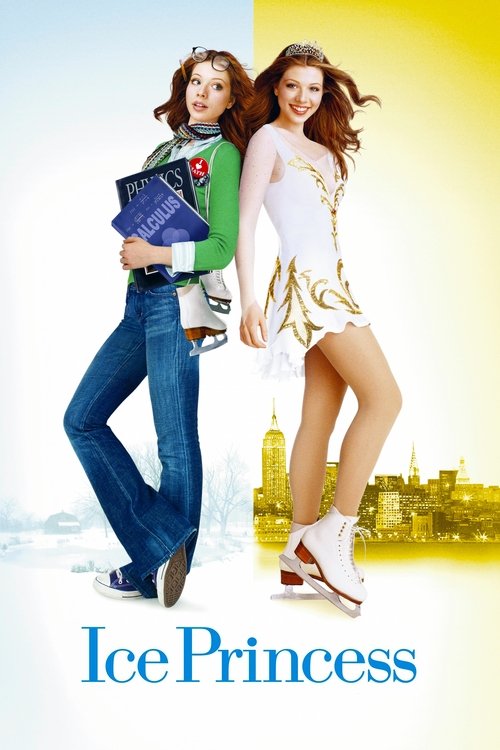
Ice Princess (2005)
Directed by Tim Fywell
No — Ice Princess is not woke, scoring 14 out of 100 on our wokeness meter.
Ice Princess (2005) is a Disney teen sports comedy-drama about a physics-minded Connecticut student who applies her homework to figure skating and discovers a competing dream.
Consciousness Markers
The plot centers on a girl defying her mother’s academic plan to pursue figure skating, with female coaches and rivals, but it frames this as a conventional follow-your-dream teen story rather than a feminist critique.
Female-led Disney sports film with a predominantly white principal cast and a few Asian-American supporting skaters; diversity is incidental rather than a stated casting priority.
No LGBTQ+ characters, relationships, or themes are present.
Race is not a subject of the film; the Asian-American skaters are present without any racial commentary or consciousness.
No environmental or climate themes are present.
No critique of capitalism, wealth, or class structures; it is a Disney family sports film.
Figure skating is depicted without any body-image or body-positivity discourse.
The protagonist is academically gifted and physics-minded, but this is not framed as neurodivergence.
No historical revisionism; the film is a contemporary fictional teen story.
The film offers mild follow-your-dream moralizing but no sustained social or political lecturing.
Why it received this score
Ice Princess (2005) is a Disney teen sports comedy-drama about a physics-minded Connecticut student who applies her homework to figure skating and discovers a competing dream. It is female-led, with Joan Cusack and Kim Cattrall as dueling mothers and a handful of Asian-American skaters in support. The casting is diverse in the mild, incidental manner of mid-2000s family films: no stated priority, no commentary. The story's engine is a girl choosing the rink over Harvard, which gives the film a faint progressive pulse. The treatment is a conventional follow-your-dream teen arc, not a feminist critique of maternal expectation or gender norms. It is earnest, harmless, and entirely comfortable with its own formula.
The film's social imagination is otherwise quiet. It does not trouble itself with queer characters, race as a subject, climate anxiety, class resentment, body-image debate, neurodivergent framing, or rewritten history. The academically gifted heroine is simply smart, not a case study. The skating is athletic discipline, not a platform for self-acceptance discourse. The rink politics are personal and petty, not structural. There is no sustained sermonizing, and the mild moral about following your dream arrives without a lecture. This is not a failure of nerve. It is a Disney family film from 2005 operating exactly within its intended boundaries.
What remains is a modest time capsule of female-led family entertainment, one that grants its heroine ambition and a few complicated women around her. Cultural awareness exists in the female ensemble and in the daughter's quiet defiance, but it never becomes the film's project. The moral is that dreams require sacrifice and supportive adults, a thesis uncontroversial enough to print on a lunchbox. As a specimen of social consciousness, the film is a low, steady hum. As a Disney sports film, it does precisely what the poster promises.
Analysis generated by our Consciousness Algorithm
Part of


Synopsis
With the help of her coach, her mom, and the boy who drives the Zamboni, nothing can stop Casey Carlyle from realizing her dream to be a champion figure skater.
Questions about Ice Princess
Is Ice Princess woke?
No — Ice Princess is not woke, scoring 14 out of 100 on our wokeness meter. That earns it a verdict of Ultra Based.
Does Ice Princess have any woke elements?
1 of the 10 markers register at 30 or above, led by Feminist Agenda (30). On Feminist Agenda: The plot centers on a girl defying her mother’s academic plan to pursue figure skating, with female coaches and rivals, but it frames this as a conventional follow-your-dream teen story rather than a feminist critique.
How does Ice Princess compare to other 2005 movies?
It ranks #57 of the 181 films from 2005 we've scored; their average is 13. The wokest is The Constant Gardener (72).
How is the Woke Score calculated?
An AI-assisted process researches the film and its reception, scores it 0–100 on ten markers, then combines those into one 0–100 Woke Score. It measures a specific set of 2020s cultural themes, not film quality.