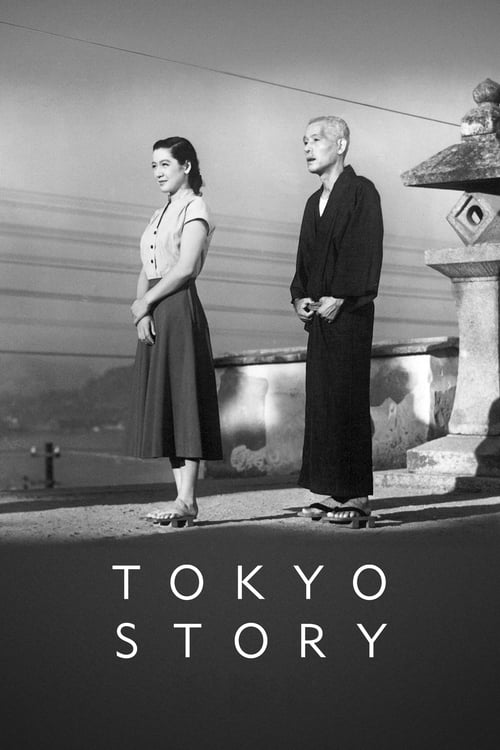
Tokyo Story (1953)
Directed by Yasujirō Ozu
No · Ultra Based
How we score movies →Consciousness Markers
The film features an all-Japanese cast reflecting its Tokyo setting, but this is geographic authenticity rather than progressive representation. No deliberate effort toward diverse casting is evident.
Female characters exist in traditional, subordinate roles with no critical examination. Noriko's dependence and Shige's limited agency reflect post-war constraints but are never interrogated as unjust.
The film contains mild social critique of urban capitalism's corrosive effects on family bonds, but this is a humanistic observation rather than explicit anti-capitalist messaging.
Ozu's filmmaking is characterized by restraint and subtlety. While the film contains implicit critique of modernity's effects, it never descends into preachy preaching or explicit moral instruction.
No LGBTQ+ themes, characters, or subtext appear in the film. The narrative is entirely centered on heteronormative family structures.
The film contains no racial consciousness or commentary. It is set entirely in Japan with an entirely Japanese cast, making racial themes irrelevant to its narrative.
Climate change or environmental consciousness plays no role in the film whatsoever. The film's concerns are entirely personal and familial.
Body positivity or discussions of physical appearance are entirely absent. The film treats bodies as neutral vessels for emotional experience.
No neurodivergent characters or themes appear in the film. Neurodiversity is not a concern of the narrative.
The film does not attempt to revise or reinterpret historical events. It accepts post-war Japanese society as given without revisionist commentary.


Synopsis
The elderly Shukishi and his wife, Tomi, take the long journey from their small seaside village to visit their adult children in Tokyo. Their elder son, Koichi, a doctor, and their daughter, Shige, a hairdresser, don't have much time to spend with their aged parents, and so it falls to Noriko, the widow of their younger son who was killed in the war, to keep her in-laws company.
Why it received this score
Tokyo Story is Yasujirō Ozu's quietly devastating meditation on aging, family obligation, and the erosion of tradition in post-war Japan. The film follows elderly parents visiting their adult children in Tokyo, where the gulf between generations and urban modernity becomes painfully apparent. The narrative centers significantly on Noriko, the widow of the couple's younger son killed in World War II, who becomes their primary companion and emotional anchor.
From a contemporary progressive perspective, this film presents a study in historical absence. It predates the cultural markers we associate with modern social consciousness by roughly 70 years. The film depicts women in decidedly traditional roles, constrained by post-war Japanese social structures. There is no conscious interrogation of these constraints. The film's genius lies in its humanistic observation, not in its social awareness. Noriko's widow status and dependence on her in-laws reflects historical reality, but the film does not wrestle with the injustice of her position. The cast is entirely Japanese, reflecting the film's setting, but this is geographic authenticity rather than progressive casting consideration.
This is a film of immense artistic and philosophical importance that scores remarkably low on contemporary progressive markers. It is precisely the kind of masterpiece that demonstrates the distinction between moral seriousness and cultural progressivism. We should appreciate it for what it is: a profound work of cinema that belongs to its time, unburdened by the need to perform social consciousness. Its power derives from its meditation on mortality and duty, not from alignment with contemporary frameworks.
Analysis generated by our Consciousness Algorithm
Critic Reviews
“Hardly anything actually happens, and yet it's one of the most emotionally involving dramas ever made.”
“Tokyo Story moves quite slowly by our Western standards, and requires more patience at first than some moviegoers may be willing to supply. Its effect is cumulative, however; the pace comes to seem perfectly suited to the material. ”
“[Hara's] sad dignity and emotional generosity are compelling.”
“Tokyo Story is a work of considerable restraint. And all the more affecting for it.”