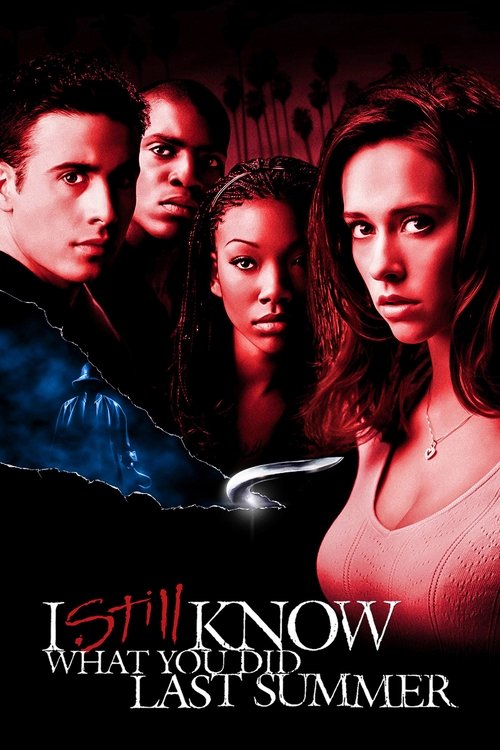
I Still Know What You Did Last Summer (1998)
Directed by Danny Cannon
No — I Still Know What You Did Last Summer is not woke, scoring 11 out of 100 on our wokeness meter.
The second installment in a franchise about a fisherman with a hook and a long memory arrives with the modest ambition of repeating the first film in a warmer climate.
Consciousness Markers
Features a notably diverse cast for a 1998 slasher, including Brandy, Mekhi Phifer, Bill Cobbs, and Jennifer Esposito in supporting roles, though the leads remain white and the film makes no comment on this casting.
No LGBTQ+ characters, themes, or subtext.
Features a female protagonist and final girl, but no feminist agenda or commentary; the film operates within standard slasher tropes.
No exploration of racial issues or consciousness; minority characters exist without comment.
No climate or environmental themes.
No anti-capitalist or eat-the-rich messaging.
No body positivity themes.
No neurodivergence themes.
No revisionist history elements.
No preachy or lecture-like energy; it is a straightforward slasher sequel.
Why it received this score
The second installment in a franchise about a fisherman with a hook and a long memory arrives with the modest ambition of repeating the first film in a warmer climate. Julie James, still haunted, wins a radio contest she did not enter and is promptly shipped to a Bahamian resort where the staff are murdered in ascending order of usefulness. The storm that strands the guests is a plot device, not a warning about anything. The film has no interest in the weather beyond its capacity to close a dock, and no interest in the island beyond its capacity to supply a body count.
What distinguishes the production, mildly, is its ensemble. Brandy plays Karla with a comic timing the script does not deserve, Mekhi Phifer gives Tyrell a warmth that survives the dialogue, and Bill Cobbs and Jennifer Esposito round out a cast noticeably more varied than the 1998 slasher average. None of this is remarked upon by anyone on screen. The film casts these performers and then kills them on schedule, which is a kind of equality, of the bleakest sort. The gesture is real and the commentary is absent, and the movie seems content to leave it there.
Elsewhere the ledger is blank. The resort's labor hierarchy goes unexamined. A voodoo subplot is deployed as set dressing with no curiosity about where it came from. The romance is heterosexual and contractual. No character pauses mid-chase to correct a historical record, interrogate a power structure, or reflect on the body. The film's only sermon is delivered by a hook, and it is brief. Critics handed it ten percent on Rotten Tomatoes while audiences handed it eighty-four million dollars worldwide. It wanted a scream from us. It got one, and then it went back to the water.
Analysis generated by our Consciousness Algorithm


Synopsis
Ever since killing the Fisherman one year ago, Julie James is still haunted by images of him after her. When her best friend Karla wins free tickets to the Bahamas, Julie finds this a perfect opportunity to finally relax. But someone is waiting for her. Someone who she thought was dead. Someone who is out again for revenge.
Questions about I Still Know What You Did Last Summer
Is I Still Know What You Did Last Summer woke?
No — I Still Know What You Did Last Summer is not woke, scoring 11 out of 100 on our wokeness meter. That earns it a verdict of Ultra Based.
Does I Still Know What You Did Last Summer have any woke elements?
Very few. None of the 10 markers reaches 30, the level where a marker counts as present; the highest is Representation Casting at 25.
How does I Still Know What You Did Last Summer compare to other 1998 movies?
It ranks #43 of the 118 films from 1998 we've scored; their average is 12. The wokest is Show Me Love (60).
Is I Still Know What You Did Last Summer the most woke I Know What You Did Last Summer movie?
No. It ranks #2 of the 3 I Know What You Did Last Summer films we've scored; the wokest is I Know What You Did Last Summer (17).