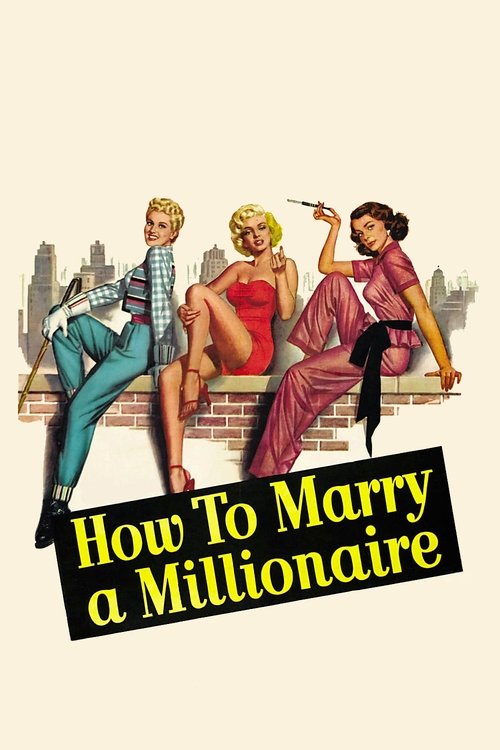
How to Marry a Millionaire (1953)
Directed by Jean Negulesco
No — How to Marry a Millionaire is not woke, scoring 0 out of 100 on our wokeness meter.
How to Marry a Millionaire arrives from 1953 with the confidence of a film that has never once been asked to justify itself.
Consciousness Markers
The cast is entirely white, led by three white female stars, with no meaningful racial or ethnic diversity in the ensemble.
There are no LGBTQ+ characters, themes, or subtext anywhere in the film's plot or characterization.
The premise is three women scheming to marry wealthy men for financial security, a setup that runs counter to any modern feminist agenda rather than advancing one.
The film engages no racial themes or commentary whatsoever; it is a light romantic comedy of Manhattan social climbing.
There is no environmental or climate content in the film.
Far from critiquing wealth, the film celebrates millionaires and treats landing a rich husband as the ultimate prize, ending on a $200 million windfall.
No body-positivity themes; the film trades on conventional glamour and the physical appeal of its stars.
Pola's near-sightedness is played purely as a slapstick comedic device, not as any exploration of neurodivergence or disability identity.
The film makes no historical claims and revises no historical record.
The film is a breezy, escapist comedy with no didactic messaging or moralizing of any kind.
Why it received this score
How to Marry a Millionaire arrives from 1953 with the confidence of a film that has never once been asked to justify itself. Three Manhattan models, played by Betty Grable, Marilyn Monroe, and Lauren Bacall, rent a Sutton Place penthouse and set about the business of landing rich husbands. The scheme is the plot. The scheme is the joke. Nobody in the frame pauses to interrogate the arrangement, and the film does not either. It is a romantic comedy built on the premise that financial security is the prize and marriage is the mechanism, and it plays that premise entirely straight for ninety-five minutes.
The cultural inventory here is remarkably bare. The cast is white, the concerns are white, and the film has no interest in saying anything about it. Pola's near-sightedness is a running gag about vanity, not a meditation on disability. Loco's romantic misadventures with a married businessman and a forest ranger are farce, not commentary. The ending, in which the women faint upon learning that the apparent pauper among their husbands commands a fortune near two hundred million dollars, is a punchline about money, delivered without a shred of embarrassment.
There is no sermon here, no lesson, no corrective to the social order. The film admires wealth, rewards the pursuit of it, and treats glamour as a virtue. A viewer arriving with a checklist of contemporary sensibilities will find every box empty, and will find the film cheerfully unconcerned about the emptiness. It is a light comedy from a different era, and it makes no apology for the era it belongs to. We can only record the finding and move on to the next bottle.
Analysis generated by our Consciousness Algorithm


Synopsis
Three women set out to find eligible millionaires to marry, but find true love in the process.
Questions about How to Marry a Millionaire
Is How to Marry a Millionaire woke?
No — How to Marry a Millionaire is not woke, scoring 0 out of 100 on our wokeness meter. That earns it a verdict of Ultra Based.
Does How to Marry a Millionaire have any woke elements?
No. All 10 markers score zero.
How does How to Marry a Millionaire compare to other 1953 movies?
It ranks #13 of the 16 films from 1953 we've scored; their average is 6. The wokest is The Wages of Fear (25).
How is the Woke Score calculated?
An AI-assisted process researches the film and its reception, scores it 0–100 on ten markers, then combines those into one 0–100 Woke Score. It measures a specific set of 2020s cultural themes, not film quality.