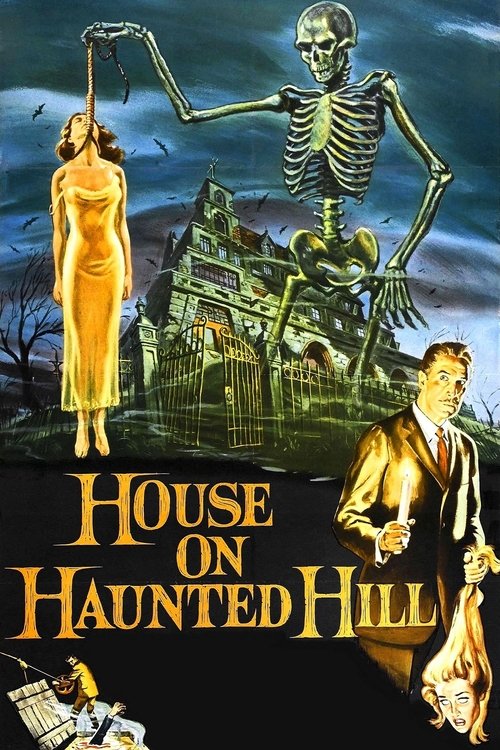
House on Haunted Hill (1959)
Directed by William Castle
No — House on Haunted Hill is not woke, scoring 0 out of 100 on our wokeness meter.
William Castle's House on Haunted Hill arrives from 1959 with a skeleton on a pulley and a reputation that has outlasted most of its contemporaries.
Consciousness Markers
The cast is entirely white, with no representation casting of any kind; the film predates such concerns by decades.
No LGBTQ+ characters, themes, or subtext appear anywhere in the film.
Carol Ohmart's Annabelle is a scheming femme fatale, not a vehicle for any feminist statement; the film has no gender-ideological agenda.
No engagement with race or racial consciousness whatsoever.
No environmental or climate themes are present.
The eccentric millionaire Loren is a genre archetype, not a critique of wealth or capitalism; the money is a plot device, not a polemic.
No body-positivity themes or messaging.
No neurodivergence themes; Dr. Trent is a scheming psychiatrist, not a depiction of neurodivergent experience.
The film is a straightforward haunted-house mystery with no historical revisionism.
A pure genre entertainment with no didactic or preachy messaging; the only thing it lectures the audience about is the price of a night's stay.
Why it received this score
William Castle's House on Haunted Hill arrives from 1959 with a skeleton on a pulley and a reputation that has outlasted most of its contemporaries. Vincent Price presides as Frederick Loren, a millionaire who rents a haunted house, hands out guns, and offers ten thousand dollars to anyone willing to endure the night. The doors lock at midnight. The windows are barred. The plot is a machine for scares, and it runs clean. There is no message tucked into the floorboards, no lesson smuggled in with the cobwebs.
The guests are a test pilot, a columnist, a psychiatrist, a nervous employee, and the house's twitchy owner. They scheme, they scream, they get locked in rooms. A vat of acid waits in the basement, as vats of acid do. Annabelle Loren conspires with her lover to murder her husband, and the husband conspires right back. Nobody pauses to deliver a sermon on the human condition. The film's only lecture concerns the price of a night's lodging and the wisdom of reading the fine print before accepting an eccentric stranger's hospitality.
Seen through the lens of contemporary cultural expectations, the cupboard is bare. The cast is uniformly white, the gender politics belong to the femme fatale tradition, and the wealthy villain is a genre fixture instead of an indictment of capital. Race, climate, body image, neurodivergence, and historical revisionism make no appearance. What remains is craftsmanship: gaslight, shadow, and a plastic skeleton sailing over the stalls. The picture wants nothing more than to frighten us for eighty minutes, and it succeeds. In an era that demands its entertainment carry a lesson, this one carries a corpse instead. We can respect the honesty of that arrangement, even if we cannot grade it on the modern rubric without finding the page entirely blank.
{"thematic_tags": []}
Analysis generated by our Consciousness Algorithm


Synopsis
Frederick Loren invites five strangers to the party of a lifetime and offers each of them $10,000 if they can stay the night in the reportedly haunted house. Armed with a gun for protection, each guest arrives in a hearse and will either leave in it much richer…Or dead.
Questions about House on Haunted Hill
Is House on Haunted Hill woke?
No — House on Haunted Hill is not woke, scoring 0 out of 100 on our wokeness meter. That earns it a verdict of Ultra Based.
Does House on Haunted Hill have any woke elements?
No. All 10 markers score zero.
How does House on Haunted Hill compare to other 1959 movies?
It ranks #11 of the 12 films from 1959 we've scored; their average is 6. The wokest is Hiroshima Mon Amour (23).
How is the Woke Score calculated?
An AI-assisted process researches the film and its reception, scores it 0–100 on ten markers, then combines those into one 0–100 Woke Score. It measures a specific set of 2020s cultural themes, not film quality.