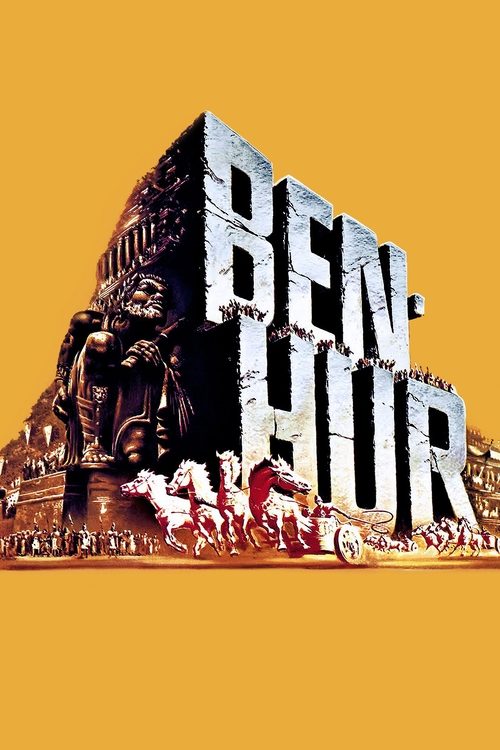
Ben-Hur (1959)
Directed by William Wyler
No · Ultra Based
How we score movies →Consciousness Markers
The film fictionalizes biblical and historical events, creating a romance between Ben-Hur and Messala that never existed. However, this is period-appropriate historical fiction rather than modern revisionism.
Cast reflects the historical setting but with whitewashed roles and limited diversity. Haya Harareet, an Israeli actress, plays Ben-Hur's sister, but most roles default to European and American actors in a Middle Eastern setting.
Female characters are passive and defined by their relationships to men. Martha Scott and Haya Harareet exist primarily as emotional anchors for the male protagonist's journey.
While depicting Jewish persecution under Roman rule, the film shows no critical awareness of racial or ethnic dynamics. It treats oppression as personal misfortune rather than systemic injustice.
No LGBTQ themes or representation present. The film contains no acknowledgment of sexual identity or orientation.
No environmental or climate themes present in this historical drama set in ancient times.
No critique of capitalism or economic systems. The narrative focuses on personal honor and revenge rather than economic or class analysis.
No body positivity messaging or representation of diverse body types. The film celebrates classical physical idealization typical of 1950s cinema.
No representation of neurodivergent characters or acknowledgment of mental health, disability, or neurological difference.
The film does not lecture the audience about contemporary social issues. It operates as straightforward historical spectacle without preachy messaging about modern concerns.


Synopsis
In 26 AD, Judah Ben-Hur, a Jew in ancient Judea, opposes the occupying Roman empire. Falsely accused by a Roman childhood friend-turned-overlord of trying to kill the Roman governor, he is put into slavery and his mother and sister are taken away as prisoners.
Why it received this score
Ben-Hur presents itself as a historical epic about religious persecution and oppression, yet it operates entirely within the sensibilities of 1959 cinema. William Wyler's sprawling spectacle concerns itself with the personal vengeance narrative of Judah Ben-Hur against his childhood friend Messala, the Roman oppressor. The film treats the occupation of Judea as a vehicle for sword-and-sandal melodrama rather than any sustained examination of imperialism or resistance. Charlton Heston's performance, while commanding, carries none of the political consciousness that a modern reading of such material might demand.
The picture's relationship to slavery is particularly instructive in its absence of any moral framework. Ben-Hur's years laboring in the galleys of a Roman warship occur off-screen, mentioned only as plot device rather than explored as human suffering. The film's climactic chariot race, the sequence for which it is remembered, functions as pure spectacle divorced from any thematic weight. One notes that the film's treatment of the crucifixion of Christ, which bookends the narrative, remains entirely reverential and uncritical, serving primarily to redeem Ben-Hur's soul through religious conversion.
In terms of social consciousness, Ben-Hur is a period piece that reflects the values of its era without questioning them. The female characters exist in supporting roles defined by their relationships to male leads. No interrogation of gender roles, racial dynamics, or systemic injustice emerges from the narrative. The film is historically significant as a technical and commercial achievement, but it carries no markers of the progressive sensibilities that would later become culturally coded as contemporary consciousness. It is a film about righteous individual triumph against personal enemies, not a film concerned with structures of power or liberation.
Analysis generated by our Consciousness Algorithm
Critic Reviews
“I’m not qualified to say whether it’s an effective delivery system for its Christian message, but I think I can credibly pronounce it a good popcorn movie. ”
“The Wyler film’s rousing chariot sequence—filmed separately and at lavish expense by Andrew Marton and Yakima Canutt, one of the greatest stuntmen who ever lived — is hard to beat. But Bekmambetov acquits himself nicely, offering up a loud and vicious circular chase, with point-of-view shots of people getting hit by chariots as armored Romans scamper around like rodeo clowns.”
“In spite of its various imperfections, Ben-Hur always manages to entertain, proving the timelessness of epic structure and scale. And even if nothing about the movie particularly stands out on its own, when all the pieces come together, one cannot help but feel immersed in the world and ideals presented.”
“There’s a fatally miscast lead (Jack Huston, you are no Charlton Heston), cut-rate special effects, reams of eyeball-glazing dialogue, and a schmaltzy “inspirational” script that pointlessly alters the story in ways that make absolutely no sense.”