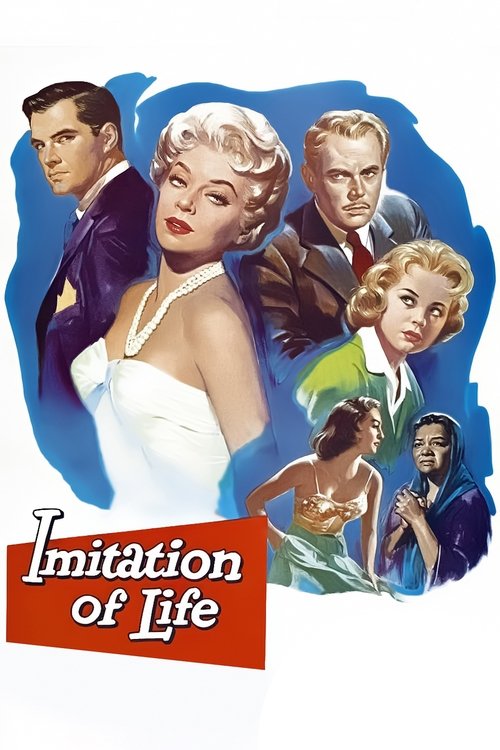
Imitation of Life (1959)
Directed by Douglas Sirk
No · Based
How we score movies →Consciousness Markers
The film engages with racial passing and identity, treating these subjects seriously within its narrative. However, the treatment is more sympathetic melodrama than systemic critique, and the casting choices undermine the progressive intent.
The film features significant Black characters, including Juanita Moore in a lead role that earned her an Oscar nomination. However, the casting of white actress Susan Kohner as the mixed-race daughter reflects 1950s limitations and undermines authentic representation.
While Sirk's work is known for embedded social critique, this film prioritizes melodramatic spectacle over explicit social messaging. Any commentary emerges through subtext rather than direct address.
The film centers on women and their ambitions, but operates within deeply traditional frameworks of motherhood and sacrifice rather than feminist critique. Female agency is subordinated to emotional melodrama.
While the film depicts class differences and economic struggle, there is no anti-capitalist critique or systemic challenge to economic hierarchies. The narrative accepts capitalist structures as given.
No LGBTQ+ themes or characters are present in the film.
No climate-related themes or messaging are present in the film.
Body positivity as a contemporary marker is not relevant to this 1950s melodrama.
No representation of or engagement with neurodivergence is present in the film.
The film does not attempt to revise historical narratives or offer alternative interpretations of historical events.


Synopsis
In 1940s New York, a white widow who dreams of being on Broadway has a chance encounter with a black single mother, who becomes her maid.
Why it received this score
Douglas Sirk's "Imitation of Life" is a curious artifact for contemporary scoring, arriving as it does from a cinema era when the entire apparatus of representation operated under different assumptions. The film addresses racial passing and identity with a seriousness that distinguishes it from its contemporaries, and Juanita Moore's performance earned genuine critical recognition. Yet the film's engagement with these themes remains embedded in melodramatic convention rather than social consciousness as we now understand it. The casting of white actress Susan Kohner as the mixed-race daughter seeking to pass as white, while not uncommon for 1959, reveals the hollowness at the film's center. Sirk's characteristic visual subversion, the way his compositions critique American society from within glossy, color-saturated surfaces, operates on a level of irony rather than explicit advocacy. One admires the film's ambitions while recognizing its compromises.
The film's low overall score reflects not moral judgment but historical reality. It engages with racial identity in ways that were genuinely unusual for mainstream Hollywood in 1959, yet it lacks the self-conscious progressive architecture that defines contemporary cultural consciousness. There is no explicit interrogation of systems, no celebration of marginalized identity for its own sake, no lecture directed at the audience about moral failings. The tragedy of the film's narrative structure, in which the daughter's attempt at racial passing destroys her mother, carries emotional weight but not ideological clarity. Sirk allows this ambiguity to persist, which may be his greatest strength as a filmmaker and also precisely what disqualifies the work from high contemporary scoring.
"Imitation of Life" occupies an interesting position in film history, one where serious engagement with social material does not necessarily correlate with modern progressive sensibilities. It remains a film worth watching for its visual sophistication and its willingness to complicate matters that Hollywood typically simplified. But it is not a film animated by the particular constellation of 2020s cultural markers that define contemporary consciousness. It is, instead, a very fine melodrama from another era, one that happened to stumble toward some of the questions we now ask systematically.
Analysis generated by our Consciousness Algorithm
Critic Reviews
“The film isn’t only revolutionary for its aesthetic rigorousness but its rare fascination with white America’s difficulty relating to people of color. ”
“If Sirk exploits the material for all it's worth and seems to be sardonically allowing the artifical genre to devour itself as he sits back and watches, at the same time the weepie aspect is so melodramatic as to tear the sobs from your throat.”
“Laugh if you want at Imitation of Life or any of Sirk’s primal cinematic operas. Although if you can laugh at the film’s end, when Mahalia Jackson herself sings “Trouble of the World,” I can’t help you. Just understand that when you laugh, you’re really laughing at yourself, and you’re laughing to keep from crying.”
“This modernized remake of Miss Hurst's frankly lachrymose tale is much the same as its soggy predecessor. It is the most shameless tear-jerker in a couple of years.”