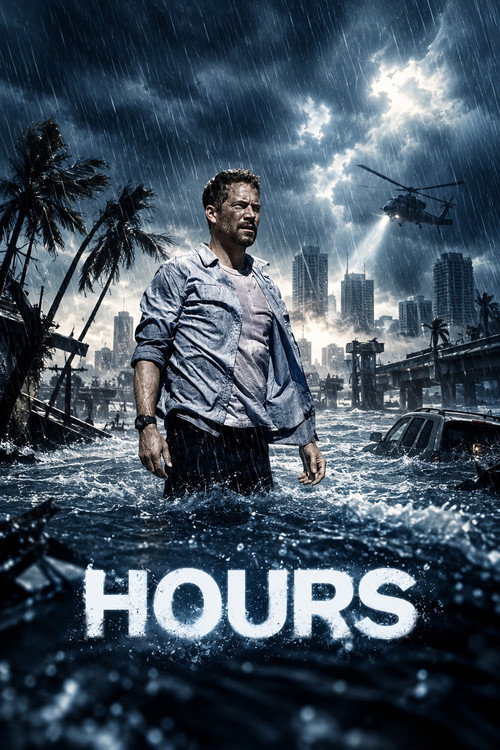
Hours (2013)
Directed by Eric Heisserer
No — Hours is not woke, scoring 4 out of 100 on our wokeness meter.
Hours arrives with a premise so lean it could be assembled from a hardware store receipt: a father, a newborn on a ventilator, a hand-cranked generator that must be turned every three minutes, and Hurricane Katrina doing what hurricanes do outside the window.
Consciousness Markers
The cast is led by Paul Walker with a predominantly white supporting ensemble; a few minority actors appear in minor roles without any framing around representation.
Hurricane Katrina carries an obvious racial subtext in reality, but the film deliberately avoids engaging with the racial politics of the disaster, focusing solely on one father's ordeal.
No LGBTQ+ characters, themes, or subtext appear anywhere in the film.
The film is a father-and-infant survival thriller; the mother dies in the opening act and no feminist themes are engaged.
The hurricane functions purely as a survival-thriller backdrop; there is no climate messaging or environmental advocacy.
Looters appear as antagonists, but the film offers no critique of capitalism or wealth inequality.
No body-positivity themes or messaging are present.
No neurodivergent characters or themes are depicted.
The film is a fictional survival story set against a real event and makes no historical revisionist claims.
The film is a tense, largely dialogue-light survival thriller with no preachy or didactic messaging.
Why it received this score
Hours arrives with a premise so lean it could be assembled from a hardware store receipt: a father, a newborn on a ventilator, a hand-cranked generator that must be turned every three minutes, and Hurricane Katrina doing what hurricanes do outside the window. Eric Heisserer directs with a plumber's patience, and Paul Walker, in one of his final roles, spends most of the running time sweating, bleeding, and counting. The film is tense, quiet, and uninterested in saying anything larger than itself. This is not a criticism. It is a description of a rare specimen.
For the purposes of classification, the restraint is total. Katrina carries an obvious and well-documented racial dimension, and the film walks past it without a glance, treating the flood as weather and the city as an empty stage. Looters serve as antagonists, but the screenplay mounts no argument about who was left behind or why, and no critique of the systems that failed them. The mother dies in the first act, mostly to clear the room. The cast is led by Walker and filled out by white performers, with a handful of minority actors in unremarked supporting parts. Nothing here is framed as a statement, because nothing here is framed at all.
There is a rescue dog. There is a vending machine. There is a man shooting at a helicopter, and later a man shot, and a nurse who does not survive her errand. Absent entirely: any lecture, any sermon, any moment where the film pauses to instruct us on how to feel about the preceding ninety minutes. In an era when even the disaster picture has learned to sermonize, this one simply runs out of battery. We are left with a modest, competent thriller and very little to file under social consciousness. The sommelier swirls the glass, finds a plain and honest vintage, and reaches for the next bottle.
Analysis generated by our Consciousness Algorithm


Synopsis
A father struggles to keep his infant daughter alive in the wake of Hurricane Katrina.
Questions about Hours
Is Hours woke?
No — Hours is not woke, scoring 4 out of 100 on our wokeness meter. That earns it a verdict of Ultra Based.
Does Hours have any woke elements?
Very few. None of the 10 markers reaches 30, the level where a marker counts as present; the highest is Representation Casting at 10.
How does Hours compare to other 2013 movies?
It ranks #210 of the 274 films from 2013 we've scored; their average is 14. The wokest is Belle (76).
How is the Woke Score calculated?
An AI-assisted process researches the film and its reception, scores it 0–100 on ten markers, then combines those into one 0–100 Woke Score. It measures a specific set of 2020s cultural themes, not film quality.