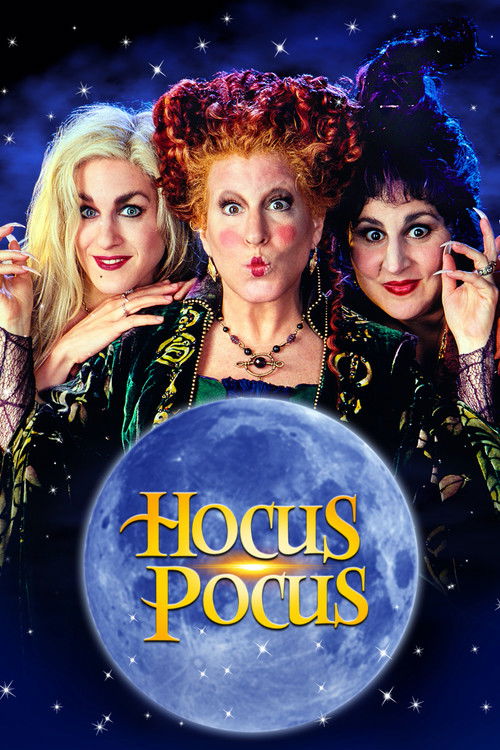
Hocus Pocus (1993)
Directed by Kenny Ortega
No — Hocus Pocus is not woke, scoring 0 out of 100 on our wokeness meter.
Hocus Pocus arrived in July of 1993, a scheduling decision that asked audiences to contemplate Halloween while sweating through a summer matinee.
Consciousness Markers
The cast is overwhelmingly white and the film makes no effort toward modern inclusive casting or commentary on representation.
There are no LGBTQ+ characters, themes, or subtext in the film.
The Sanderson sisters are female antagonists, but the film offers no feminist critique or agenda; they are comedic villains.
Race is not a theme, and the film contains no racial consciousness or commentary.
There is no environmental or climate-related message in the film.
The film does not critique capitalism, wealth inequality, or class structures.
Body image and body positivity are not addressed in the film.
There is no depiction or discussion of neurodivergence.
The Salem witch trials serve only as a fictional backdrop; the film does not revise or reinterpret history for modern ideological purposes.
The film is a light Halloween comedy and contains no preachy or lecture-like messaging.
Why it received this score
Hocus Pocus arrived in July of 1993, a scheduling decision that asked audiences to contemplate Halloween while sweating through a summer matinee. Kenny Ortega directed. Bette Midler, Sarah Jessica Parker, and Kathy Najimy played three witches hanged in 1693 Salem who return when a teenager lights a candle. Critics were unmoved. Roger Ebert gave it a single star and complained of shrieking. Disney lost money. Then, across decades of October cable airings, the film became a fixture, a cult object, and eventually a franchise. The ledger of commerce has a strange sense of humor.
For classification purposes, the film registers nothing on any of the modern markers. The Sanderson sisters are female antagonists, but they are vaudeville grotesques, not vehicles for a feminist argument. The cast is white and the film offers no comment on that fact. Race, class, climate, body image, and neurodivergence go unmentioned, because the screenplay has other business: jokes about virgins, a talking cat, and Bette Midler performing I Put a Spell on You to an enchanted crowd. Salem's witch trials serve as set dressing, a spooky backdrop, not a revisionist thesis. No sermon is delivered. No lesson is pressed upon the audience about how to live.
That absence is the film's entire personality. It is a confection, a bag of candy corn in cinematic form, and it makes no claim to improve anyone. Whether that reads as refreshing or as a void depends on the viewer's appetite. The sequel arrived three decades later, presumably with a few more notes to hit. This one simply wanted to be watched in October, and it got its wish.
Analysis generated by our Consciousness Algorithm
Part of


Synopsis
After 300 years of slumber, three sister witches are accidentally resurrected in Salem on Halloween night, and it is up to three kids and their newfound feline friend to put an end to the witches' reign of terror once and for all.
Questions about Hocus Pocus
Is Hocus Pocus woke?
No — Hocus Pocus is not woke, scoring 0 out of 100 on our wokeness meter. That earns it a verdict of Ultra Based.
Does Hocus Pocus have any woke elements?
No. All 10 markers score zero.
How does Hocus Pocus compare to other 1993 movies?
It ranks #76 of the 97 films from 1993 we've scored; their average is 11. The wokest is Bound by Honor (60).
How is the Woke Score calculated?
An AI-assisted process researches the film and its reception, scores it 0–100 on ten markers, then combines those into one 0–100 Woke Score. It measures a specific set of 2020s cultural themes, not film quality.