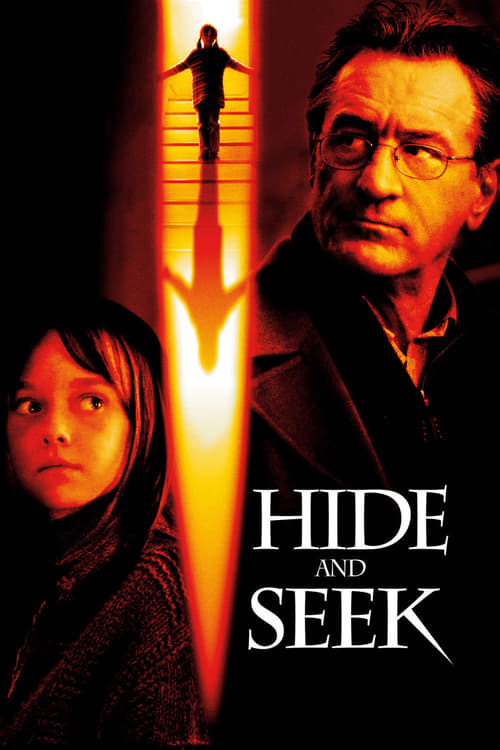
Hide and Seek (2005)
Directed by John Polson
No — Hide and Seek is not woke, scoring 0 out of 100 on our wokeness meter.
Hide and Seek arrives from 2005, a year when a psychological thriller could still be built on a dead cat in a bathtub and a child who speaks for an imaginary friend named Charlie.
Consciousness Markers
The cast is overwhelmingly white and contains no deliberate, commented-upon diversity casting.
There are no LGBTQ+ characters, themes, or subtext in the film.
Female characters exist, but the film does not advance a feminist agenda or critique patriarchal structures.
Race is not a thematic concern, and the film contains no racial consciousness or commentary.
There is no environmental or climate-related messaging in the film.
The film does not critique capitalism, wealth inequality, or class structures.
There is no body-positivity theme or challenge to conventional beauty standards.
Dissociative identity disorder is used as a horror twist and villain mechanism, not as affirmative neurodivergence representation.
The film is a fictional psychological thriller and does not revise or reinterpret historical events.
The film aims to thrill and unsettle rather than deliver progressive social or political lectures.
Why it received this score
Hide and Seek arrives from 2005, a year when a psychological thriller could still be built on a dead cat in a bathtub and a child who speaks for an imaginary friend named Charlie. Robert De Niro plays a grieving psychologist who moves his daughter Emily, played by Dakota Fanning with unnerving composure, to a house upstate. The house has a closet. The closet has secrets. The secrets have a body count. Director John Polson keeps the machinery running, though the machinery is mostly a door creaking and Fanning staring at nothing.
The film's cultural ledger is remarkably blank. The cast is white, the villain is psychological, and no character pauses to explain the social order. Dissociative identity disorder appears here as a plot device and a final scare, a twist to be revealed in the last reel, not a condition to be understood or affirmed. The daughter's two-headed drawing closes the film on a note of dread, which is where the film wants to leave us. Nobody learns anything. Nobody grows.
There is no lecture, no sermon, no moment where a character turns to the camera to instruct us on how to live. The film concerns itself with grief, rage, and the inconvenience of an imaginary friend who kills the neighbors. That is its entire ambition. The result is a thriller that critics found derivative and audiences found tolerable, and which now sits quietly in the catalogue, offending no one and instructing no one. On the scale of modern social consciousness it reads as an artifact from another era, preserved in amber, harmless, mostly forgotten. The sommelier swirls the glass, finds nothing, and moves on to the next bottle.
In the end, the film is a period piece without knowing it, a relic of a moment when a horror movie could simply try to scare people and be judged on whether it succeeded. It did not succeed especially well. But it did not lecture, and for that, the ledger stays clean.
{"thematic_tags": ["box_office_number_one"]}
Analysis generated by our Consciousness Algorithm


Synopsis
David Callaway tries to piece together his life in the wake of his wife's suicide and has been left to raise his nine-year-old daughter, Emily on his own. David is at first amused to discover that Emily has created an imaginary friend named 'Charlie', but it isn't long before 'Charlie' develops a sinister and violent side, and as David struggles with his daughter's growing emotional problems, he comes to the frightening realisation that 'Charlie' isn't just a figment of Emily's imagination.
Questions about Hide and Seek
Is Hide and Seek woke?
No — Hide and Seek is not woke, scoring 0 out of 100 on our wokeness meter. That earns it a verdict of Ultra Based.
Does Hide and Seek have any woke elements?
No. All 10 markers score zero.
How does Hide and Seek compare to other 2005 movies?
It ranks #160 of the 181 films from 2005 we've scored; their average is 13. The wokest is The Constant Gardener (72).
How is the Woke Score calculated?
An AI-assisted process researches the film and its reception, scores it 0–100 on ten markers, then combines those into one 0–100 Woke Score. It measures a specific set of 2020s cultural themes, not film quality.