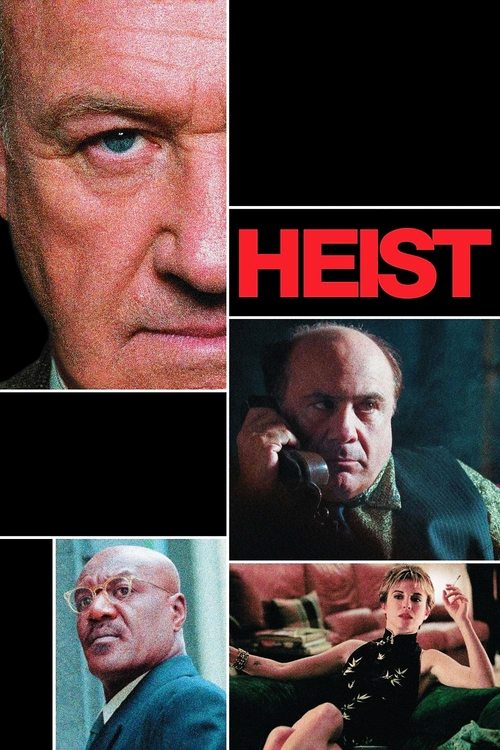
Heist (2001)
Directed by David Mamet
No — Heist is not woke, scoring 7 out of 100 on our wokeness meter.
David Mamet's Heist arrives in 2001 with a crew of professionals, a double cross, and a sailboat, and it asks nothing of us beyond attention to the con.
Consciousness Markers
Delroy Lindo appears as a lead crew member and Patti LuPone in support, but their presence is unremarked and incidental to a genre exercise; no deliberate diversity casting agenda is evident.
Rebecca Pidgeon's Fran is a classic femme fatale whose arc is defined by her betrayal of and loyalty to the men around her; the film offers no feminist critique or agency-driven framing.
The thieves resent their fence's greed, but this is standard genre friction between criminals, not a systemic critique of capitalism or wealth.
Mamet's trademark stylized dialogue is present, but it is craft and banter rather than any preachy or didactic messaging.
No LGBTQ+ characters, themes, or subtext appear anywhere in the film.
Race is never addressed or thematized; the multiracial cast exists without any commentary on racial dynamics.
No environmental or climate themes are present in this crime caper.
No body-positivity themes or messaging appear in the film.
No neurodivergent characters or themes are depicted or referenced.
The film is a contemporary fictional crime story with no historical subject matter to revise.
Why it received this score
David Mamet's Heist arrives in 2001 with a crew of professionals, a double cross, and a sailboat, and it asks nothing of us beyond attention to the con. Gene Hackman's Joe Moore wants to retire. Danny DeVito's fence wants one more job. The gold is on a plane, the loyalties are on the table, and everyone lies to everyone else in that clipped, overlapping patter Mamet has been refining for two decades. It is a machine built for pleasure, and it works. The film has no interest in instructing anyone about anything, which in retrospect reads as a small mercy.
On the matter of social consciousness, the ledger is thin. Delroy Lindo and Patti LuPone occupy the frame with authority, but their presence is never framed as a statement, and nobody pauses the heist to discuss it. Rebecca Pidgeon's Fran is a femme fatale in the classical mode, defined by whom she betrays and whom she follows, and the screenplay offers no counter-reading of her. Race is not a subject here. Neither is the climate, the body, the mind, nor the historical record. The thieves grumble about their fence's cut, which is the oldest grievance in the genre and not a thesis about capital.
What remains is craft. Mamet's dialogue is a set of verbal locks being picked in real time, and the pleasure is watching the tumblers fall. There is no sermon in it, no moment where a character turns to the camera of the soul and explains what we ought to feel. The film is amoral in the way a good caper should be, and it ends with a man smiling under a tarp full of gold. Some films want to change the world. This one wants to steal from it, efficiently, and leave before the police arrive. It succeeds on its own modest terms and asks for no medals.
{"thematic_tags": []}
Analysis generated by our Consciousness Algorithm


Synopsis
Joe Moore has a job he loves. He's a thief. His job goes sour when he gets caught on security camera tape. His fence, Bergman, reneges on the money he's owed, and his wife may be betraying him with the fence's young lieutenant. Moore and his partner, Bobby Blane, and their utility man, Pinky Pincus, find themselves broke, betrayed, and blackmailed. Moore is forced to commit his crew to do one last big job.
Questions about Heist
Is Heist woke?
No — Heist is not woke, scoring 7 out of 100 on our wokeness meter. That earns it a verdict of Ultra Based.
Does Heist have any woke elements?
Very few. None of the 10 markers reaches 30, the level where a marker counts as present; the highest is Representation Casting at 15.
How does Heist compare to other 2001 movies?
It ranks #85 of the 148 films from 2001 we've scored; their average is 12. The wokest is Monster's Ball (60).
How is the Woke Score calculated?
An AI-assisted process researches the film and its reception, scores it 0–100 on ten markers, then combines those into one 0–100 Woke Score. It measures a specific set of 2020s cultural themes, not film quality.