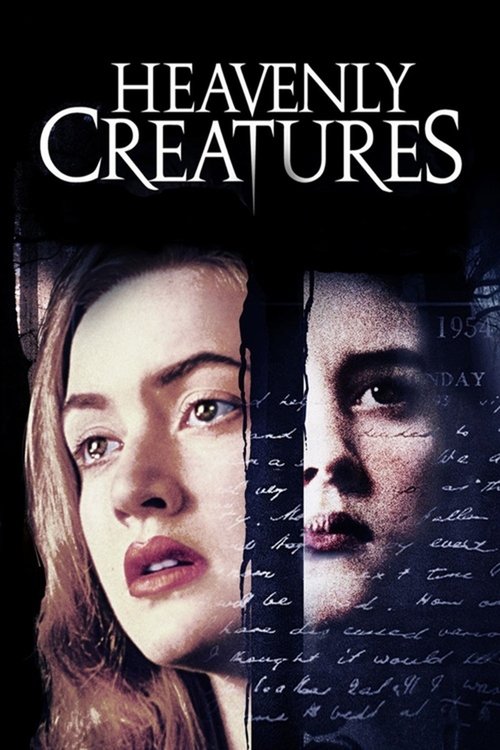
Heavenly Creatures (1994)
Directed by Peter Jackson
No — Heavenly Creatures is not especially woke, scoring 22 out of 100 on our wokeness meter.
Peter Jackson, some years before he became the custodian of Middle-earth, made a small, humid, extraordinary film about two teenage girls in 1954 Christchurch who loved each other with a ferocity their society could only diagnose as illness.
Consciousness Markers
Jackson and Walsh explicitly set out to revise the sensationalized 1950s narrative that branded the girls as simply evil, offering a humane reinterpretation of the historical case. This is a deliberate revision of the received historical account.
The central relationship is an intense, obsessive same-sex bond between two teenage girls, and the era's suspicion of Pauline's homosexuality is an explicit plot point. However, it is framed as pathology and tragedy rather than as affirming queer identity.
The film centers two young women with agency, inner lives, and rebellion against the era's patriarchal authority figures (mothers, fathers, doctors). It is a character study rather than a feminist polemic, so the agenda is present but muted.
The film is a moody, immersive character study that shows rather than tells, with no didactic speeches or moralizing about its themes.
The cast is entirely white New Zealand and British performers, cast for resemblance to the real figures rather than any representational agenda. No deliberate diversity casting is present.
There are no racial themes or non-white characters of consequence; the story is entirely about white 1950s New Zealand society.
No environmental or climate themes appear anywhere in the film.
No critique of capitalism, class economics, or wealth structures is present; the class contrast between the girls' families is incidental to the drama.
Pauline's weight loss is mentioned as a symptom of distress, but the film makes no body-positivity argument or commentary on body image.
The girls' imaginative intensity and social alienation are portrayed as psychological and emotional, not framed through any modern neurodivergence lens.
Why it received this score
Peter Jackson, some years before he became the custodian of Middle-earth, made a small, humid, extraordinary film about two teenage girls in 1954 Christchurch who loved each other with a ferocity their society could only diagnose as illness. Heavenly Creatures takes the Parker-Hulme murder and declines to make a spectacle of it. The friendship comes first. The brick in the stocking arrives late, and by then we understand the world it grew from. That is a choice, and a deliberate one.
On the matter of social consciousness, the film is a curious specimen. The bond between Pauline and Juliet is intimate and consuming, and the era's clinical suspicion of Pauline's homosexuality is written into the plot as a symptom to be cured, which earns a measure of queer relevance while offering no affirmation whatsoever. The two girls bristle against mothers, fathers, and doctors with real agency and interiority, though the film is a character study and never a manifesto. Jackson and Walsh did set out to revise the record, swapping the tabloid branding of two girls as pure evil for something recognizably human. That revisionism is the film's spine.
The rest of the ledger is quiet. There are no racial themes, no environmental sermon, no indictment of capital, no commentary on body image, and no modern vocabulary for the mind. The girls' imaginative intensity is treated as grief and obsession, not diagnosis. Heavenly Creatures prefers to show, and it shows with unnerving beauty. A lesser film would have explained them. This one lets the garden grow, and then lets it close. It is a sommelier's pour of a film: dark, precise, and served without a single note of instruction on the label.
{"thematic_tags": ["true_story"]}
Analysis generated by our Consciousness Algorithm
Synopsis
Precocious teenager Juliet moves to New Zealand with her family and soon befriends the quiet, brooding Pauline through their shared love of fantasy and literature. This friendship gradually develops into an intense and obsessive bond.
Questions about Heavenly Creatures
Is Heavenly Creatures woke?
No — Heavenly Creatures is not especially woke, scoring 22 out of 100 on our wokeness meter. That earns it a verdict of Based.
Does Heavenly Creatures have any woke elements?
2 of the 10 markers register at 30 or above, led by Revisionist History (35) and LGBTQ+ Themes (30). On Revisionist History: Jackson and Walsh explicitly set out to revise the sensationalized 1950s narrative that branded the girls as simply evil, offering a humane reinterpretation of the historical case.
How does Heavenly Creatures compare to other 1994 movies?
It ranks #10 of the 86 films from 1994 we've scored; their average is 10. The wokest is On Deadly Ground (75).
How is the Woke Score calculated?
An AI-assisted process researches the film and its reception, scores it 0–100 on ten markers, then combines those into one 0–100 Woke Score. It measures a specific set of 2020s cultural themes, not film quality.