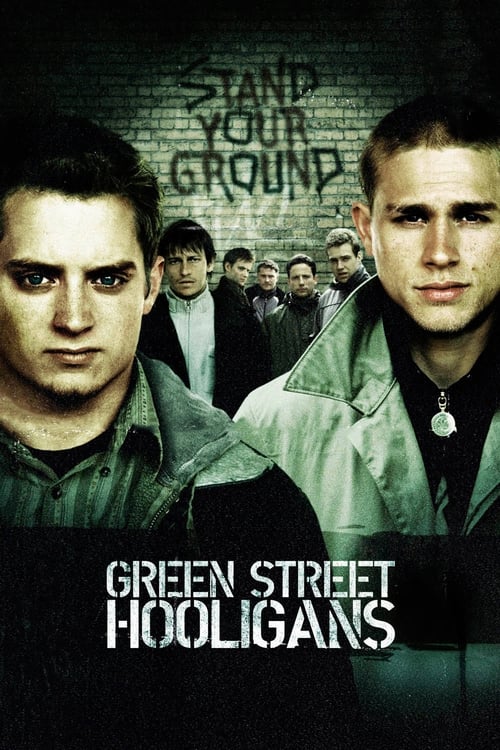
Green Street Hooligans (2005)
Directed by Lexi Alexander
No — Green Street Hooligans is not woke, scoring 6 out of 100 on our wokeness meter.
Green Street Hooligans arrives from 2005, directed by Lexi Alexander, and concerns an expelled Harvard student named Matt Buckner who flees to London and falls in with the Green Street Elite, a West Ham football firm.
Consciousness Markers
A minor subplot criticizes a wealthy Harvard family buying silence and privilege, but the film is not structured around anti-capitalist or eat-the-rich messaging.
The cast is almost entirely white British and American actors, with no deliberate or commented-upon diversity casting.
There are no LGBTQ+ characters, relationships, or themes in the film.
Although directed by a woman, the film is centered on hypermasculine football hooligan violence and offers no feminist critique or agenda.
The film does not engage with race, racial identity, or racial justice themes.
There is no environmental or climate-related content.
The film does not feature body-positivity themes; its physical ideal is tied to toughness and violence.
No neurodivergent characters or neurodivergence themes are present.
The film is a fictional crime drama about football hooliganism and does not revise or reinterpret historical events.
The film depicts violence and loyalty dramatically rather than delivering modern progressive moral lectures to the audience.
Why it received this score
Green Street Hooligans arrives from 2005, directed by Lexi Alexander, and concerns an expelled Harvard student named Matt Buckner who flees to London and falls in with the Green Street Elite, a West Ham football firm. The film offers loyalty, pints, broken glass, and a great deal of punching. That a woman directed it is a matter of biographical interest. It contributes nothing to the ledger of feminist cinema. The camera loves the brotherhood of the firm exactly as much as the firm loves itself, and the violence is staged as spectacle, not critique.
The audit of representation returns a sparse sheet. The cast is a monoculture of white British and American men, with the women confined to sister and wife duties. There are no queer characters, no engagement with race, no environmental concerns, and no interest in the body except as a thing to be toughened or broken. The single flicker of economic resentment arrives in the Harvard prologue, where a senator's son lets his roommate absorb a cocaine charge for ten thousand dollars. The film treats this as a grudge to be settled with a tape recorder, not as an indictment of inherited privilege. Call it an awareness of money and its uses, and leave it there.
No sermonizing follows. Nobody turns to the camera to explain what the audience ought to feel. The picture depicts tribalism and its costs, then sends Matt home to sing the West Ham anthem. Critics called it a Fight Club knock-off, and they were not wrong, though the earlier film at least arrived with a thesis. Here the thesis is the punch.
Analysis generated by our Consciousness Algorithm
Synopsis
After being wrongfully expelled from Harvard University, American Matt Buckner flees to his sister's home in England. Once there, he is befriended by her charming and dangerous brother-in-law, Pete Dunham, and introduced to the underworld of British football hooliganism. Matt learns to stand his ground through a friendship that develops against the backdrop of this secret and often violent world. 'Green Street Hooligans' is a story of loyalty, trust and the sometimes brutal consequences of living close to the edge.
Questions about Green Street Hooligans
Is Green Street Hooligans woke?
No — Green Street Hooligans is not woke, scoring 6 out of 100 on our wokeness meter. That earns it a verdict of Ultra Based.
Does Green Street Hooligans have any woke elements?
Very few. None of the 10 markers reaches 30, the level where a marker counts as present; the highest is Eat the Rich at 10.
How does Green Street Hooligans compare to other 2005 movies?
It ranks #112 of the 181 films from 2005 we've scored; their average is 13. The wokest is The Constant Gardener (72).
How is the Woke Score calculated?
An AI-assisted process researches the film and its reception, scores it 0–100 on ten markers, then combines those into one 0–100 Woke Score. It measures a specific set of 2020s cultural themes, not film quality.