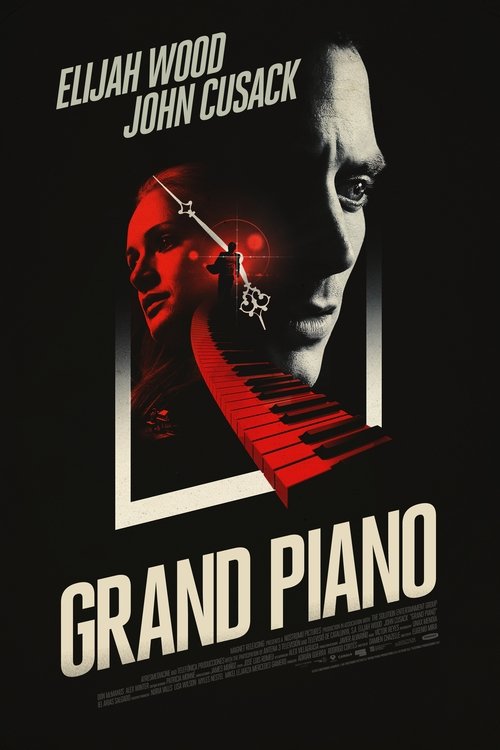
Grand Piano (2013)
Directed by Eugenio Mira
No — Grand Piano is not woke, scoring 0 out of 100 on our wokeness meter.
Grand Piano arrives from 2013, a Spanish production shot in English, directed by Eugenio Mira from a script by Damien Chazelle, who would go on to more celebrated things.
Consciousness Markers
The cast is a conventional assemblage of white European and American actors; no casting choices appear designed to signal representation.
No LGBTQ+ characters, themes, or subtext appear anywhere in the film.
Emma exists as the supportive wife whose peril motivates the hero; the film makes no feminist argument or commentary.
Race is entirely absent as a subject; the film's Chicago concert-hall milieu is uniformly white and unexamined.
No environmental or climate themes of any kind.
A hidden fortune drives the plot, but it is a MacGuffin for a thriller mechanism, not a critique of wealth or capitalism.
No body-image or body-positivity content.
Tom's stage fright and anxiety are dramatized as personal psychological obstacles, not framed as neurodivergence or neurodiversity advocacy.
The film is a wholly fictional contemporary thriller with no historical subject matter to revise.
The film is a taut, preposterous pulp thriller that never pauses to deliver a social or moral lesson to the audience.
Why it received this score
Grand Piano arrives from 2013, a Spanish production shot in English, directed by Eugenio Mira from a script by Damien Chazelle, who would go on to more celebrated things. Elijah Wood plays Tom Selznick, a concert pianist returning to the stage after five years of crippling stage fright, only to find a note on his sheet music informing him that a single wrong note will kill him. John Cusack, largely offscreen, murmurs threats into an earpiece. There is a fortune hidden inside a piano, a sniper in the rafters, and a final act staged on a lighting catwalk above the audience. The plot is absurd. It is also, somehow, gripping.
For the purposes of cultural classification, the film offers almost nothing to work with. The cast is European and American, uniformly white, and no one involved appears troubled by the fact. Race never surfaces as a subject. Neither does sexuality, nor climate, nor the redistribution of wealth, despite the vanished fortune that drives the entire mechanism. That fortune is a MacGuffin, a set of gears inside a Steinway, and it is never asked to mean anything. Tom's anxiety is a plot device, a psychological obstacle to be conquered by the final cadence, not a condition to be diagnosed or accommodated. Emma exists to be imperiled and then to sing an encore. The film has no interest in her interior life, and no interest in suggesting that it ought to.
What remains is craft. Mira stages the whole affair with a straight face and a metronome, and the tension holds because the rules are clear and the stakes are physical. Reviewers at the time called it a pulp symphony, which seems fair. It is a film that wants nothing from us but our pulse. No lesson is delivered. No audience is scolded. No contemporary virtue is signaled, and no historical record is adjusted to flatter the present. In the taxonomy of social consciousness, this is a null result. That is not a criticism. It is simply the finding, entered into the ledger without ceremony and filed accordingly.
Analysis generated by our Consciousness Algorithm


Synopsis
Tom Selznick, the most talented pianist of his generation, stopped performing in public because of his stage fright. Years after a catastrophic performance, he reappears in public in a long awaited concert in Chicago. Just moments after starting his performance in the packed theater, in front of an expectant audience, Tom finds a threatening message written on the score: 'Play one wrong note and you die'. Without leaving the piano, Tom must discover the anonymous sniper's motives and look for help without anyone realizing.
Questions about Grand Piano
Is Grand Piano woke?
No — Grand Piano is not woke, scoring 0 out of 100 on our wokeness meter. That earns it a verdict of Ultra Based.
Does Grand Piano have any woke elements?
No. All 10 markers score zero.
How does Grand Piano compare to other 2013 movies?
It ranks #249 of the 274 films from 2013 we've scored; their average is 14. The wokest is Belle (76).
How is the Woke Score calculated?
An AI-assisted process researches the film and its reception, scores it 0–100 on ten markers, then combines those into one 0–100 Woke Score. It measures a specific set of 2020s cultural themes, not film quality.