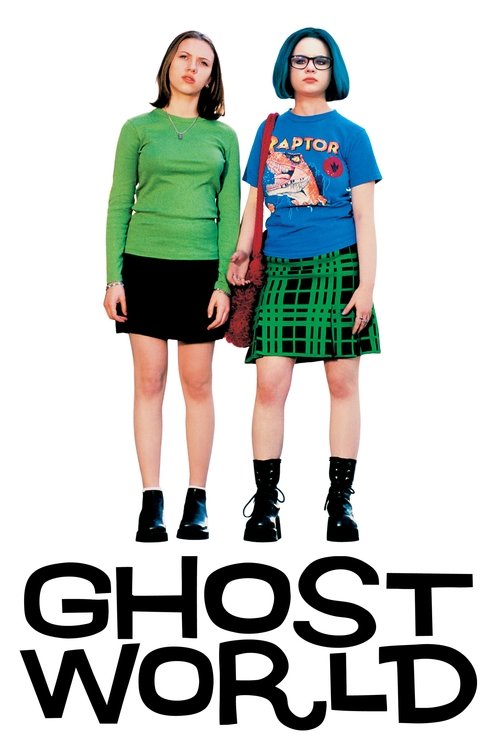
Ghost World (2001)
Directed by Terry Zwigoff
No — Ghost World is not especially woke, scoring 24 out of 100 on our wokeness meter.
Terry Zwigoff's Ghost World arrives from 2001, a year when a comic book adaptation could still mean two teenage girls in a diner and not a franchise.
Consciousness Markers
The Coon Chicken Inn poster and Enid's art-class presentation explicitly invoke American racial caricature and racism, though the film treats it more as a provocation about art and censorship than as sustained racial analysis.
The film satirizes modern consumer culture, corporate blandness, and the deadening service economy, but it is not a systematic eat-the-rich polemic.
Centers two teenage girls and their friendship, with a female art teacher and critiques of male social expectations, but it lacks an explicit feminist program.
The art teacher delivers some didactic lines about socially meaningful art, but the film overall prefers deadpan observation to preaching.
The principal cast is uniformly white, and no modern diversity-conscious casting choices are evident; the film's use of a racist caricature in a poster is thematic, not representational.
No LGBTQ+ characters, relationships, or themes are present; the central friendship is not framed as queer.
No climate change, environmentalism, or ecological themes appear in the film.
No body-positivity themes, body-diversity messaging, or fat-acceptance content are present.
Enid's alienation and Seymour's obsessive collecting are quirks, not framed through a neurodivergence lens.
The film is a contemporary character study and does not revise or reinterpret historical events.
Why it received this score
Terry Zwigoff's Ghost World arrives from 2001, a year when a comic book adaptation could still mean two teenage girls in a diner and not a franchise. Enid and Rebecca graduate high school with no plan beyond finding jobs and an apartment, and the film follows their drifting with an anthropologist's patience. The city streets are nearly empty. The jokes are delivered flat, on purpose, and the whole thing sits in a register of exhaustion that has aged well.
Where the film registers on our contemporary instruments, it does so quietly. It centers a friendship between two young women, gives them a female art teacher with opinions about socially meaningful work, and treats the male world they navigate with a cool eye. The Coon Chicken Inn poster, borrowed from Seymour and presented in art class as a comment on racism, is the film's most explicit engagement with American racial caricature. It is deployed as provocation, a question about art and offense, and the film never builds it into an argument. The satire of corporate blandness, Cook's Chicken, the deadening retail jobs, the upselling at the concession counter, lands a few solid blows against consumer culture without ever reaching for the pitchfork.
Elsewhere, the meter barely stirs. No climate anxiety, no body-diversity messaging, no queer reading of the central friendship, no diagnostic framing of Enid's alienation or Seymour's collecting. The cast is white throughout, and the film has no interest in correcting that. Roberta's lecture about art that matters is the closest thing to a sermon, and the film undercuts her by making the poster both her triumph and her downfall. This is a modest, era-appropriate specimen. It observes its characters instead of instructing them, and for a film about being young and stuck, that restraint is the entire point.
Analysis generated by our Consciousness Algorithm


Synopsis
Two quirky, cynical, teenaged girls try to figure out what to do with their lives following high school graduation. After they play a prank on an eccentric, middle-aged record collector, one of them befriends him, which causes a rift in the girls’ friendship.
Questions about Ghost World
Is Ghost World woke?
No — Ghost World is not especially woke, scoring 24 out of 100 on our wokeness meter. That earns it a verdict of Based.
Does Ghost World have any woke elements?
2 of the 10 markers register at 30 or above, led by Racial Consciousness (45) and Eat the Rich (30). On Racial Consciousness: The Coon Chicken Inn poster and Enid's art-class presentation explicitly invoke American racial caricature and racism, though the film treats it more as a provocation about art and censorship than as sustained racial analysis.
How does Ghost World compare to other 2001 movies?
It ranks #16 of the 148 films from 2001 we've scored; their average is 12. The wokest is Monster's Ball (60).
How is the Woke Score calculated?
An AI-assisted process researches the film and its reception, scores it 0–100 on ten markers, then combines those into one 0–100 Woke Score. It measures a specific set of 2020s cultural themes, not film quality.