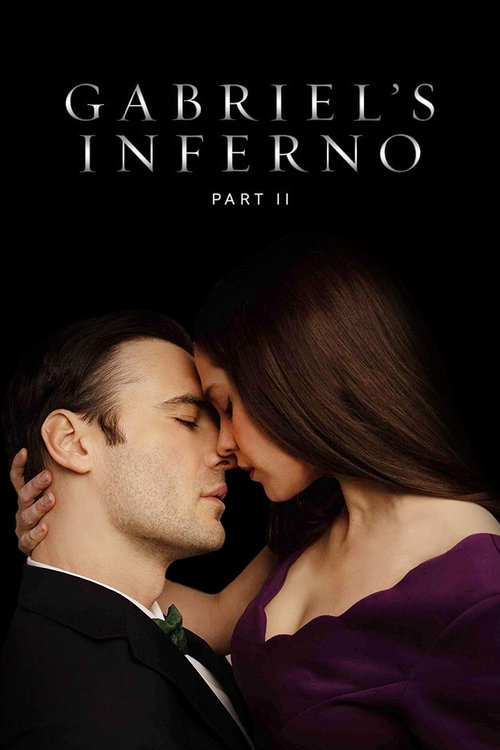
Gabriel's Inferno: Part II (2020)
Directed by Tosca Musk
No — Gabriel's Inferno: Part II is not woke, scoring 0 out of 100 on our wokeness meter.
Gabriel's Inferno: Part II arrives as the middle movement of a trilogy adapted from Sylvain Reynard's novels, distributed by a streaming service that has staked its existence on the proposition that romance readers deserve faithful adaptations.
Consciousness Markers
The cast is predominantly white with a few minority actors in supporting roles, but there is no evidence of deliberate representation casting or commentary on diversity.
No LGBTQ+ themes or characters are present in this heterosexual romance.
The plot follows a traditional romance where a man tries to win back a woman; while she initially rejects him, this is a narrative device rather than a feminist agenda.
No exploration of racial issues or consciousness.
No climate or environmental themes.
No critique of capitalism or wealth inequality.
No body positivity themes or messaging.
No depiction or discussion of neurodivergence.
No historical revisionism; the story is a contemporary romance.
The film does not preach or lecture on social issues; it is a straightforward romance drama.
Why it received this score
Gabriel's Inferno: Part II arrives as the middle movement of a trilogy adapted from Sylvain Reynard's novels, distributed by a streaming service that has staked its existence on the proposition that romance readers deserve faithful adaptations. The plot concerns a Dante scholar named Gabriel Emerson who has at last recalled the identity of Julia Mitchell, the woman he wronged years earlier, and who discovers that the memory arrives too late. She has moved on. He must win her back. There is a trip to Florence. There are leather-bound volumes. There is a great deal of smoldering in corridors.
What the film does not contain is any engagement with the social questions that occupied 2020. There is no commentary on representation, no interrogation of the professor-student power imbalance, no gesture toward identity, environment, or economics. The cast is largely white. The romance is heterosexual and traditional in its architecture: a man pursues, a woman resists, and the narrative resolves toward reunion. Julia's resistance functions as a plot mechanism, not a statement of principle. The film is interested in desire, Dante, and the correct pronunciation of Italian place names.
This leaves us with a curious artifact. A film released in the summer of 2020 that could have been released in 1994 with different haircuts and a smaller budget. It is earnest, glossy, and untroubled by the era that produced it. We assign it a score of zero, and we do so without malice. Some vintages are simply quiet.
Analysis generated by our Consciousness Algorithm


Synopsis
Professor Gabriel Emerson finally learns the truth about Julia Mitchell's identity, but his realization comes a moment too late. Julia is done waiting for the well-respected Dante specialist to remember her and wants nothing more to do with him. Can Gabriel win back her heart before she finds love in another's arms?
Questions about Gabriel's Inferno: Part II
Is Gabriel's Inferno: Part II woke?
No — Gabriel's Inferno: Part II is not woke, scoring 0 out of 100 on our wokeness meter. That earns it a verdict of Ultra Based.
Does Gabriel's Inferno: Part II have any woke elements?
No. All 10 markers score zero.
How does Gabriel's Inferno: Part II compare to other 2020 movies?
It ranks #210 of the 227 films from 2020 we've scored; their average is 21. The wokest is One Night in Miami... (83).
Is Gabriel's Inferno: Part II the most woke Gabriel's Inferno movie?
Yes. It scores highest of the 3 Gabriel's Inferno films we've scored.