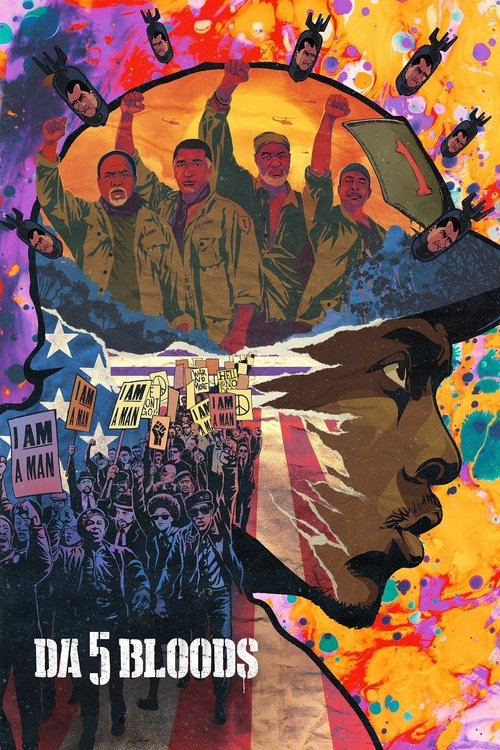
Da 5 Bloods (2020)
Directed by Spike Lee
Yes — Da 5 Bloods is woke, scoring 79 out of 100 on our wokeness meter.
Spike Lee's Da 5 Bloods begins as a heist picture about aging veterans returning to Vietnam for buried CIA gold and ends as a sermon on the racial ledger of American empire.
Consciousness Markers
The film's entire thesis is the Black experience of the Vietnam War, from soldiers forced to fight for a country that oppresses them to the gold earmarked for 'our black brethren' and a share donated to Black Lives Matter.
Spike Lee deliberately reworked the original spec script to center an all-Black ensemble of Vietnam veterans, with a predominantly African-American cast led by Delroy Lindo, Clarke Peters, and Chadwick Boseman.
Vintage Spike Lee: direct-address monologues, archival montages, and an unapologetic closing dedication to Black Lives Matter deliver the political message with a megaphone rather than a whisper.
Lee re-centers the Vietnam War narrative away from the white Hollywood canon, inserting Black veterans' history and explicitly invoking the Black Lives Matter movement in its closing beats.
The buried CIA gold and the veterans' claim to it function as a reparations metaphor, critiquing American imperialism and the economic exploitation of Black soldiers, though the film is more about racial than class struggle.
Paul's explicit PTSD and trauma-induced paranoia are central to the plot, though the film frames this as war trauma rather than a neurodivergence identity narrative.
The narrative is overwhelmingly male-centric; women like Tiên and Hedy exist largely in service of the veterans' arcs, with no sustained feminist critique.
No LGBTQ+ characters, relationships, or themes appear anywhere in the film.
No environmental or climate themes are present; the jungle is a setting, not a cause.
No body-positivity themes or messaging appear in the film.
Why it received this score
Spike Lee's Da 5 Bloods begins as a heist picture about aging veterans returning to Vietnam for buried CIA gold and ends as a sermon on the racial ledger of American empire. Lee and Kevin Willmott reworked a spec script into an all-Black ensemble piece, with Delroy Lindo, Clarke Peters, Isiah Whitlock Jr., and Norm Lewis carrying the weight. That choice is not decorative. It is the film's architecture. The movie has no LGBTQ subplot, no climate crusade, and no body-positivity detour. Its attention is elsewhere, fixed on the wound of race and the long afterlife of war.
Those wounds are the point. The Bloods were sent to fight for a country that oppressed them, and the buried gold becomes a crude but effective reparations metaphor. The critique of American imperialism and the economic exploitation of Black soldiers registers, though the film cares more about racial grievance than class warfare. Women mostly exist at the edges, serving the veterans' arcs. Paul's PTSD and paranoid rage dominate the screen, yet the film treats them as war trauma, not as a neurodivergence identity narrative. Lee also rewrites the Hollywood Vietnam canon, inserting Black veterans' history and closing with an explicit nod to Black Lives Matter. His lecture energy remains intact: direct-address monologues, archival montages, and a megaphone where a whisper might have fit.
The result is uneven, overlong, and frequently brilliant, which is the standard Spike Lee bargain. It is a film of high racial consciousness, robust representational intent, moderate historical revision, and very little interest in other contemporary pieties. The gold gets divided, the sermon gets delivered, and the audience is left to sort through the rubble. As a specimen of 2020s cultural production, it is potent, sincere, and impossible to mistake for subtle. The sommelier notes are bold, tannic, and lingering.
Analysis generated by our Consciousness Algorithm


Synopsis
Four African-American Vietnam veterans return to Vietnam. They are in search of the remains of their fallen squad leader and the promise of buried treasure. These heroes battle forces of humanity and nature while confronted by the lasting ravages of the immorality of the Vietnam War.
Questions about Da 5 Bloods
Is Da 5 Bloods woke?
Yes — Da 5 Bloods is woke, scoring 79 out of 100 on our wokeness meter. That earns it a verdict of Woke.
What makes Da 5 Bloods woke?
5 of the 10 markers register at 30 or above, led by Racial Consciousness (90), Representation Casting (85) and Lecture Energy (70). On Racial Consciousness: The film's entire thesis is the Black experience of the Vietnam War, from soldiers forced to fight for a country that oppresses them to the gold earmarked for 'our black brethren' and a share donated to Black Lives Matter.
How does Da 5 Bloods compare to other 2020 movies?
It ranks #2 of the 227 films from 2020 we've scored; their average is 21. The wokest is One Night in Miami... (83).
How is the Woke Score calculated?
An AI-assisted process researches the film and its reception, scores it 0–100 on ten markers, then combines those into one 0–100 Woke Score. It measures a specific set of 2020s cultural themes, not film quality.