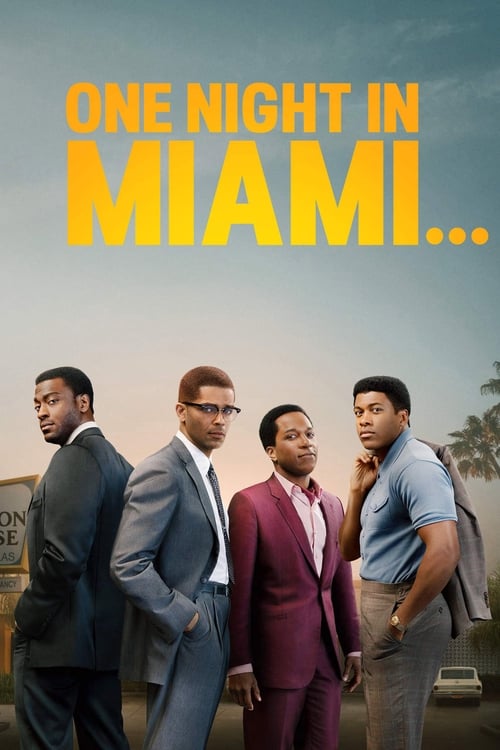
One Night in Miami... (2020)
Directed by Regina King
Yes — One Night in Miami... is very woke, scoring 83 out of 100 on our wokeness meter.
Regina King's feature directorial debut gathers four Black icons in a Miami motel room in 1964 and lets them talk.
Consciousness Markers
The entire film is a sustained meditation on the Black American experience under segregation, the civil rights movement, Nation of Islam politics, and competing strategies for Black liberation. Racial consciousness is the film's very substance.
An almost entirely Black ensemble cast, led by a Black director, telling a Black-centered historical story. The representation is intrinsic to the subject rather than imposed, but the film is a landmark of Black-cast, Black-authored prestige cinema.
The film is essentially a staged debate in which Malcolm X, Sam Cooke, Jim Brown, and Clay deliver extended speeches on racial responsibility, artistic integrity, and Black self-determination. The didactic energy is high, though it is dramatized argument rather than direct address.
Regina King's feature directorial debut is a milestone for Black women behind the camera, and the film grants brief interiority to Betty Shabazz and Barbara Cooke, but the central discourse is among four men and the film advances no explicit feminist thesis.
Malcolm X and Sam Cooke debate whether commercial success and Black economic empowerment constitute genuine progress or co-optation by white markets. The critique targets racial capitalism rather than capitalism as such, keeping the theme secondary.
The film is a fictionalized dramatization of a real 1964 meeting, inventing dialogue and confrontation around real figures. This is speculative historical dramatization rather than an ideological rewriting of the record.
No LGBTQ+ characters, themes, or subtext appear anywhere in the narrative.
No environmental or climate themes are present.
No body-positivity themes; the athletic and physical elements are incidental to the boxing backdrop.
No neurodivergent characters or themes are depicted.
Why it received this score
Regina King's feature directorial debut gathers four Black icons in a Miami motel room in 1964 and lets them talk. Cassius Clay, Malcolm X, Sam Cooke, and Jim Brown arrive as legends and leave as arguments. The film's representational weight is not decorative. An almost entirely Black ensemble, a Black director, and a Black-centered historical narrative make the casting inseparable from the subject. The camera watches these men with patience, using mirrors and overhead frames to keep all four in view. This is prestige cinema with a pulse, though the pulse is mostly conversational.
The screenplay treats the Black American experience as its entire substance. Segregation, the civil rights movement, Nation of Islam politics, and competing theories of liberation are debated with the urgency of a closing argument. Malcolm X and Sam Cooke spar over commercial success and whether Black economic empowerment is progress or co-optation by white markets. That critique targets racial capitalism, not capitalism itself, so the anti-capitalist thread remains secondary. The feminist angle is modest. King's milestone as a Black woman directing a major feature matters, and Betty Shabazz and Barbara Cooke receive fleeting interiority, but the room belongs to four men. The rest of the modern checklist goes untouched. The historical revisionism is speculative dramatization, inventing dialogue around real figures, not an ideological rewriting of the record.
The film is a staged debate, and it knows it. Extended speeches on racial responsibility, artistic integrity, and self-determination give the proceedings a high lecture quotient, though the lecturing is dramatized as argument instead of direct address. The result is talky, theatrical, and sincere. King keeps the performances from tipping into impersonation, and the script allows each man a moment of contradiction. We are not asked to agree with any single position. We are asked to sit in the room and listen. The film earns its seriousness. It does not earn a party. One Night in Miami is a sober, well-acted chamber piece about the cost of being exceptional in a country built on exclusion. It is admirable, stirring, and comfortable being a sermon with better lighting.
Analysis generated by our Consciousness Algorithm

Synopsis
In the aftermath of Cassius Clay's defeat of Sonny Liston in 1964, the boxer meets with Malcolm X, Sam Cooke and Jim Brown to change the course of history in the segregated South.
Questions about One Night in Miami...
Is One Night in Miami... woke?
Yes — One Night in Miami... is very woke, scoring 83 out of 100 on our wokeness meter. That earns it a verdict of Peak Woke.
What makes One Night in Miami... woke?
3 of the 10 markers register at 30 or above, led by Racial Consciousness (92), Representation Casting (82) and Lecture Energy (72). On Racial Consciousness: The entire film is a sustained meditation on the Black American experience under segregation, the civil rights movement, Nation of Islam politics, and competing strategies for Black liberation.
How does One Night in Miami... compare to other 2020 movies?
It is the wokest of the 227 films from 2020 we've scored; their average is 21.
How is the Woke Score calculated?
An AI-assisted process researches the film and its reception, scores it 0–100 on ten markers, then combines those into one 0–100 Woke Score. It measures a specific set of 2020s cultural themes, not film quality.