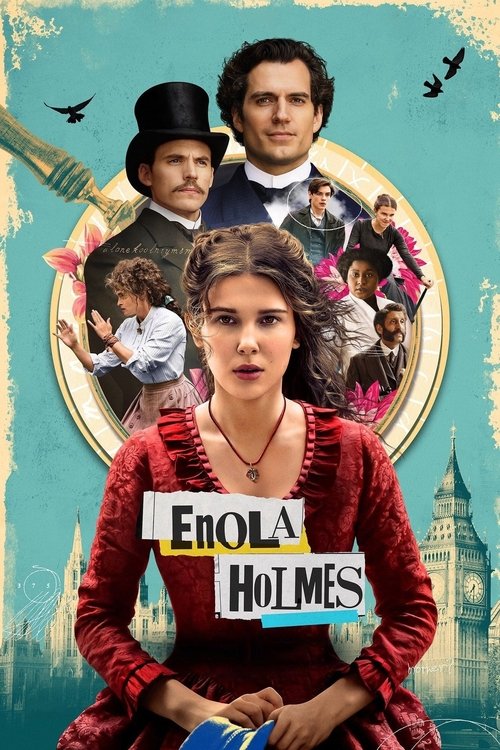
Enola Holmes (2020)
Directed by Harry Bradbeer
Yes · Woke
How we score movies →Consciousness Markers
The film centers on female agency and capability, features a suffragette subplot, and repeatedly emphasizes women's intellectual superiority and right to self-determination. Enola consistently outsmarts her famous male counterpart.
The cast includes actors of various ethnic backgrounds in meaningful supporting roles, though the film does not make this diversity a central theme or subject of particular attention.
Several scenes, particularly around suffrage and women's capability, carry preachy weight and occasionally feel more like assertions than organic character moments, though the film maintains enough adventure-plot momentum to avoid being entirely preachy.
The film reimagines the Sherlock Holmes canon by centering a female protagonist and reframing the detective mythology through a contemporary feminist lens, though it does not substantially revise historical facts.
While the cast includes actors of color, the film does not engage with race as a thematic concern or subject of particular narrative or visual attention in a way that demonstrates racial consciousness.
The film includes vague disapproval of aristocratic villainy and class-based antagonism, but does not engage in systematic critique of capitalism or economic structures.
There is no LGBTQ+ representation or thematic content present in the film.
There is no climate-related content or environmental messaging in the film.
There is no body positivity messaging or content addressing diverse body representation in the film.
There is no representation of neurodivergence or related themes present in the film.


Synopsis
While searching for her missing mother, intrepid teen Enola Holmes uses her sleuthing skills to outsmart big brother Sherlock and help a runaway lord.
Why it received this score
Enola Holmes arrives as a film convinced of its own progressive credentials, and to a considerable degree, it has earned them. The narrative centers on a teenage girl who outsmarts her famous brother through intelligence and resourcefulness, a reversal that the film treats as genuinely transgressive. The suffragette subplot, while occasionally heavy-handed, grounds the story in a specific historical moment of female political activism. Millie Bobby Brown's performance captures a certain intellectual rebellion that the filmmakers clearly intended as contemporary rather than period-specific, complete with fourth-wall breaks and knowing asides about women's agency.
The film's commitment to its progressive messaging manifests most obviously in the suffrage plot and Enola's repeated assertions of female capability, though these moments sometimes veer into lecture territory. The supporting cast includes diverse performers in meaningful roles, though the film does not particularly interrogate this diversity or make it thematic. Henry Cavill's Sherlock, positioned as Enola's inferior in deductive reasoning, serves as a vehicle for gentle mockery of traditional masculine detective fiction. What saves the film from complete earnestness is its fundamental pleasure in adventure and mystery rather than relentless messaging.
Yet the progressive elements are somewhat surface-level. The film's interest in representing women's political participation does not extend to deeper structural critique, and the class anxieties of the plot resolve through individual heroism rather than systemic examination. The anti-capitalist content is minimal, limited to vague disapproval of aristocratic villainy. Body positivity and neurodivergence representation are absent entirely. The result is a film that scores highly on feminist and representation markers while remaining relatively untouched by other progressive concerns, which is to say it succeeds at what it attempts while attempting only what its Netflix budget and family-friendly mandate permit.
Analysis generated by our Consciousness Algorithm
Critic Reviews
“Enola Holmes is an engaging, exciting mystery that the entire family will enjoy. The direction is spot on, the acting is brilliant, the plot is intriguing, and the cinematography is fantastic. But the ending is a letdown, not trusting audiences to be content with Enola’s arc.”
“While Enola Holmes empowering feminist message might feel a little on the nose at times, the film, is nevertheless, a witty and endearing little bauble with terrific elan. ”
“While the mystery might be elementary (my dear, notably absent, Watson), the storytelling is winkingly subversive, proclaiming that a new and welcome game is afoot.”
“A bright young actress, a movie-star actor and a potentially interesting concept gets smothered in 128 minutes of colorful, empty nonsense.”