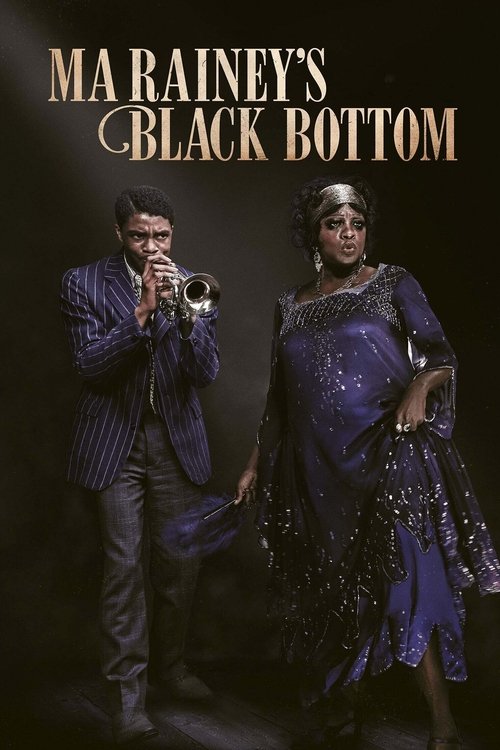
Ma Rainey's Black Bottom (2020)
Directed by George C. Wolfe
Yes — Ma Rainey's Black Bottom is woke, scoring 76 out of 100 on our wokeness meter.
George C. Wolfe's adaptation of August Wilson's play carries the weight of a canonical text and the melancholy of Chadwick Boseman's final performance.
Consciousness Markers
Racial exploitation is the film's central engine: white producers commodify Black talent, Levee recounts his family's lynching, and Cutler tells of a humiliated preacher. The racial consciousness is pervasive and explicit.
The cast is overwhelmingly Black, led by Viola Davis and Chadwick Boseman, in a story centered entirely on Black artists. The representation is inherent to the subject matter rather than a casting gesture, but it is thorough.
August Wilson's dialogue delivers extended monologues on race, God, and white exploitation, particularly Levee's and Cutler's set pieces. The film is talky and thematically pointed, though the speeches arise from character rather than direct address.
Ma Rainey's relationship with her 'lady friend' Dussie Mae is present, and the film acknowledges her bisexuality, though it is a background element rather than a foregrounded theme.
The recording industry's extraction of Black artistry for white profit is a running critique, culminating in Sturdyvant buying Levee's songs and handing them to a white orchestra. The exploitation is economic as well as racial.
Ma Rainey is a commanding, strong-willed woman who dictates terms to white male producers and refuses to be reduced to her voice. The film celebrates her authority, though it is not framed as an explicit feminist thesis.
The film dramatizes a real 1927 recording session and the career of Ma Rainey, centering Black perspectives on a historical moment usually told from the white industry's vantage. It is a period piece rather than a rewriting of the record.
Sylvester has a pronounced stutter, which becomes a minor plot point when Ma insists he speak the record's intro. It is depicted as a speech impediment rather than a neurodivergence theme.
No environmental or climate themes appear in the film.
No body positivity themes are present.
Why it received this score
George C. Wolfe's adaptation of August Wilson's play carries the weight of a canonical text and the melancholy of Chadwick Boseman's final performance. The 1927 Chicago recording studio is a pressure cooker of racial extraction. Viola Davis's Ma Rainey is a monument of stubborn authority, dictating terms to white producers who see her as a product with legs. The film's representation is total and unremarkable in the best sense. Black artists occupy every corner of the frame, and the story has no interest in explaining their existence to anyone.
The screenplay's racial consciousness is its engine. Levee's monologue about his mother and father, Cutler's story of the humiliated preacher, Ma's line about being a dog in the alley: these are not subtext. They are the text. The economic critique follows close behind, as Sturdyvant buys Levee's songs and hands them to a white orchestra, a tidy lesson in who owns the means of cultural production. Ma's authority gives the film a feminist pulse, though the movie never stops to announce a thesis. Her relationship with Dussie Mae is present and acknowledged, but it remains a background detail, a fact of her life and not a lecture. August Wilson's dialogue is talky, and the film lets the monologues run. That is a sermonizing streak, but it is character-driven, not direct address.
Sylvester's stutter is a plot mechanism, not a study of neurodivergence. The period setting dramatizes a real session and centers Black perspectives, but it does not rewrite the historical record so much as reframe the vantage. There is no climate crusade here, no body positivity agenda, and the film seems content to leave those cultural battlegrounds to other productions. The result is a chamber piece about art, money, and the cost of being talented in a rigged room. It is a serious work, well acted, and only occasionally suffocating under the weight of its own significance.
Analysis generated by our Consciousness Algorithm


Synopsis
Tensions rise when the trailblazing Mother of the Blues and her band gather at a Chicago recording studio in 1927. Adapted from August Wilson's play.
Questions about Ma Rainey's Black Bottom
Is Ma Rainey's Black Bottom woke?
Yes — Ma Rainey's Black Bottom is woke, scoring 76 out of 100 on our wokeness meter. That earns it a verdict of Woke.
What makes Ma Rainey's Black Bottom woke?
6 of the 10 markers register at 30 or above, led by Racial Consciousness (85), Representation Casting (78) and Lecture Energy (55). On Racial Consciousness: Racial exploitation is the film's central engine: white producers commodify Black talent, Levee recounts his family's lynching, and Cutler tells of a humiliated preacher.
How does Ma Rainey's Black Bottom compare to other 2020 movies?
It ranks #3 of the 227 films from 2020 we've scored; their average is 21. The wokest is One Night in Miami... (83).
How is the Woke Score calculated?
An AI-assisted process researches the film and its reception, scores it 0–100 on ten markers, then combines those into one 0–100 Woke Score. It measures a specific set of 2020s cultural themes, not film quality.