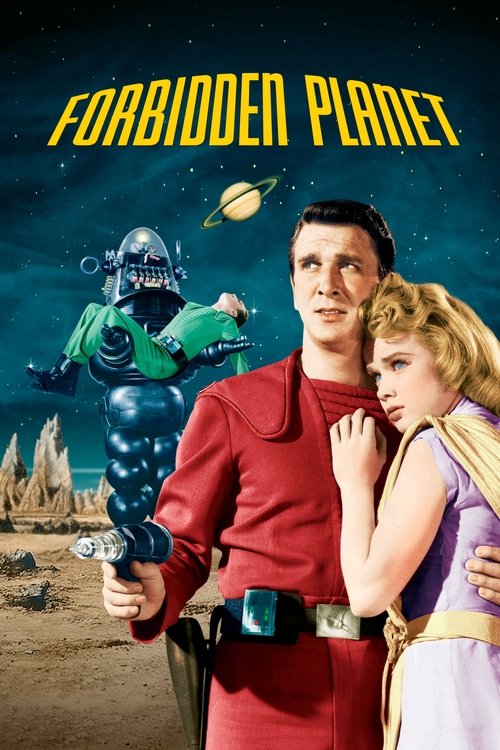
Forbidden Planet (1956)
Directed by Fred M. Wilcox
No — Forbidden Planet is not woke, scoring 0 out of 100 on our wokeness meter.
Forbidden Planet arrives from 1956 bearing the full apparatus of a landmark: the first entirely electronic score, the first human-built starship traveling faster than light, the first Robby.
Consciousness Markers
The cast is entirely white and the film makes no effort at inclusive or nontraditional casting; minority characters are absent.
No LGBTQ+ characters, themes, or subtext are present.
Altaira is largely a naive romantic prize and object of male instruction; the film does not advance a feminist critique or agenda.
No engagement with race, racism, or racial identity.
No environmental or climate themes; the planetary destruction is caused by psychic technology, not ecological crisis.
No critique of capitalism or wealth; the conflict is psychological and scientific.
No body-positivity themes; the film's treatment of Altaira's appearance is conventional 1950s objectification.
The 'monsters from the id' are Freudian subconscious projections, not a depiction or advocacy of neurodivergence.
No historical revisionism; the story is futuristic fiction.
The film contains exposition about the Krell and atomic power, but no modern social-justice moralizing or preachy lecture energy.
Why it received this score
Forbidden Planet arrives from 1956 bearing the full apparatus of a landmark: the first entirely electronic score, the first human-built starship traveling faster than light, the first Robby. It is a handsome object, all CinemaScope vistas and painted cycloramas, and the Library of Congress has preserved it for being culturally significant. We approach it, as we approach any vintage, with our instruments ready. The reading is clean. There is nothing in this bottle that a modern palate would recognize as a social program.
The film's sexual politics belong entirely to their decade. Altaira, played by Anne Francis, is a young woman raised in isolation who exists to be instructed, kissed, and eventually carried off. Commander Adams scolds her for a short dress and then apologizes for scolding her. The crewmen leer. This is not a feminist text, nor does it pretend to be one. The cast is uniformly white, the psychology uniformly Freudian, and the conflict is a scientist's own subconscious given terrible form. The famous id monster is a lesson about repression, not an argument about anything currently under debate.
We searched for our usual signposts and found none. No racial reckoning, no environmental sermon, no economic grievance, no encouragement to reconsider the body, the mind, or the historical record. The film lectures, certainly, but about atomic power and the limits of human wisdom, which is a different sermon entirely. It earns its place in the canon on craft alone. A clean sheet, delivered without complaint. Some vintages are simply of another time, and this one is content to be.
Analysis generated by our Consciousness Algorithm


Synopsis
Starship C57D travels to planet Altair 4 in search of the crew of spaceship "Bellerophon," a scientific expedition that has been missing for twenty years. They find themselves unwelcome by the expedition's lone survivor and warned of destruction by an invisible force if they don't turn back immediately.
Questions about Forbidden Planet
Is Forbidden Planet woke?
No — Forbidden Planet is not woke, scoring 0 out of 100 on our wokeness meter. That earns it a verdict of Ultra Based.
Does Forbidden Planet have any woke elements?
No. All 10 markers score zero.
How does Forbidden Planet compare to other 1956 movies?
It ranks #8 of the 11 films from 1956 we've scored; their average is 4. The wokest is Giant (28).
How is the Woke Score calculated?
An AI-assisted process researches the film and its reception, scores it 0–100 on ten markers, then combines those into one 0–100 Woke Score. It measures a specific set of 2020s cultural themes, not film quality.