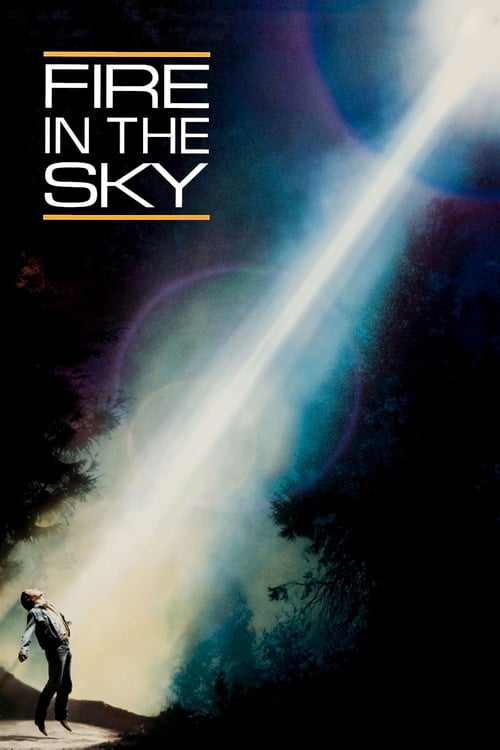
Fire in the Sky (1993)
Directed by Rob Lieberman
No — Fire in the Sky is not woke, scoring 0 out of 100 on our wokeness meter.
In 1993, Paramount released a film about six loggers in Snowflake, Arizona who watch a red light descend through the treeline and lose one of their number to it.
Consciousness Markers
The cast is overwhelmingly white and male, with no evident diversity-driven casting choices or commentary.
There are no LGBTQ+ characters, themes, or subtext in the film.
The film has no feminist agenda or gender-conscious framing; female characters are peripheral.
Race is not a subject of the film, and the story contains no racial consciousness or commentary.
Although set among loggers and forests, the film makes no environmentalist or climate-crusade argument.
There is no eat-the-rich framing or sustained critique of capitalism; tabloid opportunism is mentioned only in passing.
The film contains no body-positivity themes or messaging.
Neurodivergence is not depicted or discussed as a theme.
The film fictionalizes elements of an alleged abduction, but it does not engage in modern progressive revisionist history.
The film is a straightforward dramatization and does not lecture the audience on social or political issues.
Why it received this score
In 1993, Paramount released a film about six loggers in Snowflake, Arizona who watch a red light descend through the treeline and lose one of their number to it. The man returns five days later, naked and shattered, with a story no sheriff wants to hear. This is a dramatization of Travis Walton's 1978 book, and it plays its cards with a straight face: the polygraph, the search party, the small town turning on its own. Nobody in the frame stops to explain what the audience should feel about loggers, or rural poverty, or the tabloid economy that briefly makes Walton a commodity. The film notices the tabloids and moves on. It has a story to tell and limited interest in moral instruction.
The centerpiece remains the examination chamber, where Industrial Light & Magic earns its fee. A man is stripped, sealed in elastic, and subjected to procedures rendered with clinical patience. Roger Ebert admitted he believed he was seeing something alien, which is the highest compliment available to a film of this vintage. Around that sequence sits a fairly conventional procedural about disbelief and loyalty. Robert Patrick gained weight and grew a beard for the role; the production shot in the Umpqua National Forest and let the trees be trees. No argument is mounted about timber or land. The woods are simply where the light came down.
As a document of social consciousness, the film is barren, and this is not a criticism so much as a measurement. Its cast is white, its women peripheral, its gaze fixed on male friendship and male trauma. Race never surfaces. Neither does sexuality, nor the body as a site of affirmation, nor the mind as a category to be destigmatized. The aliens are not a metaphor for anything current. They are aliens. The result is a curious artifact: sincere, occasionally frightening, and entirely innocent of the preoccupations that would come to define the following decades of American cinema. It asks nothing of us but attention.
Analysis generated by our Consciousness Algorithm
Part of


Synopsis
After clearing brush for the government, a group of men return to town claiming their friend was abducted. Despite no apparent motive or evidence of foul play, no-one believes their story and his disappearance is treated as murder.
Questions about Fire in the Sky
Is Fire in the Sky woke?
No — Fire in the Sky is not woke, scoring 0 out of 100 on our wokeness meter. That earns it a verdict of Ultra Based.
Does Fire in the Sky have any woke elements?
No. All 10 markers score zero.
How does Fire in the Sky compare to other 1993 movies?
It ranks #76 of the 97 films from 1993 we've scored; their average is 11. The wokest is Bound by Honor (60).
How is the Woke Score calculated?
An AI-assisted process researches the film and its reception, scores it 0–100 on ten markers, then combines those into one 0–100 Woke Score. It measures a specific set of 2020s cultural themes, not film quality.