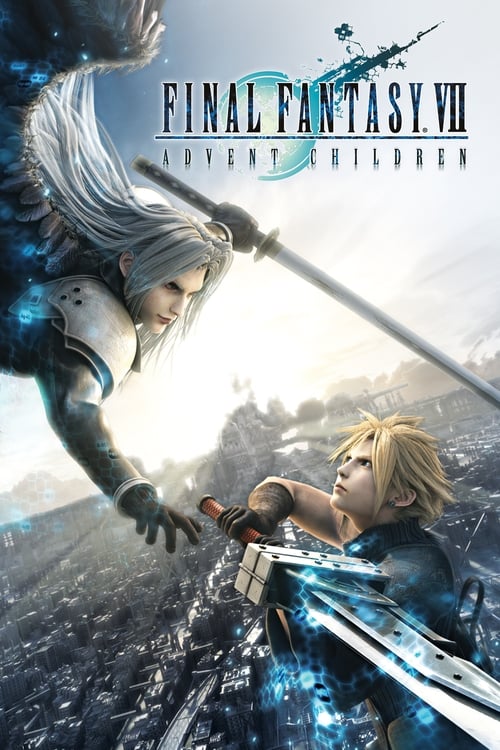
Final Fantasy VII: Advent Children (2005)
Directed by Tetsuya Nomura
No — Final Fantasy VII: Advent Children is not woke, scoring 6 out of 100 on our wokeness meter.
Final Fantasy VII: Advent Children arrives from 2005, a feature-length extension of a video game's cut scenes, and it makes no apology for being exactly that.
Consciousness Markers
The cast is entirely Japanese voice actors and the characters are drawn from the existing game roster, including the Black-coded Barret and several female fighters, but the film makes no modern representational casting statement.
Tifa and Yuffie are capable fighters, but the film's camera and design emphasize Tifa's feminine qualities, and there is no feminist thesis.
There are no LGBTQ+ themes, characters, or subtext in the film.
Barret appears as a comrade, but the film never engages with race or racial injustice.
The backdrop includes the Lifestream and mako energy, but Advent Children is a personal revenge and resurrection story, not a climate-crusade narrative.
Shinra is a corporate remnant, but the film does not critique capitalism or wealth.
There is no body-positivity theme or messaging.
Cloud's guilt and isolation are trauma, not a neurodivergence narrative.
The film is a fantasy continuation of a video game and makes no historical revisionist claims.
The film deliberately avoids explaining its themes, offering action and ambiguous imagery rather than moral instruction.
Why it received this score
Final Fantasy VII: Advent Children arrives from 2005, a feature-length extension of a video game's cut scenes, and it makes no apology for being exactly that. Two years after Midgar fell, Cloud Strife mopes in a ruined city, infected with a plague called Geostigma, while three silver-haired young men hunt the remains of a dead alien so they can resurrect a villain with a very long sword. The film has no interest in explaining itself. Tetsuya Nomura has said the team wanted viewers to draw their own conclusions, and they meant it. Scenes drift past without commentary. The grey wolf that trails Cloud is never identified aloud. This is a film that trusts its audience to have played the game, and offers nothing to anyone who has not.
On the matter of modern social consciousness, the cupboard is bare. Barret Wallace stands among Cloud's comrades, a Black-coded character inherited from the original roster, and the film treats him as a colleague with a gun arm and no further comment. No casting statement is made. Tifa and Yuffie fight capably, but the camera lingers on Tifa's figure in ways the production notes cheerfully confirm were intentional, and no thesis accompanies her punches. Cloud's isolation and guilt read as trauma and grief, not as a diagnosis. The Lifestream and mako energy sit in the background as fantasy metaphysics. Nothing in the script suggests the planet is dying because of industry, or that the wealthy ought to be eaten.
Which leaves us with a curious artifact: a blockbuster-scale animated film with almost no sermonizing whatsoever. It wants to be cool, and it succeeds at being cool, whatever that costs it in comprehensibility. We extend the modest credit it earns for a diverse roster inherited from its source material, and nothing beyond that. A relic of a less instructive era. It plays its music loudly and says nothing at all.
Analysis generated by our Consciousness Algorithm


Synopsis
Two years have passed since the final battle with Sephiroth. Though Midgar, city of mako, city of prosperity, has been reduced to ruins, its people slowly but steadily walk the road to reconstruction. However, a mysterious illness called Geostigma torments them. With no cure in sight, it brings death to the afflicted, one after another, robbing the people of their fledgling hope.
Questions about Final Fantasy VII: Advent Children
Is Final Fantasy VII: Advent Children woke?
No — Final Fantasy VII: Advent Children is not woke, scoring 6 out of 100 on our wokeness meter. That earns it a verdict of Ultra Based.
Does Final Fantasy VII: Advent Children have any woke elements?
Very few. None of the 10 markers reaches 30, the level where a marker counts as present; the highest is Representation Casting at 15.
How does Final Fantasy VII: Advent Children compare to other 2005 movies?
It ranks #112 of the 181 films from 2005 we've scored; their average is 13. The wokest is The Constant Gardener (72).
How is the Woke Score calculated?
An AI-assisted process researches the film and its reception, scores it 0–100 on ten markers, then combines those into one 0–100 Woke Score. It measures a specific set of 2020s cultural themes, not film quality.