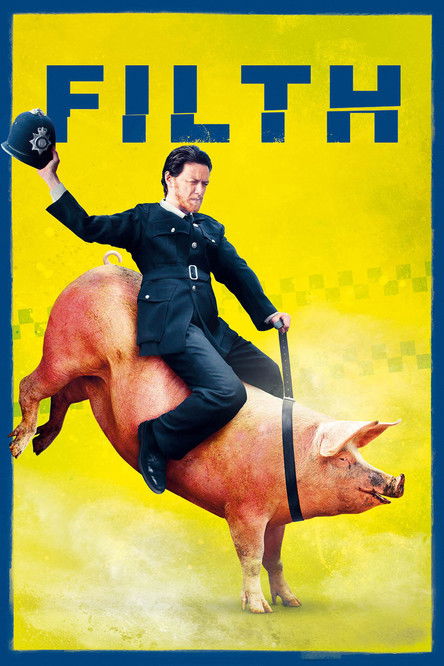
Filth (2013)
Directed by Jon S. Baird
No — Filth is not woke, scoring 7 out of 100 on our wokeness meter.
Filth is a 2013 adaptation of Irvine Welsh's novel, directed by Jon S. Baird and starring James McAvoy as a bigoted, drug-addled Edinburgh detective.
Consciousness Markers
Bipolar disorder and borderline personality disorder are central to the protagonist, but they are rendered as monstrous pathology rather than an affirming neurodivergence narrative. Mental illness is a genuine thematic element, though not in a woke register.
The cast is overwhelmingly white British, and the Japanese exchange student is a plot device (the murder victim) rather than a representation gesture. No deliberate diversity casting agenda is present.
The film wallows in its protagonist's misogyny — obscene phone calls, abusive sexual encounters — but depicts it as pathology rather than advancing any feminist critique or agenda.
Racism and bigotry are traits of the loathsome protagonist and the victim is a Japanese student, but the film offers no racial-justice consciousness or commentary; it merely portrays prejudice.
The film is a grimy, amoral character study that pointedly refuses to moralize or instruct its audience. No lecture energy.
Bruce cross-dresses as his estranged wife as a grief-driven psychological compulsion, not an expression of LGBTQ+ identity or themes. No queer content of note.
No environmental or climate themes appear anywhere in the film.
The story concerns a corrupt cop's personal collapse, not economic inequality or class warfare. No eat-the-rich sentiment.
No body-positivity themes or messaging are present.
No historical events are revised or reinterpreted; the film is a contemporary fictional character study.
Why it received this score
Filth is a 2013 adaptation of Irvine Welsh's novel, directed by Jon S. Baird and starring James McAvoy as a bigoted, drug-addled Edinburgh detective. Bruce Robertson manipulates colleagues, bullies a mild-mannered friend, makes obscene phone calls, and hallucinates his way toward a promotion. The novel was long considered un-filmable. Baird directs with grimy, unsubtle energy. McAvoy gives a delirious, demonic performance. The result is warped, unpleasant, and content to remain so. This is not a film with social instruction on its mind.
The cultural awareness here is minimal. The cast is overwhelmingly white British. The murder of a Japanese exchange student sets the plot in motion, but the victim remains a device. Bruce cross-dresses as his estranged wife to keep her close. That is grief and psychosis, not an exploration of queer identity. He makes obscene phone calls and engages in abusive sex, but the film treats misogyny as a symptom of his collapse, not as a subject for feminist critique. Racism and bigotry are traits of a loathsome protagonist, not an invitation to racial consciousness. There is no climate crusade, no eat-the-rich anger, no body-positivity messaging, no revisionist history. The film is too busy being vile.
The one area with genuine thematic weight is mental illness. Bipolar disorder and borderline personality disorder sit at the center of Bruce's behavior. The film renders them as monstrous pathology, not as an affirming neurodivergence narrative. It never asks us to celebrate or accommodate his condition. It asks us to watch him destroy himself and others. The film also refuses to lecture. It is amoral, grim, and proud of it. The final fourth-wall break, with Bruce repeating same rules apply as the chair slips, is a smirk, not a sermon. As a piece of progressive social consciousness, it is a dry well. As a character study, it is effective in a way that leaves a stain.
Analysis generated by our Consciousness Algorithm
Part of


Synopsis
A bigoted junkie cop suffering from borderline personality disorder and drug addiction manipulates and hallucinates his way in a bid to secure promotion.
Questions about Filth
Is Filth woke?
No — Filth is not woke, scoring 7 out of 100 on our wokeness meter. That earns it a verdict of Ultra Based.
Does Filth have any woke elements?
Very few. None of the 10 markers reaches 30, the level where a marker counts as present; the highest is Neurodivergence at 25.
How does Filth compare to other 2013 movies?
It ranks #173 of the 274 films from 2013 we've scored; their average is 14. The wokest is Belle (76).
How is the Woke Score calculated?
An AI-assisted process researches the film and its reception, scores it 0–100 on ten markers, then combines those into one 0–100 Woke Score. It measures a specific set of 2020s cultural themes, not film quality.