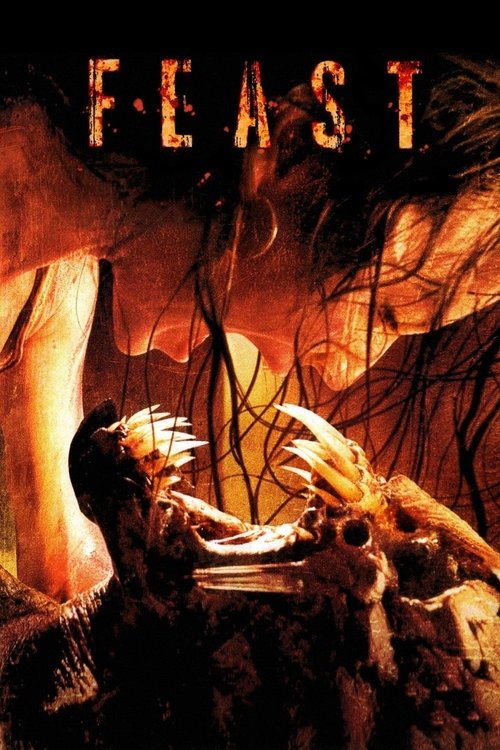
Feast (2005)
Directed by John Gulager
No — Feast is not woke, scoring 8 out of 100 on our wokeness meter.
Feast arrived in 2005 as the prize of a television contest, a monster movie assembled by committee and handed to a first-time director who had plainly watched a great deal of creature cinema and drawn the least respectable conclusions from it.
Consciousness Markers
The cast is modestly diverse for a mid-2000s monster movie, but the film makes no comment on it and the characters are defined by horror-movie archetypes rather than identity.
A female survivor (Tuffy/Heroine 2) does take charge in the back half, but the film surrounds this with gratuitous nudity and sexual-assault gags, so it reads as exploitation rather than feminist intent.
No LGBTQ+ characters, themes, or subtext of any kind.
No engagement with race or racial themes whatsoever.
No environmental or climate content.
No economic critique or class commentary; the bar patrons are simply monster fodder.
No body-positivity themes; the film's treatment of bodies is purely gore and titillation.
No neurodivergent characters or themes.
No historical revisionism; the film is a contemporary creature feature with no historical subject matter.
A gleefully gross B-movie with no preachy or message-driven agenda; it exists to shock and entertain.
Why it received this score
Feast arrived in 2005 as the prize of a television contest, a monster movie assembled by committee and handed to a first-time director who had plainly watched a great deal of creature cinema and drawn the least respectable conclusions from it. A Nevada bar, a family of ravenous things outside, a cast of patrons named for their function: Hero, Beer Guy, Harley Mom, Bossman. The film has no interest beyond the next kill, and it pursues that interest with something close to devotion. It is crude, loud, and entirely content to be so.
For the purposes of cultural accounting, the ledger is thin. The cast is more varied than the genre generally managed in that era, though the film never remarks on it, and every character is defined by the manner of their death. Race, sexuality, class, ecology, the interior life of the mind: none of it appears on the menu. What passes for a feminist gesture is the late promotion of Tuffy to the onscreen title of Heroine 2, a woman who takes command once grief has hollowed her out. This sits beside the film's enthusiasm for undressing its actresses and its willingness to play a sexual assault on a still-living body for laughs. The gesture is not a statement. It is a beat in a horror movie, and the movie knows it.
There is no sermon here. Feast never pauses to instruct, never turns to the audience to explain what should be felt. It wants to disgust and amuse in roughly equal measure, and it manages often enough to account for a mixed critical reception and a pair of sequels. We can classify it, note the near-total absence of contemporary social consciousness, and file it accordingly. The patrons of that bar do not deserve a message. They deserve to be eaten, and the film obliges them without hesitation.
Analysis generated by our Consciousness Algorithm


Synopsis
When a motley crew of strangers find themselves trapped in an isolated tavern, they must band together in a battle for survival against a family of flesh-hungry creatures.
Questions about Feast
Is Feast woke?
No — Feast is not woke, scoring 8 out of 100 on our wokeness meter. That earns it a verdict of Ultra Based.
Does Feast have any woke elements?
Very few. None of the 10 markers reaches 30, the level where a marker counts as present; the highest is Representation Casting at 15.
How does Feast compare to other 2005 movies?
It ranks #90 of the 181 films from 2005 we've scored; their average is 13. The wokest is The Constant Gardener (72).
How is the Woke Score calculated?
An AI-assisted process researches the film and its reception, scores it 0–100 on ten markers, then combines those into one 0–100 Woke Score. It measures a specific set of 2020s cultural themes, not film quality.