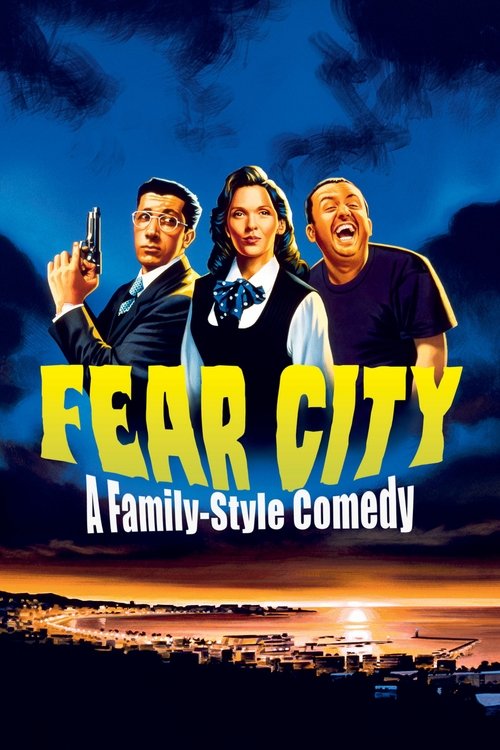
Fear City: A Family-Style Comedy (1994)
Directed by Alain Berbérian
No — Fear City: A Family-Style Comedy is not woke, scoring 4 out of 100 on our wokeness meter.
La Cité de la peur, released in 1994 and known in English as Fear City: A Family-Style Comedy, arrives from the comedy trio Les Nuls with a single purpose: to bury American blockbusters under an avalanche of puns.
Consciousness Markers
The plot mildly satirizes the film industry's cynical publicity machine (a director exploiting murders to promote her movie), but it is showbiz farce, not an eat-the-rich polemic.
A woman (Odile) is the nominal protagonist and a film director, but she is played for slapstick and romantic farce rather than any feminist statement.
The cast is a uniformly white French comedy troupe (Les Nuls) plus cameos; no diversity-conscious casting agenda is present.
No LGBTQ+ characters, themes, or subtext appear anywhere in this spoof.
Race is entirely absent as a subject; the film is a white French ensemble parodying Hollywood thrillers.
No environmental or climate content of any kind.
No body-positivity themes; physical comedy and vomiting gags are played for laughs, not affirmation.
No neurodivergent characters or themes are present.
No historical revisionism; the film is a contemporary spoof of American cinema.
This is a pun-driven comedy with zero didactic or preachy messaging.
Why it received this score
La Cité de la peur, released in 1994 and known in English as Fear City: A Family-Style Comedy, arrives from the comedy trio Les Nuls with a single purpose: to bury American blockbusters under an avalanche of puns. A struggling director named Odile Deray has made a slasher picture called Red is Dead. Someone begins murdering projectionists in the exact manner of the film, leaving behind the letters O, D, I, L. Cannes beckons. A bodyguard named Karamazov is hired. Basic Instinct is reenacted with a chair. Pretty Woman and The Terminator get their turn. The plot is scaffolding for wordplay, and the wordplay is relentless.
Assessed against contemporary cultural sensibilities, the film registers as a near-total void, which is not a criticism so much as a measurement. Odile occupies the center of the story and holds a director's chair, yet she exists to be flustered, seduced, and outwitted. The screenplay has no interest in her as a statement. Race never enters the frame. Neither does queerness, environmental anxiety, body affirmation, or neurological difference. The film's one glancing critique targets the publicity apparatus of the movie business, where a killing can be repurposed as marketing, but this is the cynicism of showbiz veterans, not a cry against capital. Nobody storms a barricade. They eat lunch.
The nearest thing to a message arrives in the final scene, when the heroes notice the killer's letters spell the heroine's name and shrug it off in favor of dinner. That is the film's entire moral philosophy: recognition is optional, appetite is not. A viewer hunting for sermons will leave empty-handed. A viewer who speaks French will leave quoting it for thirty years.
Analysis generated by our Consciousness Algorithm

Synopsis
A second-class horror movie has to be shown at Cannes Film Festival, but, before each screening, the projectionist is killed by a mysterious fellow, with hammer and sickle, just as it happens in the film to be shown.
Questions about Fear City: A Family-Style Comedy
Is Fear City: A Family-Style Comedy woke?
No — Fear City: A Family-Style Comedy is not woke, scoring 4 out of 100 on our wokeness meter. That earns it a verdict of Ultra Based.
Does Fear City: A Family-Style Comedy have any woke elements?
Very few. None of the 10 markers reaches 30, the level where a marker counts as present; the highest is Eat the Rich at 10.
How does Fear City: A Family-Style Comedy compare to other 1994 movies?
It ranks #54 of the 86 films from 1994 we've scored; their average is 10. The wokest is On Deadly Ground (75).
How is the Woke Score calculated?
An AI-assisted process researches the film and its reception, scores it 0–100 on ten markers, then combines those into one 0–100 Woke Score. It measures a specific set of 2020s cultural themes, not film quality.