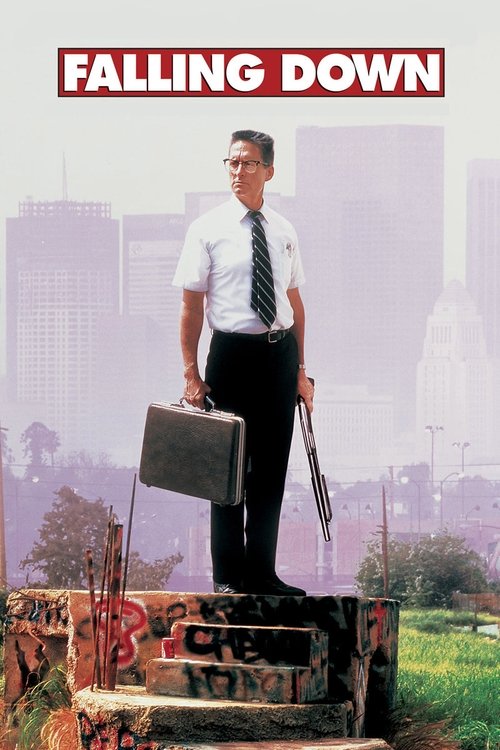
Falling Down (1993)
Directed by Joel Schumacher
No — Falling Down is not woke, scoring 19 out of 100 on our wokeness meter.
Falling Down arrives from 1993 with a flat-top haircut, a briefcase, and a body count, and it has lost none of its capacity to make audiences argue with the screen.
Consciousness Markers
Economic grievance is the engine of the film: price gouging, defense-industry layoffs, needless construction to justify budgets, loan rejection, and the screenwriter's own framing of the protagonist as an archaic power structure. The film depicts but does not endorse the rage.
Foster delivers extended diatribes on prices, land, and society, and Prendergast closes with a mini-sermon weighing social inequality against personal responsibility. The film is more Rorschach test than pulpit, however.
The cast includes Korean, Mexican, and Black characters, but they are largely deployed as threats, hustlers, or stereotypes, drawing organized protests from Korean American groups. Diversity exists, but as fodder for the protagonist's grievance rather than as affirming representation.
Race is present throughout—the Korean grocer, the Black loan applicant whose 'Don't forget me' hints at shared economic grievance—but the film's dominant frame is the white-victimization narrative, not racial consciousness.
Detective Sandra Torres is a competent female investigator, but the film centers a violent male protagonist and his frightened ex-wife under a restraining order. There is no discernible feminist agenda.
Foster rants about the wasteful use of land on the private golf course and sabotages it, and grumbles about pointless road repairs. These are incidental anti-waste barbs, not a climate crusade.
The only LGBTQ-adjacent beat is Foster's brief disgust at the Neo-Nazi surplus-store owner's homophobia, a passing anti-bigotry note rather than any queer theme or character.
No body-positivity content of any kind.
Foster's mental deterioration is framed as psychotic violence and madness, not as neurodivergent identity or acceptance.
No historical revisionism; the film is a contemporary, fictional LA story.
Why it received this score
Falling Down arrives from 1993 with a flat-top haircut, a briefcase, and a body count, and it has lost none of its capacity to make audiences argue with the screen. Joel Schumacher directs Michael Douglas as William Foster, a laid-off defense worker who abandons his car in a Los Angeles traffic jam and walks toward his daughter's birthday party, collecting grievances and firearms along the way. The film's reputation as a Rorschach test is well earned. Vincent Canby said as much at the time, and thirty years of debate have not settled the question of what we are meant to feel.
The engine here is economic. Price gouging, defense-industry layoffs, a rejected loan, road crews padding a budget, a golf course hoarding land. The film depicts that rage with real precision and declines, mostly, to endorse it. The rage gets funneled into a white-victimization channel, where the Korean grocer, the Mexican gang members, and the Black loan applicant exist as obstacles and atmospheric threats. Korean American organizations protested the portrayal, and Warner Bros. canceled the Korean release. Diversity is present. It functions as scenery for a man's collapse.
Elsewhere the ledger runs thin. Detective Sandra Torres is capable, but the camera belongs to the angry man and his frightened ex-wife. Queer content amounts to the hero disliking a Neo-Nazi's homophobia. There is no body-positivity program, no neurodivergent framing (the madness is menace, not identity), no climate crusade, no historical revision. Foster's diatribes and Prendergast's closing homily supply some sermonizing, yet the film stays a mirror. It remains a sharp, unpleasant time capsule of 1993 anxieties.
Thematic tags: box_office_number_one (it topped the US box office for its first two weeks). No sequel, remake, true-story, book, superhero, or Oscar categories apply; the Edgar Award is not an Academy Award.
{"thematic_tags": ["box_office_number_one"]}
{"review": "Falling Down arrives from 1993 with a flat-top haircut, a briefcase, and a body count, and it has lost none of its capacity to make audiences argue with the screen. Joel Schumacher directs Michael Douglas as William Foster, a laid-off defense worker who abandons his car in a Los Angeles traffic jam and walks toward his daughter's birthday party, collecting grievances and firearms along the way. The film's reputation as a Rorschach test is well earned. Vincent Canby said as much at the time, and thirty years of debate have not settled the question of what we are meant to feel.\n\nThe engine here is economic. Price gouging, defense-industry layoffs, a rejected loan, road crews padding a budget, a golf course hoarding land. The film depicts that rage with real precision and declines, mostly, to endorse it. The rage gets funneled into a white-victimization channel, where the Korean grocer, the Mexican gang members, and the Black loan applicant exist as obstacles and atmospheric threats. Korean American organizations protested the portrayal, and Warner Bros. canceled the Korean release. Diversity is present. It functions as scenery for a man's collapse.\n\nElsewhere the ledger runs thin. Detective Sandra Torres is capable, but the camera belongs to the angry man and his frightened ex-wife. Queer content amounts to the hero disliking a Neo-Nazi's homophobia. There is no body-positivity program, no neurodivergent framing (the madness is menace, not identity), no climate crusade, no historical revision. Foster's diatribes and Prendergast's closing homily supply some sermonizing, yet the film stays a mirror. It remains a sharp, unpleasant time capsule of 1993 anxieties.", "thematic_tags": ["box_office_number_one"]}
Analysis generated by our Consciousness Algorithm
Part of


Synopsis
An ordinary man frustrated with the various flaws he sees in society begins to psychotically and violently lash out against them.
Questions about Falling Down
Is Falling Down woke?
No — Falling Down is not woke, scoring 19 out of 100 on our wokeness meter. That earns it a verdict of Ultra Based.
Does Falling Down have any woke elements?
1 of the 10 markers register at 30 or above, led by Eat the Rich (55). On Eat the Rich: Economic grievance is the engine of the film: price gouging, defense-industry layoffs, needless construction to justify budgets, loan rejection, and the screenwriter's own framing of the protagonist as an archaic power structure.
How does Falling Down compare to other 1993 movies?
It ranks #20 of the 97 films from 1993 we've scored; their average is 11. The wokest is Bound by Honor (60).
How is the Woke Score calculated?
An AI-assisted process researches the film and its reception, scores it 0–100 on ten markers, then combines those into one 0–100 Woke Score. It measures a specific set of 2020s cultural themes, not film quality.