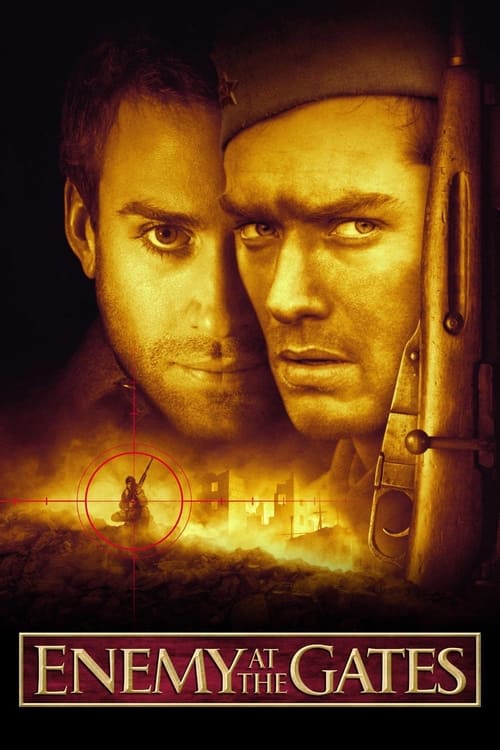
Enemy at the Gates (2001)
Directed by Jean-Jacques Annaud
No — Enemy at the Gates is not woke, scoring 0 out of 100 on our wokeness meter.
Jean-Jacques Annaud's Enemy at the Gates arrives in 2001 with the full apparatus of the prestige war picture: a muddy Volga crossing, a cat-and-mouse sniper duel, and a love triangle folded in for reasons the reviews at the time struggled to justify.
Consciousness Markers
The cast is overwhelmingly white and male, with Rachel Weisz and Eva Mattes in conventional roles; there is no deliberate inclusive casting or commentary.
No LGBTQ+ characters, themes, or subtext are present.
Tania is primarily a love interest and auxiliary figure; the film has been criticized for minimizing Soviet women snipers rather than advancing a feminist agenda.
No racial consciousness or comment on race appears; the story is ethnically homogeneous in its Soviet and German setting.
No environmental or climate theme is present.
The film critiques Soviet propaganda and coercion, not capitalism or wealth; there is no eat-the-rich framing.
No body-positivity theme or body-diverse casting emphasis is present.
No neurodivergence theme or representation is present.
The film fictionalizes and simplifies Stalingrad history, but not through a modern progressive reinterpretation; its inaccuracies are conventional dramatization rather than woke revisionism.
It is a conventional war drama with a love triangle; any message about propaganda is dramatized rather than delivered as a modern lecture.
Why it received this score
Jean-Jacques Annaud's Enemy at the Gates arrives in 2001 with the full apparatus of the prestige war picture: a muddy Volga crossing, a cat-and-mouse sniper duel, and a love triangle folded in for reasons the reviews at the time struggled to justify. Jude Law plays Vasily Zaitsev, a shepherd turned marksman, and Ed Harris plays the German major sent to erase him. The film wants to be about men and rifles and the terrible patience of waiting. It mostly succeeds at that, and it fails at nearly everything else.
Rachel Weisz's Tania is a militia private who translates radio intercepts and falls in love, which is the full extent of her function. The film was criticized on release for reducing Soviet women snipers, who accounted for thousands of confirmed kills, to bystanders who never fire a shot. That criticism is accurate, and it is also a complaint about historical fidelity, not a piece of modern consciousness-raising. The screenplay treats Soviet propaganda as a machine of coercion and morale, and it dramatizes that idea through Danilov's slow disillusionment instead of pausing to explain it to us. Bob Hoskins chews through Khrushchev with visible pleasure.
The film's inaccuracies are the ordinary kind: invented duels, compressed timelines, a blocking-detachment scene that historians have called nonsense. None of it is bent toward a contemporary argument. There is no inclusive casting to speak of, no racial or environmental theme, no economic grievance, no body-diverse ensemble, no neurodivergent subplot, no sermon. It is a 2001 studio war film, and it behaves like one from the first frame to the last. The veterans in the Duma were offended. The critics were lukewarm. The classification is straightforward.
Analysis generated by our Consciousness Algorithm
Part of


Synopsis
A Russian and a German sniper play a game of cat-and-mouse during the Battle of Stalingrad in WWII.
Questions about Enemy at the Gates
Is Enemy at the Gates woke?
No — Enemy at the Gates is not woke, scoring 0 out of 100 on our wokeness meter. That earns it a verdict of Ultra Based.
Does Enemy at the Gates have any woke elements?
No. All 10 markers score zero.
How does Enemy at the Gates compare to other 2001 movies?
It ranks #128 of the 148 films from 2001 we've scored; their average is 12. The wokest is Monster's Ball (60).
How is the Woke Score calculated?
An AI-assisted process researches the film and its reception, scores it 0–100 on ten markers, then combines those into one 0–100 Woke Score. It measures a specific set of 2020s cultural themes, not film quality.