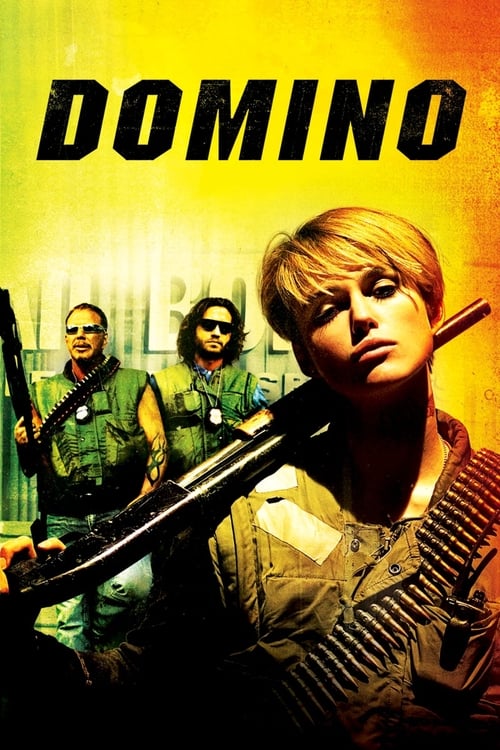
Domino (2005)
Directed by Tony Scott
No — Domino is not woke, scoring 16 out of 100 on our wokeness meter.
Tony Scott's Domino arrives with the confidence of a film that believes its own chaos constitutes a statement.
Consciousness Markers
The ensemble is notably diverse for 2005 — Delroy Lindo, Mo'Nique, Lucy Liu, and Édgar Ramírez in prominent roles — but this is natural, unremarked casting rather than representation-as-message.
Domino is a woman succeeding in the male-dominated bounty-hunter world, but the film treats this as a character quirk of a real person rather than a thesis about gender.
A multiracial cast populates the story, and Alf's Afghan subplot gestures at geopolitics, but the film makes no racial commentary or consciousness its subject.
The plot revolves around a heist and casino money, and Alf ships the loot to 'free Afghanistan,' but this is pulp plotting rather than an anti-capitalist critique.
Tony Scott's hyper-stylized cacophony has no interest in moral instruction; whatever messaging exists is buried under MTV editing.
No LGBTQ+ characters, themes, or subtext anywhere in the film.
No environmental themes whatsoever.
No body-positivity themes; the film's treatment of Knightley's physique is pure exploitation-cinema styling.
No neurodivergent characters or themes.
Loosely inspired by a real person but heavily fictionalized for style, not to revise or correct any historical narrative.
Why it received this score
Tony Scott's Domino arrives with the confidence of a film that believes its own chaos constitutes a statement. Keira Knightley plays the model turned bounty hunter, a woman operating in a profession populated almost entirely by men, and the film notes this without ever building an argument on it. Her gender is a detail of biography, a curiosity the screenplay enjoys mentioning, not a thesis it cares to defend. Around her, the ensemble is genuinely mixed, Delroy Lindo, Mo'Nique, Lucy Liu, Édgar Ramírez and Riz Abbasi in substantial parts, and the film never pauses to congratulate itself for the arrangement. The casting simply is. That restraint deserves a small nod, or would, if the editing allowed anyone to notice anything for longer than a second and a half.
The plot, a $10 million armored car robbery routed through a DMV forgery racket, a dying grandchild, and a Las Vegas casino, is dense enough to defeat most viewers on a first pass. Money is stolen, money is chased, and money is ultimately shipped to Afghanistan, where children open the crates in celebration. We are invited to read this as something. It is not. This is pulp wearing a leather jacket, and the gesture toward geopolitical conscience is decoration, no more load-bearing than the explosions.
Nothing here concerns the climate. Nothing concerns body image, though the camera's relationship with Knightley's wardrobe suggests other preoccupations entirely. Nobody is neurodivergent. No historical record is being corrected. The film is loosely tethered to a real woman, but it fictionalizes her freely in service of style, not argument. The personal lives on display stay strictly conventional. Tony Scott has no sermon to deliver. He has a headache to deliver, and he delivers it thoroughly.
Analysis generated by our Consciousness Algorithm


Synopsis
The story of the life of Domino Harvey, who abandoned her career as a Ford model to become a bounty hunter.
Questions about Domino
Is Domino woke?
No — Domino is not woke, scoring 16 out of 100 on our wokeness meter. That earns it a verdict of Ultra Based.
Does Domino have any woke elements?
1 of the 10 markers register at 30 or above, led by Representation Casting (30). On Representation Casting: The ensemble is notably diverse for 2005 — Delroy Lindo, Mo'Nique, Lucy Liu, and Édgar Ramírez in prominent roles — but this is natural, unremarked casting rather than representation-as-message.
How does Domino compare to other 2005 movies?
It ranks #49 of the 181 films from 2005 we've scored; their average is 13. The wokest is The Constant Gardener (72).
How is the Woke Score calculated?
An AI-assisted process researches the film and its reception, scores it 0–100 on ten markers, then combines those into one 0–100 Woke Score. It measures a specific set of 2020s cultural themes, not film quality.