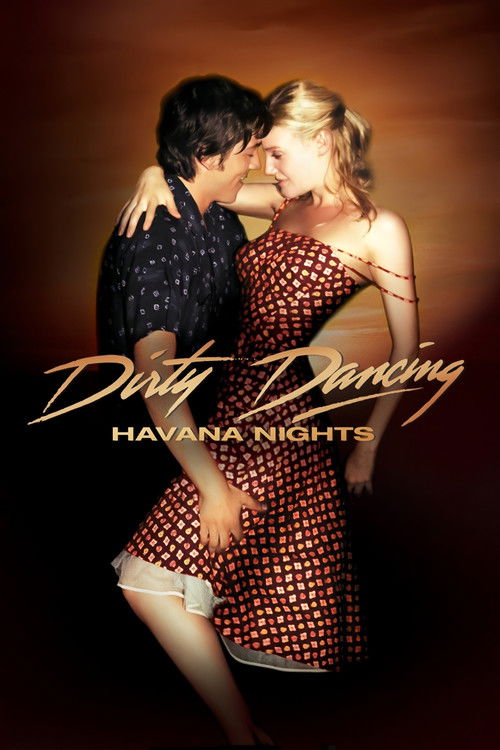
Dirty Dancing: Havana Nights (2004)
Directed by Guy Ferland
No — Dirty Dancing: Havana Nights is not especially woke, scoring 25 out of 100 on our wokeness meter.
Dirty Dancing: Havana Nights arrives in 1958 Cuba with a Latino male lead, a Cuban supporting cast, and a white British actress as the American girl who learns to feel the music.
Consciousness Markers
The film centers a Cuban male lead (Diego Luna) and a largely Latino supporting cast (Mýa, Heather Headley, Angélica Aragón) in a story rooted in Cuban culture, but this diversity is dictated by the Havana setting rather than a deliberate 2020s-style casting agenda, and the female lead remains a white British actress.
The film gestures at Cuban-American class and colonial tension — Carlos warns the Americans they will be expelled, and the romance crosses ethnic and class lines — but critics widely dismissed the politics as muddled and clichéd.
Katey is a bookworm who defies her parents' expectations, aspires to Radcliffe, and asserts her independence (including slapping James after he assaults her), but the arc remains a conventional romance rather than a feminist statement.
The Cuban Revolution and the resentment of wealthy American elites form a backdrop, and Carlos is a revolutionary, but the anti-capitalist thread is thin, romanticized, and largely decorative.
The political material is background texture rather than sermon; the original screenplay's serious political themes were stripped out, leaving little preaching.
No LGBTQ+ characters, themes, or subtext appear anywhere in the film.
No environmental or climate themes are present.
No body-positivity themes; if anything, the production was reportedly fixated on casting a thin lead, the opposite of the marker.
Katey is characterized as a bookworm, which is a personality trait, not a depiction of neurodivergence.
The film is a fictional romance set against the Cuban Revolution, not a reworking of historical record for ideological ends.
Why it received this score
Dirty Dancing: Havana Nights arrives in 1958 Cuba with a Latino male lead, a Cuban supporting cast, and a white British actress as the American girl who learns to feel the music. The representation is real enough on screen, but it is dictated by the setting. Havana supplies the faces; the camera still belongs to the visitor. Diego Luna brings gravity to Javier, and the film gestures at class and colonial resentment through his brother Carlos, who warns the wealthy Americans that their time is ending. These gestures sit in the background like hotel decor. The revolution rumbles, the romance proceeds, and the politics remain a decorative rumble.
Katey has a bookworm streak, a Radcliffe plan, and enough nerve to slap James after he assaults her. That is a flicker of independence inside a very conventional courtship. The film's racial consciousness is similarly intermittent: the cross-class romance and Carlos's warnings register, then dissolve into cliché. The original screenplay by Peter Sagal was reportedly a serious political romance, and almost none of that survives. The lecture energy is therefore low. There is little sermonizing because there is little argument. LGBTQ themes, climate concerns, neurodivergence, and revisionist history are absent. Body positivity is absent in a more awkward way, since the production was reportedly fixated on a thin lead.
The film wears its social consciousness like a rented dinner jacket. It fits badly at the shoulders and comes from a better wardrobe. Havana Nights wants the texture of Cuban history without the inconvenience of taking it seriously. The dancing is competent, the romance is predictable, and the cultural awareness is mostly a soundtrack and a location. We are left with a mild case of progressive dressing, not a conversion.
Analysis generated by our Consciousness Algorithm


Synopsis
In pre-revolution Cuba, Katey Miller is about to defy everyone's expectations. Instead of a parent-approved suitor, Katey is drawn to the sexy waiter, Javier, who spends his nights dancing in Havana's nightclubs. As she secretly learns to dance with Javier, she learns the meanings of love, sensuality and independence.
Questions about Dirty Dancing: Havana Nights
Is Dirty Dancing: Havana Nights woke?
No — Dirty Dancing: Havana Nights is not especially woke, scoring 25 out of 100 on our wokeness meter. That earns it a verdict of Based.
Does Dirty Dancing: Havana Nights have any woke elements?
2 of the 10 markers register at 30 or above, led by Representation Casting (45) and Racial Consciousness (40). On Representation Casting: The film centers a Cuban male lead (Diego Luna) and a largely Latino supporting cast (Mýa, Heather Headley, Angélica Aragón) in a story rooted in Cuban culture, but this diversity is dictated by the Havana setting rather than a deliberate 2020s-style casting agenda, and the female lead remains a white British actress.
How does Dirty Dancing: Havana Nights compare to other 2004 movies?
It ranks #24 of the 178 films from 2004 we've scored; their average is 12. The wokest is Tropical Malady (62).
How is the Woke Score calculated?
An AI-assisted process researches the film and its reception, scores it 0–100 on ten markers, then combines those into one 0–100 Woke Score. It measures a specific set of 2020s cultural themes, not film quality.