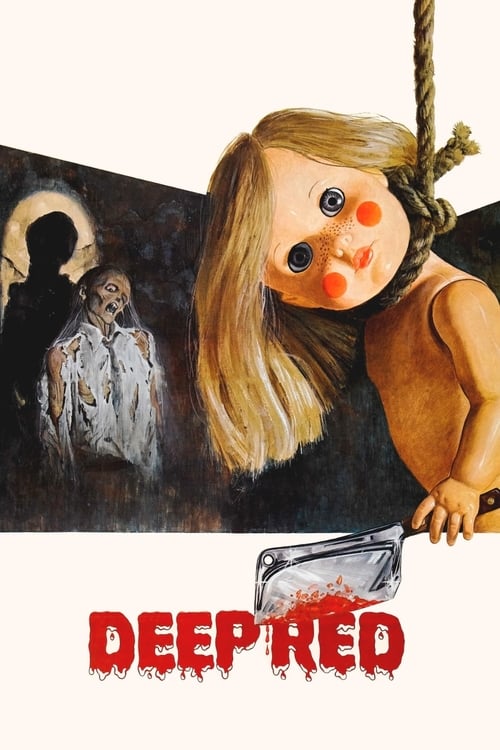
Deep Red (1975)
Directed by Dario Argento
No — Deep Red is not woke, scoring 5 out of 100 on our wokeness meter.
Deep Red is a 1975 Italian giallo directed by Dario Argento, and it behaves exactly like one.
Consciousness Markers
Gianna Brezzi is a tenacious, capable female reporter who actively drives the investigation, but this is a genre convention of the giallo rather than a feminist statement.
The cast is a standard Italian giallo ensemble of the era; no deliberate diversity casting or representation agenda is present.
No LGBTQ+ characters, themes, or subtext appear in the film.
The film has no engagement with racial themes or consciousness whatsoever.
No environmental or climate themes are present.
No critique of capitalism or wealth is present; the story is a pure murder mystery.
No body positivity themes; the film uses bodies primarily as sites of graphic violence.
The film depicts madness and psychological trauma (Carlo's compulsive drawing, Martha's insanity) as horror tropes, not as neurodivergence advocacy or representation.
No historical revisionism; the film is a contemporary-set fictional thriller.
The film makes no didactic or preachy arguments; it is a stylized exercise in suspense and gore.
Why it received this score
Deep Red is a 1975 Italian giallo directed by Dario Argento, and it behaves exactly like one. An English pianist in Rome witnesses the cleaver murder of a psychic neighbor, then teams with a reporter to untangle a mystery involving black gloves, a child's song, and a walled-up corpse. Goblin's score pulses. Turin's piazzas loom. The film is a machine for suspense, not a seminar. Its engagement with modern progressive categories is close to nonexistent. There is no representation agenda, no LGBTQ subtext, no racial consciousness, no climate anxiety, no anti-capitalist sermon, no body-positive message, no neurodivergence advocacy, no revisionist history, and no lecturing. Madness appears as a horror device, which is the genre's old habit. The film has other things on its mind, chiefly the precise placement of a meat cleaver.
The lone flicker of social awareness comes from Gianna Brezzi, Daria Nicolodi's tenacious reporter. She is capable, nosy, and actively useful to the investigation, which is more than many giallo women get. Yet her competence is a genre convention, not a feminist thesis. The screenplay gives her agency, then a knife wound, then a hospital bed. She survives because the plot requires a witness, not because the film is making an argument about women in journalism. A low score is appropriate. The movie is not interested in changing minds. It is interested in making audiences check their locks.
Taken as a cultural artifact, Deep Red is almost aggressively free of sermonizing. Argento's concerns are visual and visceral: the camera crawls, the blood spills, the doll moves, the elevator descends. There is no lecture energy because there is no lecture. This is not a defect. It is simply a classification. The film's social consciousness is a dry vintage, best served without fuss. We can admire the craft and note the empty ledger. For anyone seeking contemporary progressive markers, the cellar is bare. For anyone seeking a definitive giallo, the cellar is full.
Analysis generated by our Consciousness Algorithm


Synopsis
An English pianist living in Rome witnesses the brutal murder of his psychic neighbor. With the help of a tenacious young reporter, he tries to discover the killer using very unconventional methods. The two are soon drawn into a shocking web of dementia and violence.
Questions about Deep Red
Is Deep Red woke?
No — Deep Red is not woke, scoring 5 out of 100 on our wokeness meter. That earns it a verdict of Ultra Based.
Does Deep Red have any woke elements?
Very few. None of the 10 markers reaches 30, the level where a marker counts as present; the highest is Feminist Agenda at 8.
How does Deep Red compare to other 1975 movies?
It ranks #13 of the 22 films from 1975 we've scored; their average is 15. The wokest is Dog Day Afternoon (62).
How is the Woke Score calculated?
An AI-assisted process researches the film and its reception, scores it 0–100 on ten markers, then combines those into one 0–100 Woke Score. It measures a specific set of 2020s cultural themes, not film quality.