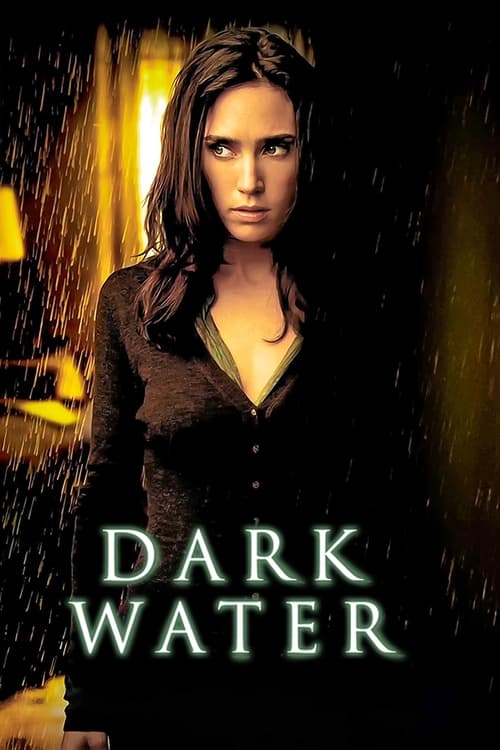
Dark Water (2005)
Directed by Walter Salles
No — Dark Water is not woke, scoring 6 out of 100 on our wokeness meter.
Walter Salles, having previously guided audiences down the dusty, sun-bleached roads of Brazil, here directs a film that is wet in every frame.
Consciousness Markers
The film centers on a single mother fighting an ex-husband for custody and asserting her independence, but this is a maternal melodrama rather than a feminist thesis; the mother's ultimate sacrifice reinforces a self-sacrificing-mother archetype.
The negligent landlord and superintendent who cover up a child's death for money offer a faint critique of property owners' indifference, but it is framed as individual corruption rather than a systemic anti-capitalist argument.
The cast is overwhelmingly white and drawn from established Hollywood character actors; no deliberate or commented-upon diverse casting is present.
No LGBTQ+ characters, relationships, or themes appear anywhere in the film.
No racial themes, commentary, or consciousness are present; the story is a domestic ghost tale with no engagement with race.
No environmental or climate themes appear in the film.
No body-positive themes or messaging are present.
The child's 'imaginary friend' and the mother's psychological distress are supernatural and horror devices, not depictions of neurodivergence.
The film is a straightforward ghost story with no revisionist or reframed historical narrative.
The film is atmospheric and psychological rather than preachy; it delivers no explicit social or political sermon to the audience.
Why it received this score
Walter Salles, having previously guided audiences down the dusty, sun-bleached roads of Brazil, here directs a film that is wet in every frame. Dark Water is a 2005 remake of Hideo Nakata's 2002 Japanese original, itself drawn from a Koji Suzuki short story, and it arrives drenched in the familiar palette of the J-horror translation: dripping ceilings, flooded corridors, a water tower looming over Roosevelt Island. Jennifer Connelly plays Dahlia, a mother of one locked in a custody dispute with her ex-husband, and the film's real subject is her fraying composure. The ghost is almost incidental. A body in a tank, an imaginary friend named Natasha, a child who nearly drowns in a bathroom. The pieces are assembled with care and produce very little.
The film's social content is thin, and it seems to know it. There is a single mother asserting her independence against a smug ex-husband, and there is a superintendent named Veeck who let a girl drown because her family paid him to ignore the plumbing. That is corruption of the small, venal, individual variety, the sort of thing a landlord does, not an argument about property itself. Dahlia's arc ends in self-erasure, a mother dissolving into water so her daughter can go live with the father. The sacrifice reads as maternal melodrama, an old archetype dressed in new mold.
Nothing here lectures. Nobody explains the moral of the story to the camera. The film shows no interest in casting as statement, no engagement with race or climate or the body or the wiring of the mind, and no revisionist urge. It simply drips for roughly an hour and forty-five minutes, and then stops. A CinemaScore of D minus suggests audiences wanted something to happen. What they got was atmosphere, and a ghost who mostly wanted a mother. We classify it accordingly, with the weary respect due any vintage that declines to argue with anyone.
Analysis generated by our Consciousness Algorithm


Synopsis
Dahlia and her five-year-old daughter are ready to begin a new life together. But their new apartment — dilapidated and worn — suddenly seems to take on a life of its own. Mysterious noises, persistent leaks of dark water and other strange happenings send Dahlia on a haunting and mystifying pursuit — one that unleashes a torrent of living nightmares.
Questions about Dark Water
Is Dark Water woke?
No — Dark Water is not woke, scoring 6 out of 100 on our wokeness meter. That earns it a verdict of Ultra Based.
Does Dark Water have any woke elements?
Very few. None of the 10 markers reaches 30, the level where a marker counts as present; the highest is Feminist Agenda at 12.
How does Dark Water compare to other 2005 movies?
It ranks #112 of the 181 films from 2005 we've scored; their average is 13. The wokest is The Constant Gardener (72).
How is the Woke Score calculated?
An AI-assisted process researches the film and its reception, scores it 0–100 on ten markers, then combines those into one 0–100 Woke Score. It measures a specific set of 2020s cultural themes, not film quality.