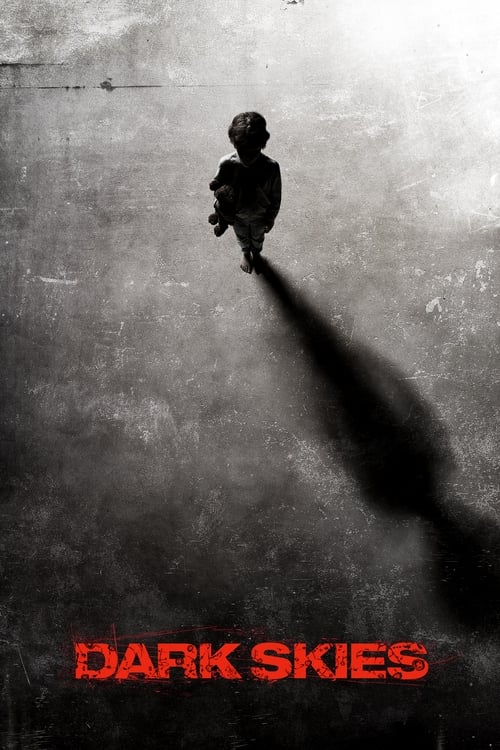
Dark Skies (2013)
Directed by Scott Stewart
No — Dark Skies is not woke, scoring 0 out of 100 on our wokeness meter.
Dark Skies arrives with the Blumhouse seal, produced by the same hands that gave us Paranormal Activity and Insidious, and it conducts itself with the grim professionalism of a contractor finishing a basement.
Consciousness Markers
The cast is a uniformly white suburban family plus a white specialist; no deliberate or commented-upon diverse casting.
No LGBTQ+ characters, themes, or subtext of any kind.
Lacy works while Daniel is unemployed, but this is a plot circumstance rather than any articulated feminist thesis or commentary.
Race is entirely absent as a subject; the film concerns alien abduction in an unnamed white suburb.
No environmental or climate themes whatsoever.
The family's financial strain is background texture for the horror, not a critique of capitalism or the wealthy.
No body-image or body-acceptance themes; the marks on the children's bodies are abduction stigmata, not a body-positivity statement.
Catatonic episodes and blackouts are presented as alien interference, not neurodivergence.
No historical events are reinterpreted or revised.
The film is a straightforward suspense thriller with no preachy messaging or moral instruction.
Why it received this score
Dark Skies arrives with the Blumhouse seal, produced by the same hands that gave us Paranormal Activity and Insidious, and it conducts itself with the grim professionalism of a contractor finishing a basement. Scott Stewart wrote and directed. The Barret family lives on a quiet suburban street in an unnamed American city. Daniel is unemployed. Lacy sells real estate. Their sons talk through walkie-talkies from their beds. Then the kitchen rearranges itself overnight, birds fly into the siding, and a figure stands over the youngest boy's bed until the light comes on and the room is empty.
What follows is abduction lore assembled with competence and no particular urgency. Catatonic episodes. Geometric marks on small torsos. A specialist named Edwin Pollard, played by J.K. Simmons with the weary authority of a man who has explained the Greys too many times, warns that the family has been chosen. The Barrets board up the windows on the Fourth of July and eat dinner while the television plays fireworks. The film means this as irony. It lands as set dressing.
The cultural ledger here is blank, and not in a coy way. This is a haunted-house picture with a saucer, and its anxieties are domestic and financial in the ordinary sense: a mortgage, a marriage, a child taken. The whiteness of the cast goes unremarked because the film has no interest in remarking on anything. The mother's income carries the household, but the screenplay draws no conclusion from it. There is no sermon, no thesis, no instructive pause. Critics split, forty-two percent on the aggregator, a C-plus from audiences. A workmanlike piece of suspense, as the Washington Post put it, and nothing more.
Analysis generated by our Consciousness Algorithm
Part of


Synopsis
From the producers of Paranormal Activity, Insidious, and Sinister comes Dark Skies: a supernatural thriller that follows a young family living in the suburbs. As husband and wife Daniel and Lacey Barret witness an escalating series of disturbing events involving their family, their safe and peaceful home quickly unravels. When it becomes clear that the Barret family is being targeted by an unimaginably terrifying and deadly force, Daniel and Lacey take matters in their own hands to solve the mystery of what is after their family.
Questions about Dark Skies
Is Dark Skies woke?
No — Dark Skies is not woke, scoring 0 out of 100 on our wokeness meter. That earns it a verdict of Ultra Based.
Does Dark Skies have any woke elements?
No. All 10 markers score zero.
How does Dark Skies compare to other 2013 movies?
It ranks #249 of the 274 films from 2013 we've scored; their average is 14. The wokest is Belle (76).
How is the Woke Score calculated?
An AI-assisted process researches the film and its reception, scores it 0–100 on ten markers, then combines those into one 0–100 Woke Score. It measures a specific set of 2020s cultural themes, not film quality.