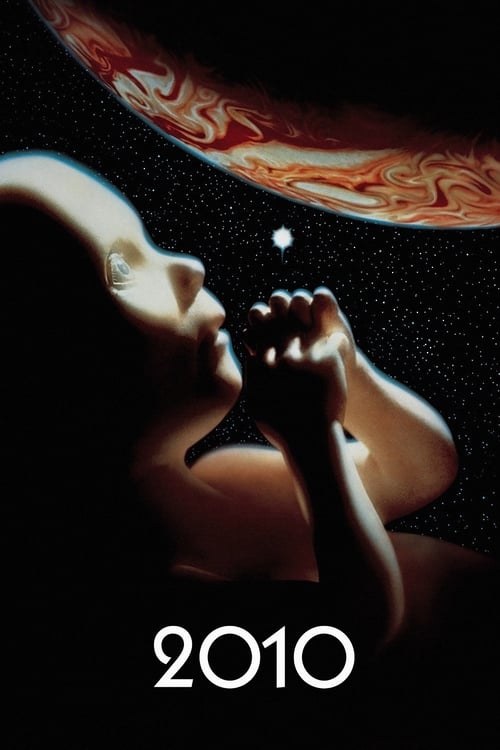
2010 (1984)
Directed by Peter Hyams
No — 2010 is not woke, scoring 12 out of 100 on our wokeness meter.
Peter Hyams's 2010 arrives as a sequel to a cathedral of ambiguity and proceeds to install fluorescent lighting and a fire exit.
Consciousness Markers
A joint American-Soviet crew is central, with Helen Mirren as Soviet captain Tanya Kirbuk and Russian actor Savely Kramarov in the cast, plus James McEachin in support. The international ensemble is notable but presented as Cold War geopolitics rather than modern diversity casting.
The finale delivers an explicit plea for American-Soviet peace, with the alien message and Floyd's narration moralizing about cooperation, though it is delivered with restraint.
Helen Mirren's Captain Kirbuk commands the Soviet vessel and holds her own against Floyd, a notable female authority figure for 1984, but the film advances no feminist thesis.
No LGBTQ+ characters, themes, or subtext appear anywhere in the film.
The film's central tension is US-Soviet rivalry; race is neither a theme nor a subject of commentary.
No environmental or climate themes; the Jupiter ignition and Europa transformation are cosmic events, not ecological allegory.
No critique of capitalism or wealth; the conflict is between nation-states, not economic classes.
No body-image or body-positivity content of any kind.
HAL's malfunction is a programmed logical conflict, not a depiction of neurodivergence.
The film is speculative science fiction set in a near future; it makes no revisionist claims about historical events.
Why it received this score
Peter Hyams's 2010 arrives as a sequel to a cathedral of ambiguity and proceeds to install fluorescent lighting and a fire exit. It is a competent, talky space procedural about a joint American-Soviet mission to Jupiter, and its cultural imagination is firmly Cold War. The multinational crew reads as geopolitical necessity, not identity-forward casting. Helen Mirren's Captain Kirbuk commands the Soviet vessel with crisp authority and trades barbs with Roy Scheider's Floyd, which gives the film a mild feminist charge. It never builds a thesis around her. She is a capable commander in a story about nations learning to cooperate.
The film's moral engine is détente. The finale, with its alien message and Floyd's narration about peace, asks the superpowers to stop pointing nuclear weapons at each other. That plea is earnest and restrained, a sermon delivered in a low voice. It is also the closest the film comes to social instruction. Race is not a subject. Neither is capitalism, climate, body image, nor neurodivergence. HAL's breakdown is a programmed contradiction, not a metaphor for atypical minds. The film makes no revisionist claims about history; it is speculative fiction set in a near future. LGBTQ themes are absent without subtext or gesture.
Representation here is a matter of flags and accents. Savely Kramarov and James McEachin appear in support, and the cast is international in a way that serves the plot's Cold War chess match. The film does not pause to congratulate itself for this arrangement. It wants to be a thriller about orbital mechanics, mistrust, and a giant black monolith that turns Jupiter into a star. On the progressive-sensibility ledger, it registers as a faint signal from 1984: a little feminist authority, a little peace preaching, and otherwise a clean, chilly vacuum.
Analysis generated by our Consciousness Algorithm


Synopsis
While planet Earth poises on the brink of nuclear self-destruction, a team of Russian and American scientists aboard the Leonov hurtles to a rendezvous with the still-orbiting Discovery spacecraft and its sole known survivor, the homicidal computer HAL.
Questions about 2010
Is 2010 woke?
No — 2010 is not woke, scoring 12 out of 100 on our wokeness meter. That earns it a verdict of Ultra Based.
Does 2010 have any woke elements?
Very few. None of the 10 markers reaches 30, the level where a marker counts as present; the highest is Lecture Energy at 22.
How does 2010 compare to other 1984 movies?
It ranks #7 of the 51 films from 1984 we've scored; their average is 7. The wokest is Revenge of the Nerds (30).
How is the Woke Score calculated?
An AI-assisted process researches the film and its reception, scores it 0–100 on ten markers, then combines those into one 0–100 Woke Score. It measures a specific set of 2020s cultural themes, not film quality.