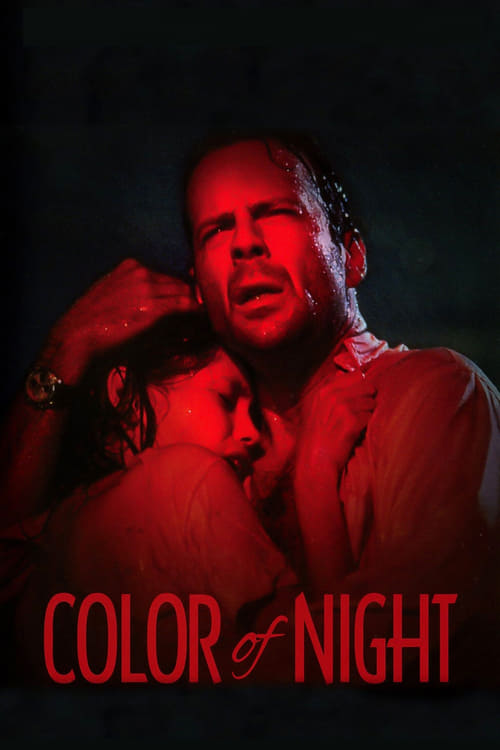
Color of Night (1994)
Directed by Richard Rush
No — Color of Night is not woke, scoring 9 out of 100 on our wokeness meter.
Color of Night arrives from 1994 as an erotic thriller with the single-mindedness of a bad dream.
Consciousness Markers
The therapy group includes characters with OCD, nymphomania, suicidal ideation, and psychosomatic color blindness, but mental illness is sensationalized rather than framed as neurodivergence advocacy.
The cast includes Rubén Blades and Eriq La Salle in supporting roles, but the diversity is incidental rather than part of a representational agenda.
A teen character is described as having gender dysphoria and later revealed to be a woman impersonating her brother, but the film treats this as pathology and a plot twist rather than LGBTQ+ affirmation.
Jane March's Rose is central and ultimately kills the villain, but she is primarily framed as an erotic object and trauma victim, with no feminist critique.
There is no engagement with racial themes or racial consciousness; minority characters exist without commentary.
No climate or environmental themes are present.
No anti-capitalist or eat-the-rich messaging appears in the film.
No body-positivity themes or messaging are present.
The film is a contemporary erotic thriller with no historical revisionism.
The film is lurid melodrama and does not lecture the audience on social issues.
Why it received this score
Color of Night arrives from 1994 as an erotic thriller with the single-mindedness of a bad dream. Bruce Willis plays a color-blind psychiatrist who inherits a therapy group and an affair with a mysterious woman. The film's cultural awareness is mostly accidental. Rubén Blades and Eriq La Salle appear in supporting roles, but their presence carries no representational argument. A teenage character with gender dysphoria is treated as a plot mechanism and a symptom, then folded into a twist. That is not affirmation. It is pathology with a reveal. The group's mental illnesses are staged for sensation: OCD, nymphomania, suicidal ideation, psychosomatic color blindness. The film observes these conditions the way a carnival barker observes a sideshow.
Rose, played by Jane March, sits at the center and eventually pulls the trigger on the villain. Yet the camera frames her as an erotic object and a trauma victim, and the film offers no feminist critique of that arrangement. Racial consciousness, climate concern, anti-capitalist anger, body positivity, and historical revisionism are absent. The film does not lecture. It has no sermon to deliver. It is lurid melodrama with a giallo gloss, a Razzie-winning reputation, and a cult afterlife that depends on its own absurdity.
The remainder is a curio of accidental provocation. The therapy group is a suspect pool, trauma is a twist, and the restoration of color vision arrives with a kiss. We can call this social consciousness only in the sense that a fever dream is conscious of the body it inhabits. The film is not preachy. It is just strange, and strangely sincere about its own nonsense.
Analysis generated by our Consciousness Algorithm


Synopsis
A color-blind psychiatrist is stalked by an unknown killer after taking over his murdered friend's therapy group and becomes embroiled in an intense affair with a mysterious woman who may be connected to the crime.
Questions about Color of Night
Is Color of Night woke?
No — Color of Night is not woke, scoring 9 out of 100 on our wokeness meter. That earns it a verdict of Ultra Based.
Does Color of Night have any woke elements?
Very few. None of the 10 markers reaches 30, the level where a marker counts as present; the highest is Neurodivergence at 20.
How does Color of Night compare to other 1994 movies?
It ranks #25 of the 86 films from 1994 we've scored; their average is 10. The wokest is On Deadly Ground (75).
How is the Woke Score calculated?
An AI-assisted process researches the film and its reception, scores it 0–100 on ten markers, then combines those into one 0–100 Woke Score. It measures a specific set of 2020s cultural themes, not film quality.